
Egypt's currency crisis is resolved. The Egyptian pound fell from 15.7 to approximately 50 per dollar between 2022 and 2024; the parallel market was eliminated; the IMF program passed its fifth and sixth reviews; net international reserves reached a record $53.134 billion. The stabilisation chapter is closed. What the market has not yet priced is what comes next: a record $7.1 billion in SCZone investment in a single fiscal year, three Chinese tyre manufacturers committing nearly $3.5 billion in twelve months, and an electric vehicle manufacturing agreement signed in June 2026 that positions Egypt as a regional automotive export hub. The currency repriced. The industrial transformation is just beginning.
WHAT CONSENSUS SAYS
The mainstream view on Egypt has shifted from cautious pessimism to cautious optimism. The IMF program is on track. Reserves are at record levels. Inflation has declined from 38% at its peak to 13% in May 2026. The currency is stable. The consensus narrative is one of vindication: the structural adjustment worked, Egypt avoided the disorderly scenario, and the country is on a path toward private-sector-led growth.
The consensus trade is to hold Egyptian Eurobonds for the carry, note the improving macro backdrop, and wait for the structural reform agenda to deliver.
This is a reasonable position. It is also a position that prices in the stabilisation without pricing in the transformation.
There is a distinction between a country that has stabilised and a country that is being structurally repurposed. Egypt is undergoing the second. The market has noticed the first.
WHAT THE SIGNAL SHOWS
The devaluation of 2024 did what devaluations do: it repriced Egyptian labour, Egyptian land, and Egyptian manufacturing capacity in dollar terms. A factory worker in Egypt’s industrial zones now costs a fraction of a comparable worker in China’s coastal provinces. Industrial land in the Suez Canal Economic Zone is available at prices that would be unrecognisable to a developer in Shenzhen. Egyptian exports, priced in Egyptian pounds but sold in dollars, became structurally competitive overnight.
Chinese manufacturers noticed before the market did.
The tyre cluster is the leading indicator:
In August 2025, the Sailun Group signed an agreement to build a $1 billion tyre manufacturing plant in the Suez Canal Economic Zone. In April 2026, Shandong Linglong Tyre announced plans to invest nearly $2 billion in a facility at Borg El Arab producing car and heavy truck tyres for export to the Gulf and the United States. In June 2026, China National Tire and Rubber Corporation announced a $550 million expansion in Alexandria; 1.5 million tyres annually, 1,600 jobs, production starting 2028. Three separate Chinese tyre manufacturers committing $3.5 billion to the same country in under twelve months is not coincidence. It is a supply chain being deliberately assembled.
The upstream inputs are being built in the same zone. In July 2026, China’s Zenith Group signed a $300 million agreement to produce 120,000 tonnes annually of steel cord; the high-tensile reinforcement used in radial tyres. The feedstock is being manufactured domestically, within the same industrial cluster as the tyre factories that consume it.
The electric vehicle pivot:
On June 15, 2026, ROX Motor from China signed a joint agreement to manufacture range-extended electric vehicles locally in partnership with a major Egyptian industrial group. The agreement was signed under Egypt’s Automotive Industry Development Program, which targets domestic vehicle production of 100,000 units annually by 2030. These vehicles will be manufactured for export as well as domestic sale. Earlier, the Chinese automaker Jetour established a $123 million joint venture in Giza with local content at 40% of manufactured components.
The SCZone build-out in verified numbers:
The Suez Canal Economic Zone attracted a record $7.1 billion in investment during FY2025/26 alone. Over the past 3.5 fiscal years, committed investment contracts total $14.21 billion. The broader diplomatic pipeline across 20 countries has been declared at a target of $60 billion. The zone now hosts 200 operational factories from investors representing 28 countries. East Port Said is projected to handle 5.6 million containers in 2026.
The Suez Canal recovery:
The Suez Canal Authority reported total revenues of $4.67 billion for the completed FY2025/26, representing a 23% year-on-year rebound as vessels returned following an easing of regional Red Sea disruptions. The canal generated $9.4 billion at its 2022/23 peak. The gap between current revenues and the pre-disruption level, approximately $4.7 billion annually, represents upside not yet in the consensus forecast.
The foreign currency position:
Tourism revenues climbed 14.9% year on year to approximately $14.4 billion in the first nine months of FY2025/26. Remittances from Egyptians working abroad rose 32% to approximately $35 billion over the same period. Net international reserves reached a record $53.134 billion at the end of May 2026; seven consecutive months above the $50 billion threshold. The current account deficit narrowed 45.2%. The energy sector’s institutional overhang has been cleared; outstanding payments to oil and gas investment partners settled to zero for the first time in years, compared with approximately $6.1 billion outstanding in June 2024.
The equity market baseline:
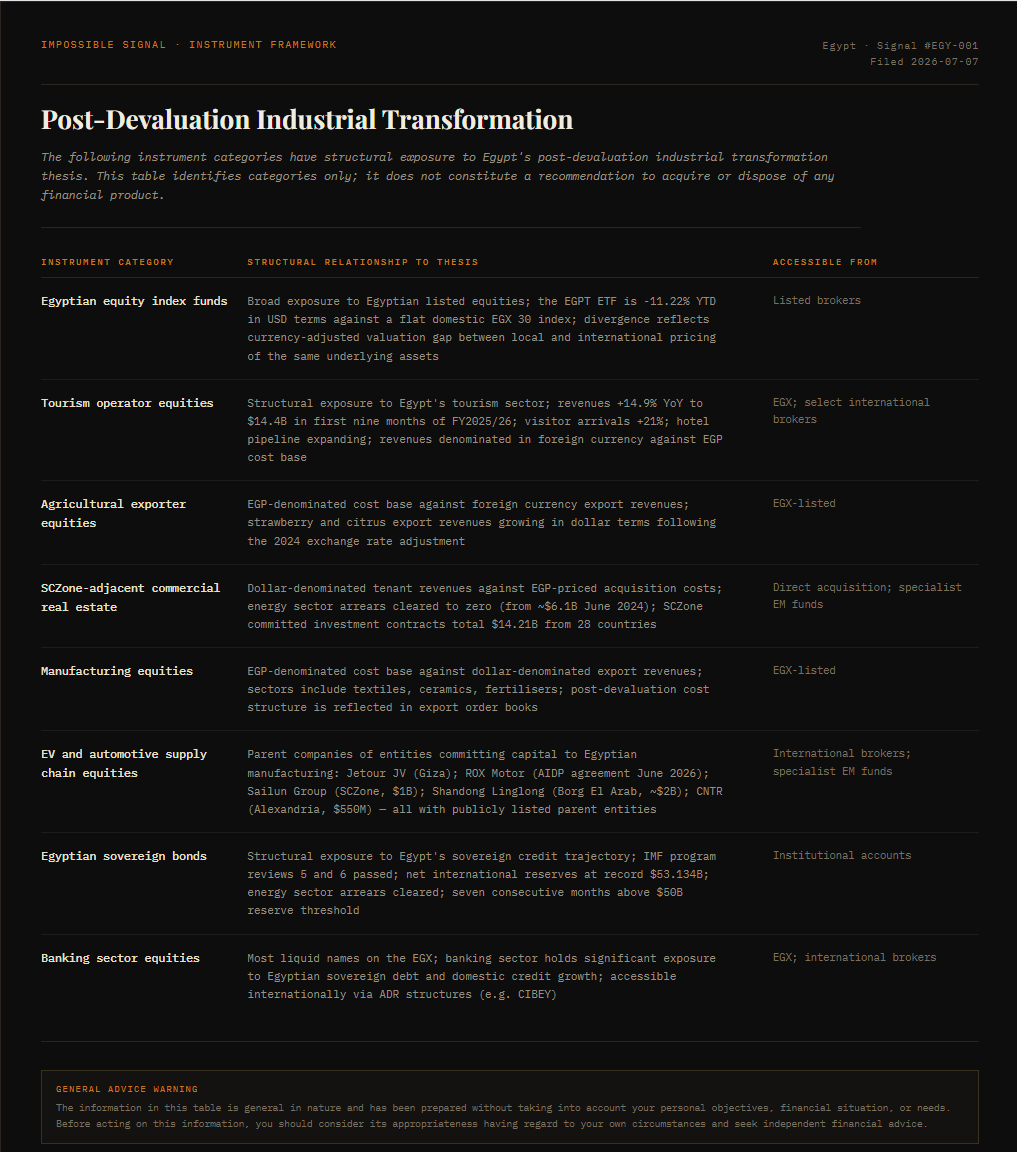
The EGX 30 index sits at 52,502.74, virtually flat year-to-date; consolidating near historic highs. The VanEck Egypt Index ETF (EGPT) trades at $21.48, down 11.22% year-to-date in USD terms as dollar-denominated investors have not yet repriced the industrial transformation. Commercial International Bank Egypt (COMI on EGX) trades at 129.71 EGP; its US ADR (CIBEY) at $2.63. The domestic index holding flat while the USD-denominated ETF falls 11% is itself a signal: the local market is pricing stability; global dollar investors are pricing something cautious. The industrial transformation thesis suggests both are wrong in the same direction.
The trade agreement multiplier:
Products manufactured in Egypt can reach over 1.5 billion consumers worldwide with zero or reduced tariffs. The EU Association Agreement provides duty-free access to European markets for industrial goods. The African Continental Free Trade Area positions Egypt as a manufacturing gateway for Africa. Qualified Industrial Zones allow Egyptian exports to enter the US market duty-free under co-production rules. The Greater Arab Free Trade Area provides regional access. A Chinese manufacturer building in Egypt’s SCZone is not building for Egypt. It is building for Europe, Africa, the Gulf, and the United States simultaneously, from a single location with preferential access to all four.
COUNTRY DIMENSION MAP
Impossible Signal scores every country across 12 structural dimensions before filing a signal. The table below shows Egypt's current position across each dimension, the direction of travel, and the signal strength. The dimensions driving the thesis are marked in red. The dimension the market is most significantly underweighting is identified at the bottom.
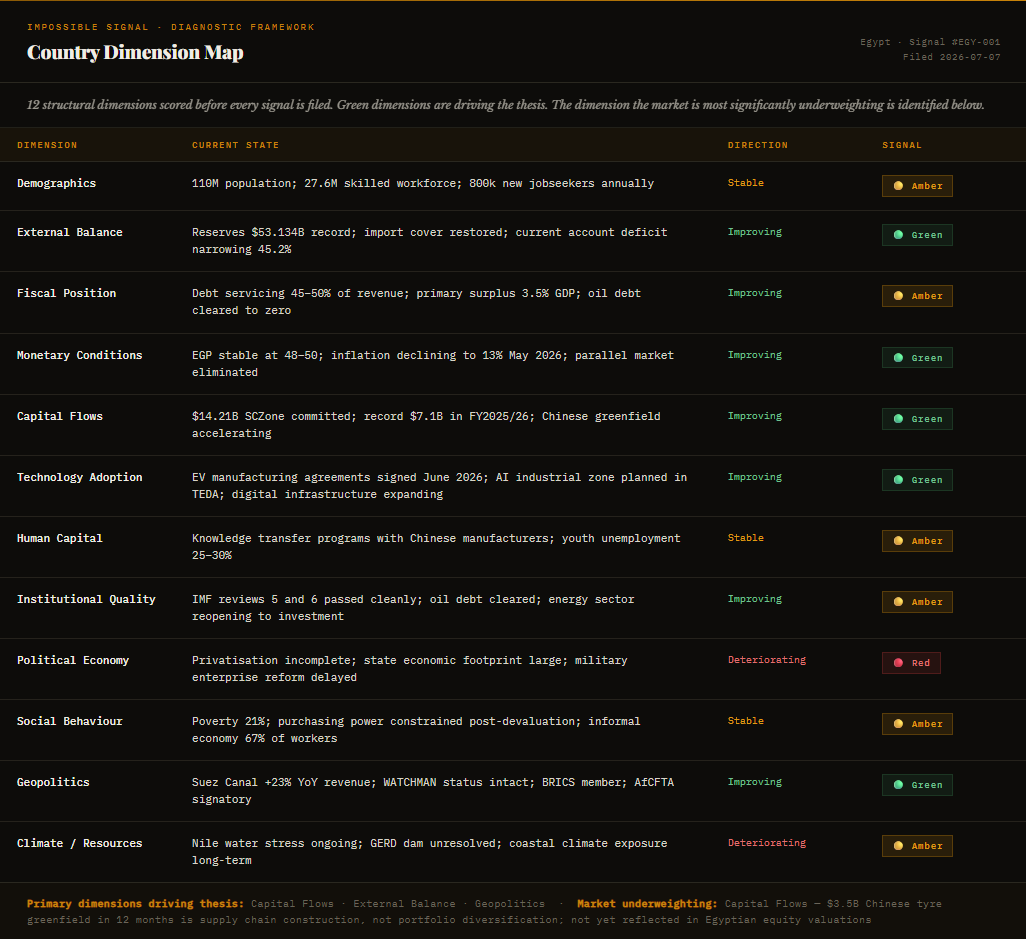
Primary dimensions driving the thesis: Capital Flows, External Balance, Geopolitics
The dimension the market is most significantly underweighting: Capital Flows. The market is reading Egypt's FDI data as portfolio diversification. The $3.5 billion Chinese tyre cluster, the EV manufacturing agreement, and the SCZone vertical integration represent something structurally distinct: greenfield industrial capital building integrated supply chains targeting export markets in Europe, Africa, and the Gulf. The distinction between acquiring an existing asset and building a new supply chain from the ground up is material. Egypt is receiving the second kind at a scale not seen in its modern economic history.
CORE CONTRADICTION
Every Impossible Signal thesis is built on a single, measurable mismatch between what the market believes and what the structural data shows. This is Egypt's.
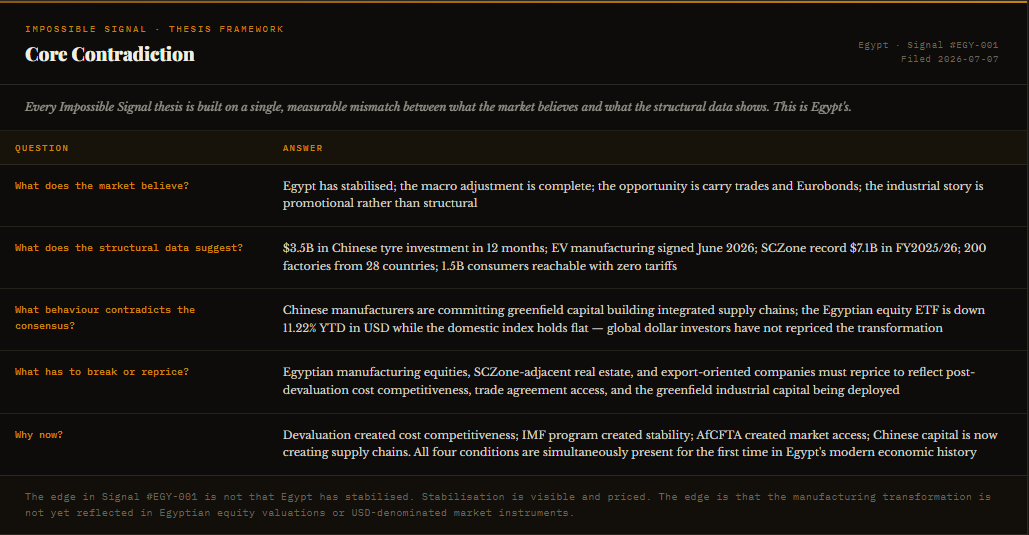
The edge in Signal #EGY-001 is not that Egypt has stabilised. Stabilisation is visible and priced. The edge is that the manufacturing transformation being funded by $14.21 billion in SCZone committed capital, of which $7.1 billion was committed in a single fiscal year, is not yet reflected in Egyptian equity valuations or in the USD-denominated market instruments available to global investors.
SIGNAL SCORING MODEL
Impossible Signal derives every probability estimate from a transparent, weighted scoring model before applying analyst judgment. The model scores eight categories on a scale of 1 to 5. The weighted total maps to a probability band. The final probability sits within that band; any deviation requires a written explanation.
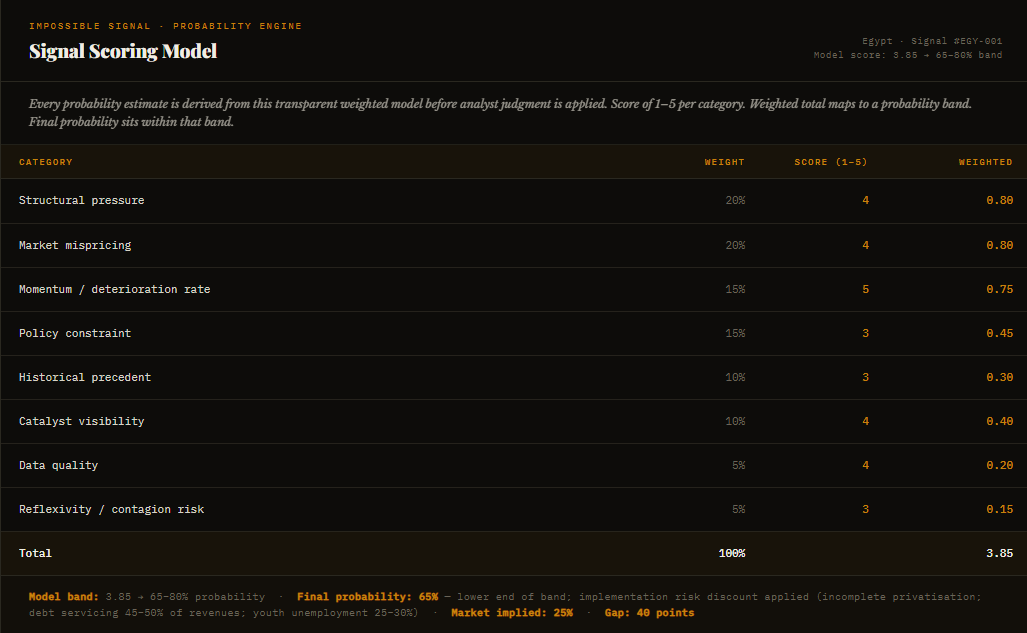
A weighted score of 3.85 maps to a model-implied probability band of 65–80%.
Final probability: 65%. Positioned at the lower end of the model band. Three structural risks apply discount pressure: the privatisation agenda remains incomplete and the state’s economic footprint constrains private-sector-led growth; debt servicing consumes 45 to 50% of government revenues, limiting fiscal flexibility; and youth unemployment at 25 to 30% creates social stability risk that could disrupt reform momentum. The industrial transformation thesis is structurally sound but carries a meaningful implementation risk discount.
Market-implied probability at filing: 25%. Derived from the 11.22% YTD underperformance of the EGPT ETF against a flat domestic index, and from Egyptian manufacturing equity valuations relative to comparable post-devaluation emerging market peers.
Probability gap: 40 points.
CATALYST MAP
Events that should trigger a probability update. Monitored on every update cycle. Impact reflects estimated directional change if the catalyst resolves as stated.
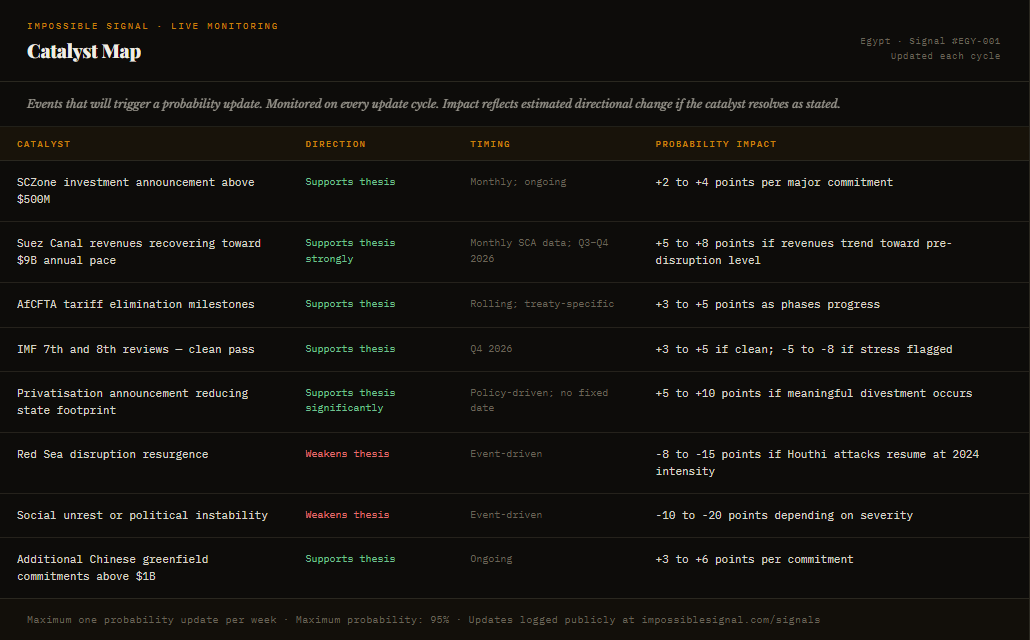
Probability updates are published whenever a material catalyst resolves. Maximum one update per week. Maximum probability: 95%.
THE IMPOSSIBLE SCENARIO
After a devaluation of this magnitude, one of two structural outcomes follows. Either the repriced economy attracts the capital and builds the productive capacity that makes the new exchange rate sustainable; or the fiscal and political constraints prevent that transformation, the competitiveness window closes before the industrial base is established, and the country finds itself with a weaker currency and no structural improvement to show for it.
Invert the question. What would have to be true for the manufacturing transformation thesis to fail? The $14.21 billion in SCZone committed capital would have to be withdrawn. The AfCFTA access would have to be revoked. The post-devaluation cost competitiveness would have to be eroded by inflation before the export capacity is established. The political economy would have to block the reforms that allow private capital to scale alongside the state.
None of these conditions are currently occurring. The evidence points in the opposite direction. Greenfield capital is arriving in a deliberate sequence: tyre feedstock, tyre manufacturing, EV assembly. A single fiscal year produced a record $7.1 billion in new SCZone investment commitments. This is not opportunistic capital seeking arbitrage. It is capital committed to a multi-year production thesis.
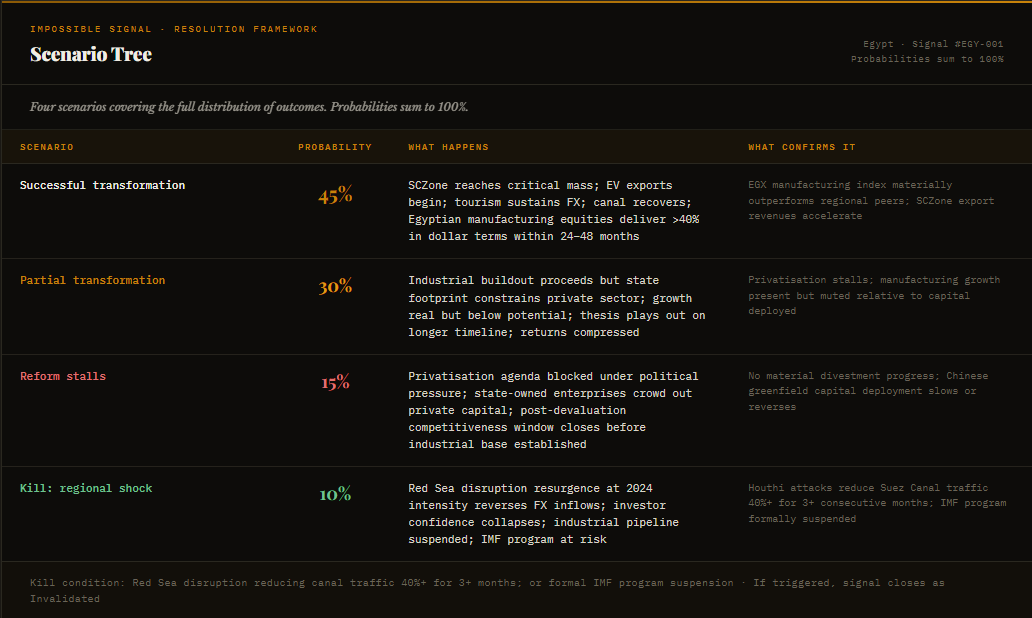
Scenario A: Successful transformation — 45% The SCZone industrial cluster reaches critical mass. EV and automotive manufacturing exports begin. Tourism recovery and remittances sustain the foreign currency position. Suez Canal revenues return toward $9 billion annually. Egyptian manufacturing equities and SCZone-adjacent assets deliver returns exceeding 40% in dollar terms within 24 to 48 months.
Scenario B: Partial transformation — 30% The industrial buildout proceeds but is constrained by the state’s economic footprint and incomplete privatisation. Growth is real but below potential. The transformation plays out on a longer timeline. Returns are compressed by implementation delays rather than thesis failure.
Scenario C: Reform stalls — 15% The privatisation agenda stalls under political pressure. State-owned enterprises crowd out private capital. The post-devaluation competitiveness window closes before the industrial base is established. The transformation thesis weakens materially.
Kill scenario: Regional shock — 10% A significant escalation of regional geopolitical tensions, specifically a resurgence of Red Sea shipping disruptions at 2024 intensity sustained for more than three months, reverses the foreign currency inflows and collapses investor confidence in the industrial pipeline.
THE SIGNAL
Signal #EGY-001
We assess 65% probability that Egyptian manufacturing equities, SCZone-adjacent real assets, and export-oriented industrial and tourism assets deliver returns exceeding 40% in dollar terms within a 24 to 48 month window (July 2026 – July 2028), as the market reprices the post-devaluation industrial transformation currently underway.
This scenario appears to be priced at approximately 25% probability in relevant markets, based on current Egyptian equity valuations relative to the scale of greenfield industrial capital being deployed and the trade agreement access available to manufacturers based in Egypt.
The probability gap: 40 points.
When a post-devaluation manufacturing platform of this scale and structure has been established in comparable emerging market situations historically, the relevant equity and real asset instruments have repriced significantly within 18 to 36 months of the inflection point.
Market benchmarks at filing: EGX 30 Index: 52,502.74 EGPT ETF: $21.48 CIB Egypt (COMI): 129.71 EGP / ADR (CIBEY): $2.63
Resolution trigger: A composite of Egyptian manufacturing equities, tourism operators, and SCZone-adjacent assets appreciates more than 40% in dollar terms from the filing date, driven by earnings growth in export-oriented sectors and continued capital flow acceleration into the SCZone industrial cluster.
Kill condition: A resurgence of Red Sea shipping disruptions reducing Suez Canal traffic by more than 40% from current recovery trajectory, sustained for more than three consecutive months; or a formal suspension of the IMF program.
THE INSTRUMENT
The following instrument categories have structural exposure to Egypt's post-devaluation industrial transformation thesis.
The 2016 parallel: The clearest historical precedent is the post-devaluation period following Egypt’s November 2016 float. Egyptian exporters, tourism operators, and fertiliser producers delivered significant dollar-denominated returns in the 18 to 30 months that followed. The current transformation is larger in scale; the Chinese greenfield industrial capital alone exceeds anything that followed 2016, and the AfCFTA market access multiplier did not exist in that cycle.
A devaluation does not destroy an economy; it reprices it. The same structural conditions that created the currency crisis created the investment opportunity. The market is pricing the former. The signal is the latter.
ACTIVE SIGNALS SCORECARD
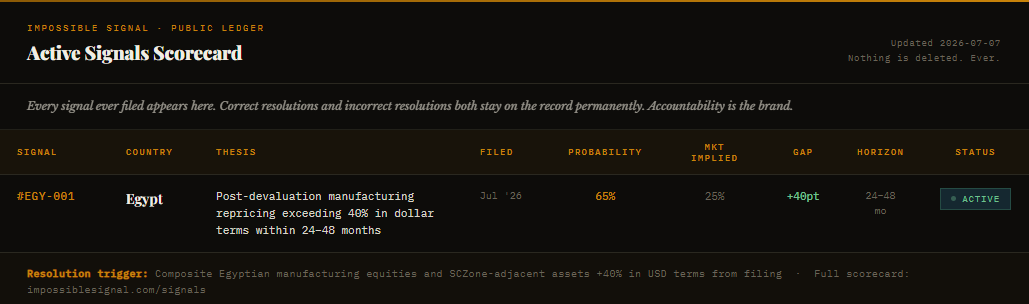
Market-implied probability at filing: 25%. Probability gap: 40 points.
Full scorecard and resolution history: impossiblesignal.com/signals
NEXT ISSUE
Pakistan, where twenty-two IMF programs have not resolved the same structural problem, and a Eurobond maturity wall is about to test whether the twenty-third will be different.
A NOTE ON SUBSCRIPTIONS
Impossible Signal launches as a free publication. Starter and Pro subscription tiers with market specifics will be made available in near future.
Research for this publication is conducted using a human-directed, AI-assisted analysis framework. All signal assessments, probability estimates, and editorial judgments are made by a human analyst. AI tools are used to assist with data gathering, pattern recognition, and drafting; not to replace analyst judgment.
Impossible Signal publishes general financial information and macro analysis with the aim of increasing transparency and demystifying world economics. Nothing in this publication constitutes personal financial advice or a recommendation to buy or sell any financial instrument. Probability estimates are analytical assessments based on publicly available data. Past signal performance does not guarantee future results. You should seek independent financial advice before making investment decisions.
Unsubscribe · Archive · impossiblesignal.com