

Pakistan brokered the first direct US-Iran talks since 1979. Its military leadership holds a direct line to the White House. A mutual defence pact with Saudi Arabia contains an Article 5 clause. The sovereign credit market has read this diplomatic transformation as a backstop that carries the IMF programme to completion. The programme's own arithmetic disagrees.
WHAT CONSENSUS SAYS
Pakistan has achieved a remarkable stabilisation. The 37-month Extended Fund Facility (EFF) approved in September 2024 is on track: all seven Quantitative Performance Criteria (QPCs) were met at end-December 2025. The primary surplus, the government’s budget position before interest payments, is running at 3.2% of GDP for the nine months to March against a 1.6% full-year programme target. SBP reserves reached $18.47 billion in early July, up from $9.4 billion two years ago, with total liquid reserves at $22.67 billion. The government repaid a $1.3 billion external bond in full in April 2026 and returned to the international bond market the same month with a $750 million issuance that drew strong demand after a multi-year absence.
Pakistan’s geopolitical elevation has deepened the consensus view. Hosting the first US-Iran talks in 47 years and signing a mutual defence pact with Saudi Arabia has brought the country closer to Gulf states that have historically provided financial support in moments of external stress. The mainstream view is that Pakistan has navigated its most dangerous period, and that the programme completes on schedule in October 2027.
WHAT THE SIGNAL SHOWS
The reserve headline is a borrowed number.
SBP reserves stood at $18.47 billion as of July 3, 2026, after a $1.94 billion single-week jump from government inflows. This is the number cited in programme reviews, government communications, and market reports. It is not the number that matters for programme stability.
Strip out the bilateral deposits. Saudi Arabia now holds approximately $8 billion with the SBP: a $5 billion deposit extended in April for three years, plus $3 billion in new support. China holds approximately $4 billion. These are cash deposits placed by foreign governments, on which Pakistan pays interest, and which sit inside the gross reserve figure. They are not Pakistan’s money. Fitch Ratings confirmed in April 2026 that net foreign exchange reserves remained negative after accounting for bilateral deposits, the Chinese central bank swap line, and commercial bank deposits. The IMF’s own Net International Reserves floor, the metric that actually binds under the programme, projected approximately negative $6.7 billion ahead of the third review.
The April 2026 settlement with the UAE illustrates how this system actually works. Pakistan repaid the Abu Dhabi Fund for Development’s full $3.45 billion after the Fund shifted from routine annual rollovers to one-month and two-month extensions through early 2026. The repayment was funded by the new Saudi tranches. The UAE liability did not disappear; it became a Saudi liability. Pakistan’s bilateral dependency was not reduced in April. It was concentrated, into a single counterparty that is simultaneously its new mutual defence treaty partner.
The fiscal structure is unchanged beneath the surface improvement.
The primary surplus is real, but its composition matters. Central bank profit transfers and a petroleum levy pushed toward Rs80 per litre are doing much of the work. The Federal Board of Revenue (FBR) collected Rs12,983 billion in FY26, missing its target, and the FY27 budget requires Rs15,264 billion; a 17.6% increase in a single year, of which new permanent tax measures contribute only 0.3% of GDP. The rest is assigned to enforcement and growth.
The deeper arithmetic is federal. Of the Rs15,264 billion FBR target, Rs8,848 billion flows to the provinces under the revenue-sharing award. The centre retains roughly Rs6,416 billion from the country’s main tax machine. Debt servicing for FY27 is budgeted at Rs8,054 billion. The federal government’s interest bill exceeds its entire retained share of FBR taxes before a single rupee is spent on defence, development, or relief. Circular debt, the accumulated unpaid obligations in the energy sector, adds a further Rs4.9 trillion of quasi-fiscal weight: approximately Rs1.5 trillion in the power sector as of February 2026 and Rs3.4 trillion in gas as of December 2025, per the IMF’s own tables.
The informal economy is the structural ceiling, and the IMF’s own models say so.
Pakistan’s informal economy is estimated at approximately 59% of GDP, with 72.5% of the non-agricultural workforce off the books and three million businesses unregistered. The FBR cannot close its gap through administration alone; the structural problem is the arithmetic of taxing 41% of an economy while servicing the obligations of the full 100%. Agriculture, 24.6% of value added, is taxed at an effective rate of 0.3%. GST efficiency has fallen from 27.4% to 22.8% of the theoretical base over a decade.
The comparative numbers make the ceiling visible. Pakistan’s tax-to-GDP ratio stands at 10.3%, against an Asia-Pacific average of 19.3% and roughly 18% in India. The IMF’s own tax capacity assessment places Pakistan’s ceiling at approximately 12.9% of GDP even with strengthened administration, citing the size of the agriculture sector and governance constraints. The programme targets 13.6%. The lender’s capacity model and the lender’s programme target do not agree with each other.
This is why December 2026 matters more than any other date in the programme. The FBR revenue floor, currently an indicative target where a miss produces a footnote, becomes a full Quantitative Performance Criterion: Rs7,022 billion cumulative by end-December. A miss then requires a formal Executive Board waiver for disbursements to continue. The FBR has missed its annual target in every recent fiscal year, including FY26.
The remittance buffer carries the same structural qualifier. Official remittances of approximately $38 billion annually are the primary cited external cushion, but hawala and hundi networks have historically diverted significant flows away from formal channels; official inflows dropped roughly 20% year on year in late 2022 before recovering under enforcement. In March 2026 a joint SBP and Federal Investigation Agency working group was formed to combat illegal transfers. The buffer is policy-dependent, not structural. The Gulf trading hubs that clear Pakistan’s parallel economy have more visibility into its real financial position than any ratings agency.
The historical pattern.
Pakistan has undertaken more than twenty IMF programmes since 1958. None has resolved the underlying structural problem, and the recurring shape is consistent: strong early compliance, deterioration in the middle reviews as political pressure on reform delivery intensifies, then a waiver, a delay, or an interruption. The current programme has already required one waiver, at the second review, for a Rs463 million underspend on social transfers; a minor breach, and it precedes this filing, so it does not count toward this signal’s resolution. It is evidence of the pattern, not the trigger. The reviews that test the politically difficult commitments, energy tariffs, tax base broadening, and state enterprise reform, are the ones ahead, and from December they include the FBR floor as a formal criterion.
The geopolitical backstop is conditional, transactional, and now also a fiscal risk.
Pakistan’s diplomatic elevation in 2026 is genuine. On April 11 and 12, delegations from the United States and Iran convened in Islamabad for the first direct high-level engagement since 1979. Pakistan was chosen not for institutional mediation experience but because the alternatives were unavailable: US-India relations had deteriorated, and China was structurally unavailable to Washington. Pakistan filled the gap created by those exclusions.
The Gulf-Pakistan relationship is explicitly transactional. The Gulf provides remittances, investment, and the deposits underpinning Pakistan’s gross reserves. Pakistan provides military manpower, strategic reassurance, and now an Article 5-equivalent commitment under the September 2025 agreement with Saudi Arabia, which treats an attack on one as an attack on both. The arrangement providing the financial backstop and the arrangement creating the most acute fiscal risk are the same agreement, and after April, the same counterparty. The market has already demonstrated what this exposure is worth: when the Middle East war escalated in early 2026, Pakistan’s credit default swap spreads widened from 344 to 577 basis points within weeks, and the five-year bond spread touched 906 basis points on April 7 before retracing. The same shock reached the consumer. National inflation nearly doubled in three months, from 7.3% in March to 11.1% in June, and the State Bank attributes the uptick to energy and transport costs; transport inflation alone ran 25.7% year on year in June, with motor fuel up 32.1%. As of May, Iran had restored operational access to 30 of its 33 missile sites. The ceasefire the ratings agencies credit for Pakistan’s improved outlook is described by its own facilitators as fragile.
THE NOISE BLOCKING THE SIGNAL
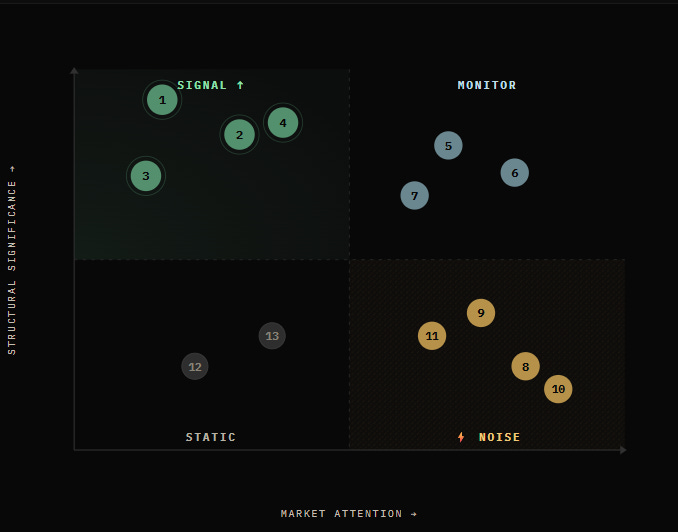
Pakistan’s strategic dimensions plotted by market attention versus structural significance to the default thesis. The signal lives top-left.
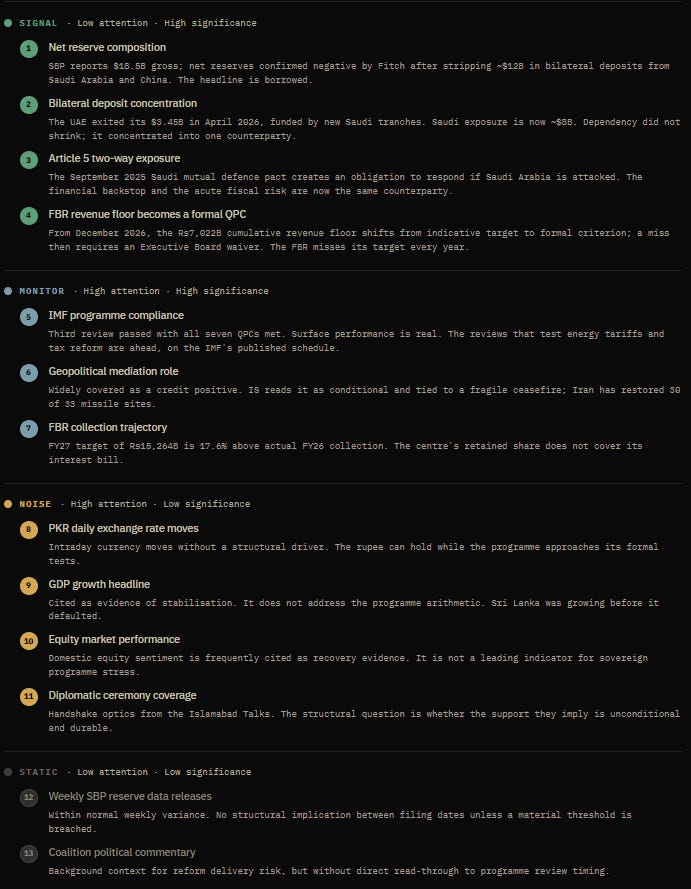
COUNTRY DIMENSION MAP
Impossible Signal scores every country across 12 structural dimensions before filing a signal. The dimension the market is most significantly underweighting is identified below.
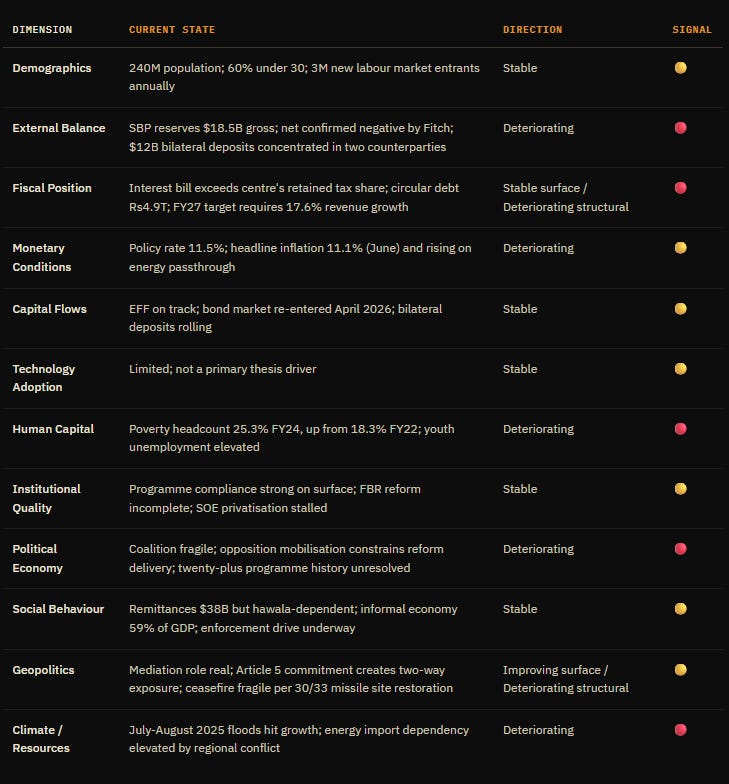
Primary dimensions driving the thesis: Fiscal Position, External Balance, Political Economy.
The dimension the market is most significantly underweighting: Fiscal Position, specifically the December 2026 collision between a revenue floor set as a formal criterion and a tax base that the IMF’s own capacity model says cannot reach the programme’s destination.
CORE CONTRADICTION
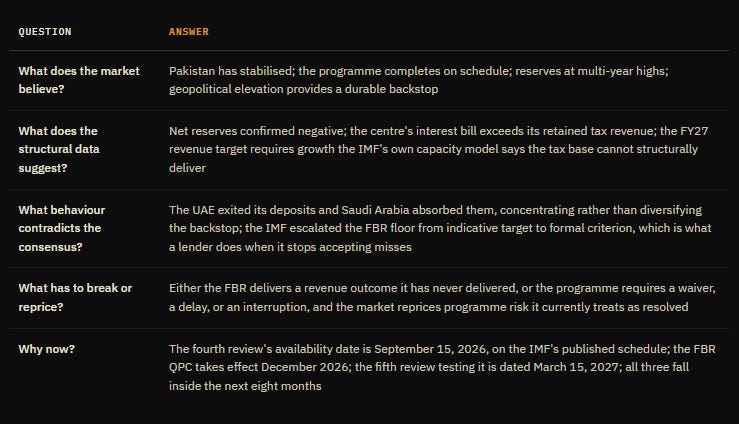
SIGNAL SCORING MODEL
Every probability estimate is derived from a transparent, weighted scoring model before analyst judgment is applied. The weighted total maps to a probability band. Any deviation from the band requires a written explanation.
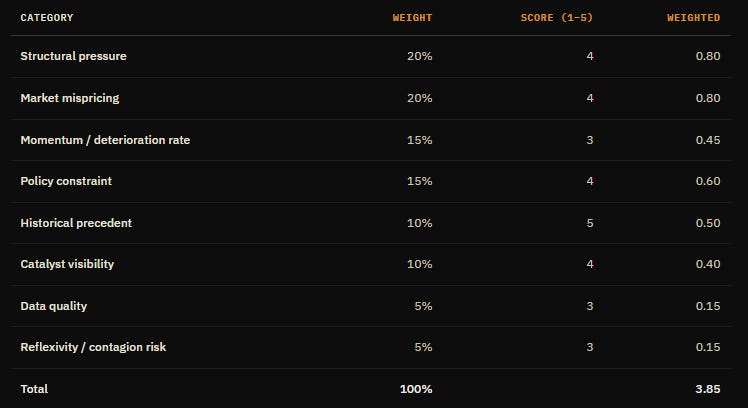
A weighted score of 3.85 maps to a model-implied probability band of 65–80%.
Final probability: 60%. Five points below the band floor. Three factors justify the deviation. First, the current programme is genuinely performing better than its predecessors at the equivalent stage; all seven QPCs cleared at the third review. Second, the April 2026 market re-entry on strong demand demonstrates funding access that reduces near-term interruption risk. Third, the geopolitical relationships, however transactional, demonstrably absorbed the April maturity wall and may do so again.
Market-implied benchmark at filing. No traded instrument prices programme status directly, so three independent methods bound the market’s view. First, the five-year dollar bond spread of 728 basis points over US Treasuries (July 18, 2026) implies, at a standard 40% recovery assumption, a risk-neutral default intensity of approximately 12.1% annually and roughly 14% cumulative over the 15-month window. Second, the sovereign CDS level of 509 basis points (January 2026, NYU Stern country risk data) implies roughly 10% over the same window by the same method. Third, historical cumulative default rates for B- rated sovereigns run 10 to 15% over comparable horizons. Three methods, three sources, one range: 10 to 14%. Default is the tail outcome of programme failure, so this range is a floor on the market’s implied programme risk. We treat 25% as a generous ceiling, judging from the April issuance clearing on strong demand and the spread retracement after the war spike.
Probability gap: at least 35 percentage points.
CATALYST MAP
Events that should trigger a probability update. Impact reflects estimated directional change if the catalyst resolves as stated. Catalyst proximity for this signal: Near.
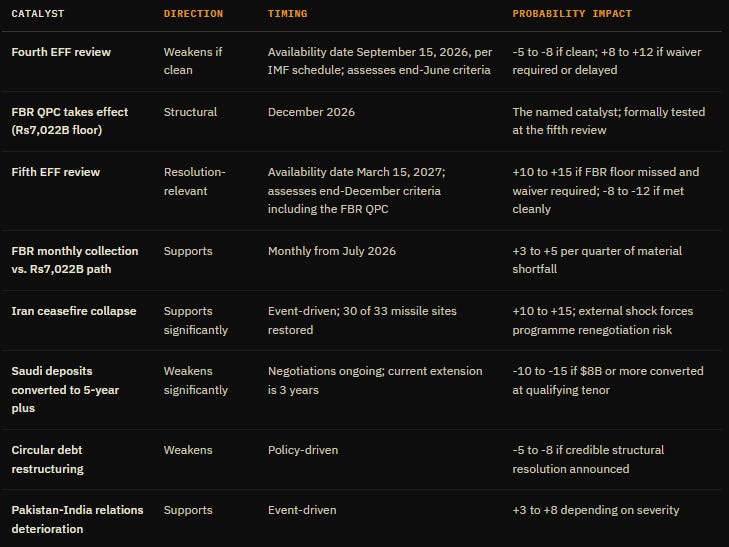
Note: direction is stated relative to this signal. Events that weaken Pakistan's position support the probability of the programme going off-track, and vice versa.
THE IMPOSSIBLE SCENARIO
“The crisis takes a much longer time coming than you think, and then it happens much faster than you would have thought.”
Rudiger Dornbusch, MIT economist
Invert the question. What would have to be true for the programme to complete cleanly in October 2027, with no waiver, no material delay, and no interruption?
The FBR would have to hit Rs7,022 billion by December and Rs15,264 billion by June, a 17.6% annual increase, against a tax base the IMF’s own capacity model caps below the programme’s destination, under a formal criterion where a miss is no longer a footnote. The $12 billion in bilateral deposits would have to roll without friction, now concentrated in Saudi Arabia. Circular debt at Rs4.9 trillion would need containing without triggering the energy tariff politics that have destabilised every prior programme. The Iran ceasefire would have to hold, or its collapse would have to leave Pakistan’s Gulf relationships, treaty obligations, and remittance flows intact. And the governing coalition would have to sustain, for fifteen more months, the reform delivery that every prior coalition has eventually abandoned.
None of these conditions are impossible. Some are probable. The question is whether all of them hold simultaneously.
Scenario A: The FBR wall — 34%. Revenue tracks below the Rs7,022 billion path through the second half of 2026. The December QPC is missed at its first test and the fifth review, dated March 15, 2027, requires an Executive Board waiver. The programme continues, but the signal resolves: formally off-track. This is the modal path, and it is the pattern of prior programmes repeating on the IMF’s own schedule.
Scenario B: External shock forces delay or interruption — 26%. The ceasefire collapses, or a bilateral rollover falters, or both. Gulf financial attention shifts to the conflict. A scheduled review slips beyond 90 days as financing assurances are renegotiated. The programme is formally off-track through the external channel rather than the fiscal one.
Scenario C: Muddle-through completion — 25%. The FBR undershoots by less than feared, or one-off measures bridge the December floor; reviews complete inside their windows. The programme limps to completion in October 2027 without a formal off-track event. The signal resolves incorrect, and the scorecard records it.
Scenario D: Structural resolution — 15%. Saudi Arabia converts deposits to long-term financing. Formalisation drives genuine revenue overperformance. Circular debt is credibly restructured. The programme completes with headroom and Pakistan exits the recidivism pattern for the first time in its history. This is the kill scenario; its observable core is the kill condition below, and the April deposit extension was a partial step toward it. The filed probability already reflects that.
Scenarios A and B resolve the signal correct: a combined 60%. Scenarios C and D resolve it incorrect: a combined 40%.
“If something cannot go on forever, it will stop.”
Herbert Stein, chairman of the US Council of Economic Advisers, 1972 to 1974
THE SIGNAL
Signal #PAK-001
We assess 60% probability that Pakistan’s Extended Fund Facility goes formally off-track before its scheduled completion in October 2027, resolved by any of the following occurring after the filing date: an IMF Executive Board waiver of nonobservance on any quantitative performance criterion; completion of any scheduled review more than 90 days after its availability date; or formal interruption, suspension, or cancellation of the programme.
Market-implied benchmark: 10 to 14% cumulative default probability, converged across three methods (bond spread, CDS, ratings cohort); market base case is programme completion. Generous ceiling on implied programme risk: 25%.
Market benchmarks at filing: Pakistan 5Y USD spread: 728bp over UST (July 18, 2026) · SBP reserves: $18.47B (July 3, 2026) · Policy rate: 11.5% · CPI: 11.1% YoY (June 2026)
Probability gap: at least 35 percentage points.
Catalyst proximity: Near. Fourth review availability September 15, 2026; FBR floor becomes a formal QPC at Rs7,022 billion cumulative in December 2026; fifth review, which tests it, dated March 15, 2027. All per the IMF’s published schedule.
Resolution trigger: Any qualifying off-track event after the filing date, as defined above; or clean programme completion in October 2027, which resolves the signal incorrect.
Kill condition: Announced conversion of $8 billion or more of Gulf bilateral deposits into financing arrangements with disclosed tenor of five years or longer and no rollover requirement, at any point during the signal window. The April 2026 Saudi extension ($5 billion, three years) is a partial step toward this condition and is reflected in the filed probability; it does not satisfy it.
THE INSTRUMENT
The following instrument categories have structural exposure to Pakistan's sovereign credit thesis.
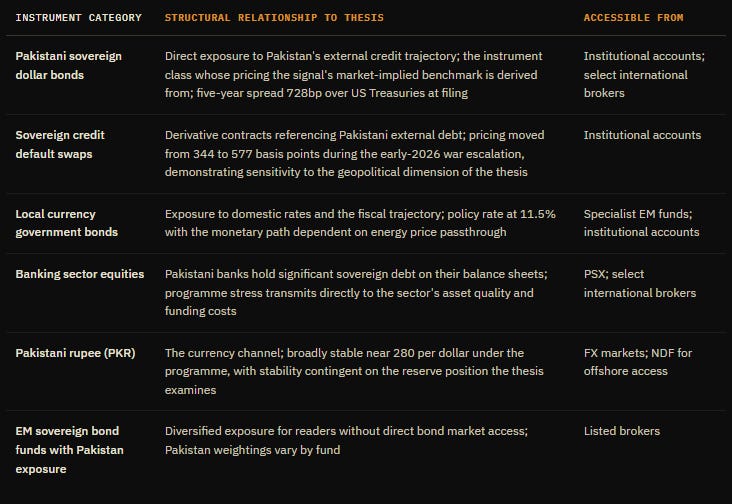
The information in this table is general in nature and has been prepared without taking into account your personal objectives, financial situation, or needs. Before acting on this information, you should consider its appropriateness having regard to your own circumstances and seek independent financial advice.
Pro-tier entry trigger conditions and position sizing framework are pending regulatory review. Starter and Pro subscribers will be notified on release. Nothing in this table constitutes a recommendation to acquire or dispose of any financial product.
ACTIVE SIGNALS SCORECARD

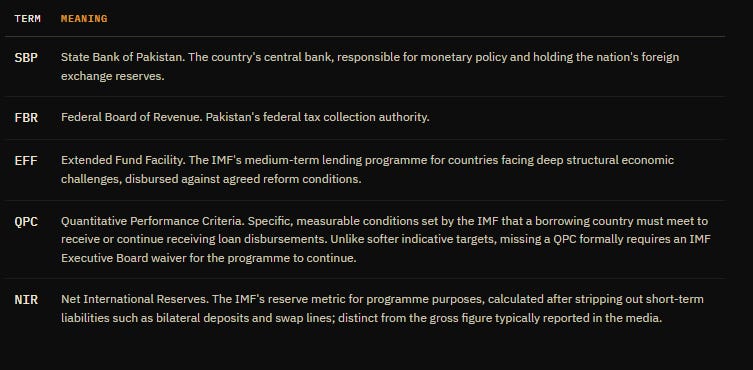
Key Terms
Institutions and mechanisms referenced in this issue, for quick reference.
NEXT ISSUE
Uzbekistan, where a landmark London listing drew a standing ovation and the assets that matter stayed home. The market read the debut as proof the reform is delivering. The timeline tells a different story. Publishing in two weeks.
A NOTE ON SUBSCRIPTIONS
Impossible Signal launches as a free publication. Starter and Pro subscription tiers with market specifics will be made available in near future.
This analysis draws on more than 100 primary and secondary sources reviewed across the research cycle, including the International Monetary Fund (Country Report No. 26/101 and the World Revenue Longitudinal Database), the World Bank, the State Bank of Pakistan (including its June 2026 Inflation Monitor), Pakistan's Ministry of Finance and Federal Board of Revenue, FRED (Federal Reserve Economic Data), the OECD, and the three major ratings agencies: Fitch, Moody's, and S&P Global.
Research for this publication is conducted using a human-directed, AI-assisted analysis framework. All signal assessments, probability estimates, and editorial judgments are made by a human analyst. AI tools are used to assist with data gathering, pattern recognition, and drafting; not to replace analyst judgment.
Impossible Signal publishes general financial information and macro analysis with the aim of increasing transparency and demystifying world economics. Nothing in this publication constitutes personal financial advice or a recommendation to buy or sell any financial instrument. Probability estimates are analytical assessments based on publicly available data. Past signal performance does not guarantee future results. You should seek independent financial advice before making investment decisions.