

Uzbekistan's national fund sprinted to a standing ovation in London, the largest listing on the exchange this year. The transformation it represents is a marathon. Within eight weeks of the celebrated debut, every flagship company behind it had slipped its own listing to next year, or off the calendar entirely. The market is pricing the first mile as the finish line
A note before the signal
This is not a crisis signal. Uzbekistan is not debt distressed, its reserves are near record levels, and the reform programme underway is genuinely substantial. The signal concerns timing, not direction: the gap between the horizon the market is pricing and the horizon the transformation actually requires. Impossible Signal's first two issues examined countries where consensus underpriced fragility. This issue examines a country where consensus is underpricing patience.
WHAT CONSENSUS SAYS
Uzbekistan is the reform story of the decade in emerging markets. A country of roughly 39 million at the centre of the old Silk Road, ruled in succession by Persian, Arab, Mongol, and Russian power, absorbed into the Soviet Union in 1924 and independent since 1991, has spent the past several years opening an economy that spent most of a century closed. The evidence consensus cites is substantial, and getting stronger by the month.
In May 2026, the Uzbekistan National Investment Fund, a fund managed by one of the world’s largest asset managers and holding minority stakes in thirteen state enterprises, dual listed in London and Tashkent. It raised approximately $604 million at a $1.95 billion valuation, drew orders exceeding supply by roughly four times, pulled in BlackRock and Franklin Resources as cornerstone investors committing $300 million before the book even opened, and stood as the London Stock Exchange’s largest IPO of the year. A prominent Swedish security-policy institute, in one of the more sophisticated bull cases available, argues the listing is not merely a transaction but a constraining mechanism: once BlackRock and Franklin Templeton sit on the shareholder register, reversing course becomes contractual and measurable, not just reputational.
Part of the appeal is scale. Uzbekistan is home to one of the largest gold mining companies in the world, sits among the world’s top ten producers of cotton, and is pushing textiles up the value chain from raw export toward finished goods. It is deliberately opening its energy sector to Gulf capital behind a stated target of 54% of electricity from renewable sources by 2030 and a first nuclear power unit, a Russian-built small modular reactor complex, targeted for 2029 with full commissioning by 2033.
The macroeconomic backdrop supports the enthusiasm. The economy grew 8.5% in the first half of 2026 alone, on top of 7.7% growth in 2025 that pushed GDP to roughly $147 billion. International reserves reached $70.8 billion as of May 1, up from $68.99 billion a month earlier. The central bank has held its policy rate at 14% through four consecutive 2026 meetings, keeping real rates positive while inflation eases toward its 5% medium-term target, a credible, active, IMF-consistent monetary stance by any measure. Uzbekistan’s IT export sector is a genuine second growth engine: internet penetration stands at 89%, and IT Park’s resident companies, more than 650 of them including DHL, Cisco, Coca-Cola, and Procter & Gamble as clients, are exporting services at a run rate approaching $800 million annually against a stated national target of $5 billion by 2030.
The domestic capital market itself tells the same story in miniature. As recently as early 2025, total market capitalisation on the Republican Stock Exchange “Toshkent” stood at roughly $9.1 billion, just 7 to 9% of GDP. By June 2026 it had reached an all-time high near $35.5 billion, 20 to 25% of GDP, a multiple of where it stood eighteen months earlier.
And the government has found a second, deliberately unconventional financing channel. In June 2026, Uzbekistan became the tenth member, and the first from Central Asia, of the New Development Bank, the multilateral lender established by the BRICS economies. Unlike IMF-style financing, NDB lending carries development conditions but not structural conditionality: no mandated spending cuts, no required privatisations, and the bank has committed to conducting a rising share of its lending, roughly 30%, in members’ own currencies. An initial project portfolio worth approximately $5 billion was outlined at accession, spanning irrigation, mining, and infrastructure.
The consensus reading of all of this is straightforward: the privatisation programme is delivering, the reform trajectory has been validated by the most demanding capital markets in the world, and the window to invest is, in the language of one prominent asset manager’s own research note, before the crowd.
WHAT THE SIGNAL SHOWS
The fund listed. The companies did not. The sequence ran backwards.
Look closely at what was actually sold in London. The listed vehicle is a fund holding minority stakes, a wrapper. Not one of the thirteen underlying operating companies has completed its own listing. Investors who bought the celebrated debut bought exposure to a portfolio constructed around the assets, not the assets themselves.
The sequencing makes this sharper still. Under the government’s own original plan, the gold miner was meant to be the first of the decreed companies to reach international markets, ahead of the fund itself. Instead, the fund listed first, and the gold miner’s own preparations were paused indefinitely. The company meant to lead the parade is the one no longer marching.
The distinction matters because of what happened to the rest of the pipeline too. The governing presidential decree, industry-sourced as Presidential Resolution No. 145 and dated April 2025, committed twelve state enterprises to IPO or secondary placement, phased from 2025 through 2028. Within eight weeks of the London debut, the government confirmed that the two most prominent remaining names, the national airline and the national telecom operator, would not list in 2026 as originally planned; both moved to 2027. The gold miner went further, with all previously discussed schedules now open ended.
The government’s stated reason is the need for deeper restructuring and improved governance before entering international markets. That reason deserves to be taken seriously; it is also precisely what a longer timeline looks like from the inside.
The debt keeps flowing. The equity stays home.
The company at the centre of this is not a marginal asset. It is, by production, one of the four largest gold miners on earth, just shy of Canada’s Barrick Gold Corp, having produced 3.2 million ounces in 2025. Its most recent annual report shows revenue of $10.8 billion, up 46% year on year, and pre-tax profit of $6.1 billion, up 71%, a pre-tax margin of 56%. Officials have been reported, as early as November 2025, to be concerned that a public listing would reduce the dividends the company generates for the state budget. Gold prices hit a record above $5,500 an ounce in January 2026 and have stayed elevated since.
What the company has not lacked is appetite from international debt investors. It has now placed Eurobonds in three separate rounds: a $300 million issue in 2020; $500 million and $500 million more across 2028 and 2031 maturities in October 2024, an offering that drew a peak order book exceeding $5.5 billion, more than five times the amount raised; and a further $500 million placed in 2026 even as its equity listing sat frozen. Total Eurobond issuance from this one company now approaches $1.8 billion, continuing right through the period its IPO has been paused.
The pattern is precise, not incidental. Debt obligates the company to make coupon payments and nothing more. Equity obligates the state to share upside, governance, and eventually control. One of those the government will sell to international markets on demand, repeatedly, at scale. The other it is holding back indefinitely, at the exact moment record profits and elevated gold prices make the asset most valuable and dilution most expensive.
The financing that removes the pressure.
The NDB accession is one part of why the state can afford to wait. The other, more striking part came on April 1, 2026, when Uzbekistan placed its largest-ever sovereign bond denominated in its own currency, equivalent to $1 billion, in international markets, at a rate of 12.25%, the lowest yet on this specific instrument type; prior comparable local-currency international issuances carried rates of 16.625% in 2024 and 15.5% in 2025. Thirty-two major international investors joined the placement call; by the end of the day, nearly fifty foreign investors had submitted orders worth roughly four times the announced size. The bond is described by the government as the largest local-currency transaction across Central and Eastern Europe, the Middle East, and Africa in fifteen years, and is under consideration for inclusion in a major emerging-market bond index, which could open access to a pool of investors managing an estimated $300 billion.
Taken together, these are two financing channels, neither dependent on selling the privatisation pipeline on any particular schedule. A government with growing, diversifying, conditionality-light access to capital does not need to sell its best assets on anyone’s calendar but its own. The postponements are not a failure of the reform. They are what a state rationally does when the pressure to sell recedes.
The gold that runs the ledger.
Uzbekistan’s reserve position is formidable in size and singular in composition: gold constitutes the large majority of international reserves by value, and gold exports are a substantial share of total goods exports. Earlier in 2026, the country’s gold export volumes fell sharply against the prior year, not because production faltered, but because the central bank chose to accumulate physical holdings during a run of record prices, then released reserves into the market at a chosen window. That is a deliberate sovereign strategy, not a demand collapse, but it produces the same practical effect the original concern was about: a large share of the country’s headline external accounts now moves on the timing of one institution’s internal decisions about when to monetise a stockpile it already holds, rather than on external trade demand. This is the structural context for the suspended gold listing. The company’s dividends flow directly to the state budget. A listing would introduce outside claimants on those flows at exactly the moment elevated gold prices make them most valuable.
The pattern beyond the pipeline, moving in real time.
The listing slippage does not stand alone, and it is not slow-moving history. As recently as mid-June 2026, the government publicly reaffirmed its plan to complete a partial listing of the national airline, a 15 to 20% stake, on international markets by the end of the year. Barely two weeks later, that commitment had flipped: the same government confirmed the airline’s IPO, alongside the telecom operator’s, would move to 2027, with the remaining connectivity-sector companies pushed to “2028, or perhaps 2029” in the government’s own words. The decree’s own six-company deadline, not just the individual company timelines sitting under it, is now showing signs of the same drift.
The same drift shows up in trade policy. Uzbekistan targeted full membership of the World Trade Organization at the body’s 14th Ministerial Conference in March 2026; the conference passed without accession, a fact the government’s own press office confirmed directly. The country’s chief negotiator used the phrase “unintended slowdowns” in December 2025. Bilateral negotiations concluded with Russia and the European Union in late 2025, and with India by the end of May 2026, leaving a single remaining bilateral, with Taiwan, that the government now expects to close before the end of the year. None of this is disqualifying, and the underlying reform work, dozens of legal acts aligned with WTO rules, technical barriers removed, export restrictions lifted, is genuinely substantial. But the pattern recurs everywhere it can be checked: real, serious work, running on a timeline that keeps moving to the right of where it was first announced.
The IMF’s own June 2026 Article IV consultation lands close to the same place. It calls for “accelerating the restructuring and privatization” of state-owned commercial banks, for “reducing the state’s footprint,” and warns specifically against “directed and preferential lending and administrative controls” in place of genuine market mechanisms, an independent, institutional voice arriving at the pace-of-reform concern this signal is built on.
Where the risk sits.
A final structural observation, and the reason this issue exists. In the transaction the market celebrated, the risk allocation runs one way. International investors hold a listed, liquid, tradeable wrapper they can exit in a single trading session. The state retains the operating companies, the execution risk, the restructuring burden, and the timeline. If the marathon runs long, the wrapper’s holders reprice and rotate; the country runs the remaining miles regardless. Critics of this development-finance model call the pattern the Wall Street Consensus: private capital captures the upside of a transformation while the public balance sheet carries the risk of it running slowly or wrong. Whatever the label, the asymmetry is visible in this specific structure, and the market is not currently pricing it as a risk. It is pricing it as a success already delivered.
THE NOISE BLOCKING THE SIGNAL
Every Uzbekistan dimension plotted by market attention versus structural significance to the timeline-realism thesis. The signal lives top-left.
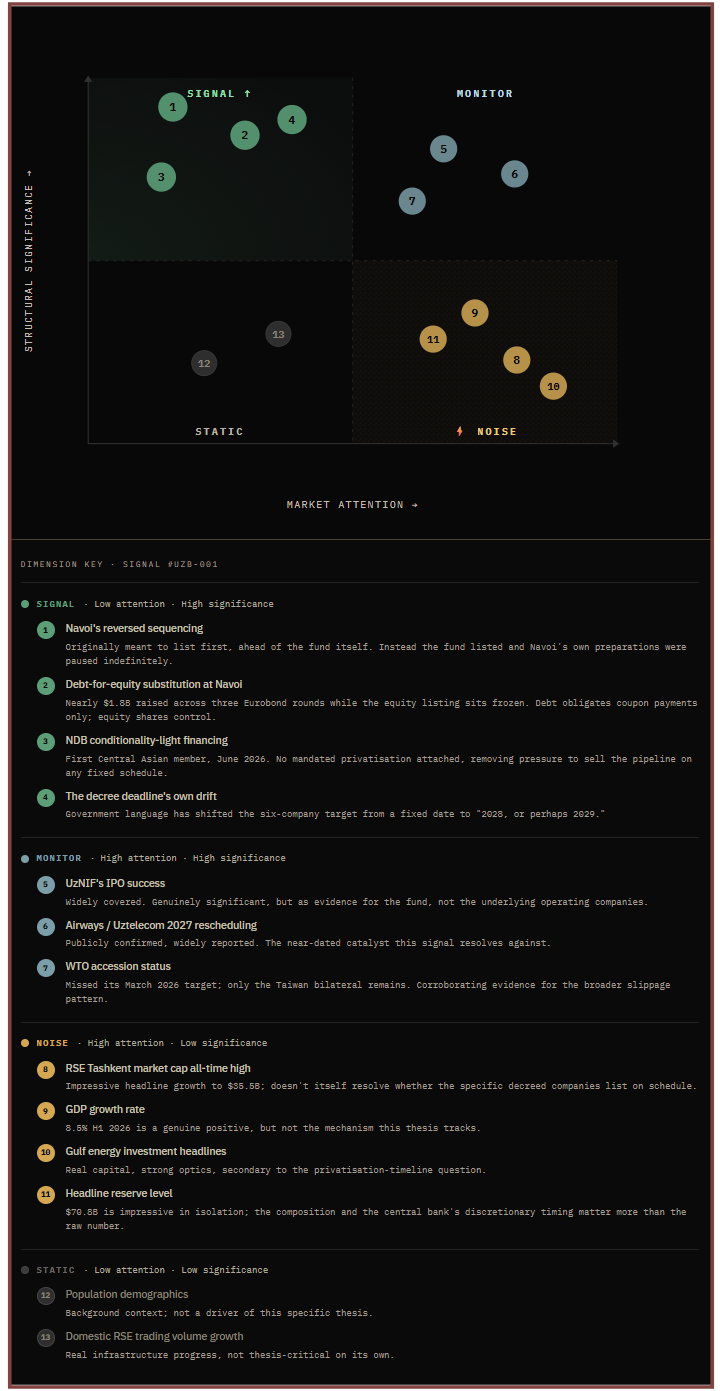
COUNTRY DIMENSION MAP
Impossible Signal scores every country across 12 structural dimensions before filing a signal.
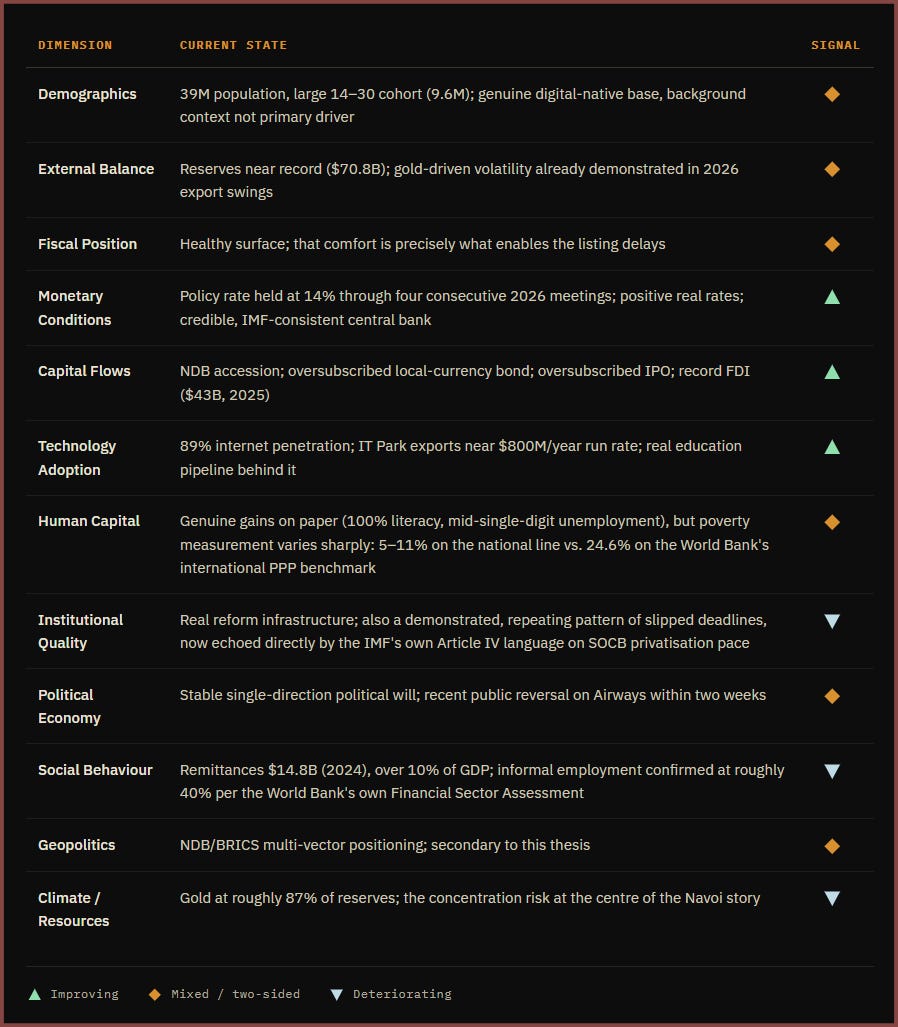
Primary dimensions driving the thesis: Institutional Quality, Climate/Resources, Social Behaviour.
The dimension the market is most significantly underweighting: Institutional Quality. UzNIF’s success is being read as proof of delivery capacity, when the demonstrated pattern, repeated across the IPO pipeline and WTO accession alike, is the opposite.
CORE CONTRADICTION
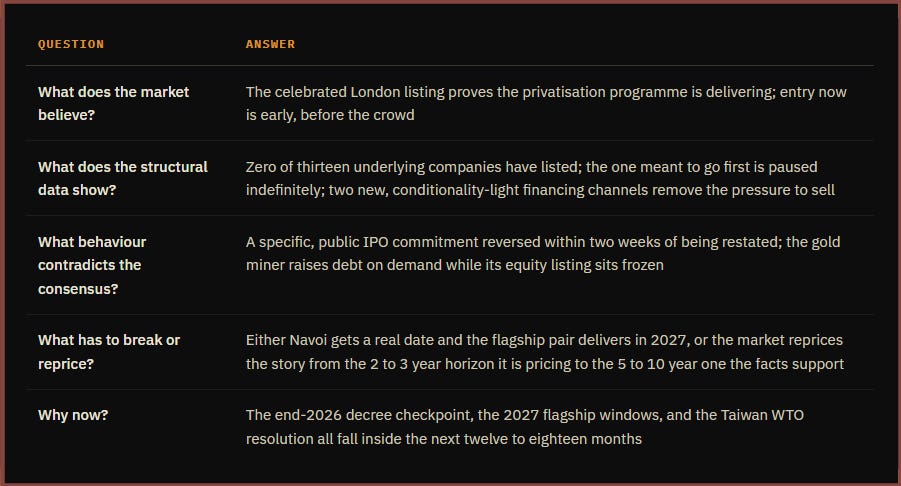
SIGNAL SCORING MODEL
Every probability estimate is derived from a transparent, weighted scoring model before analyst judgment is applied. The weighted total maps to a probability band.
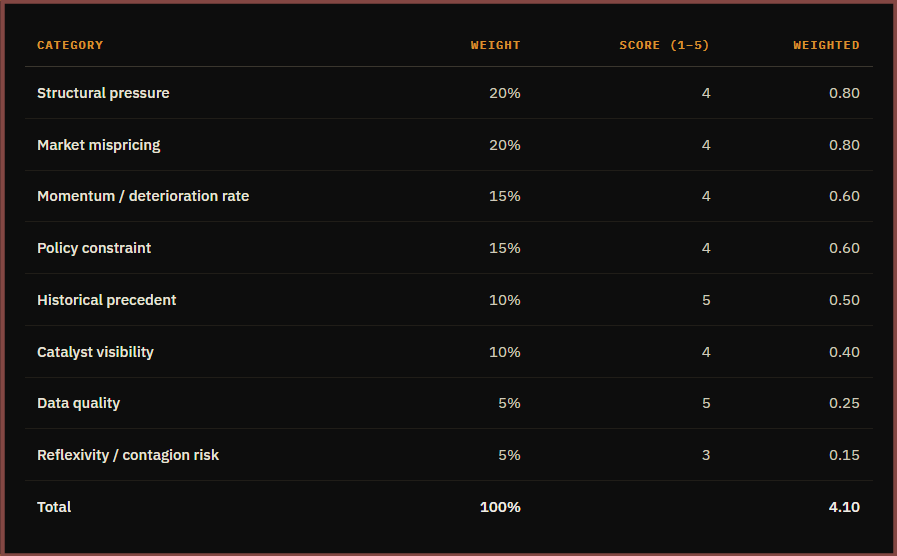
A weighted score of 4.10 maps to a model-implied probability band of 65 to 80%.
Final probability: 68%. Held back from the top of the band by two factors: Navoi’s suspension carries no date at all, weakening precision even as it strengthens direction; and the underlying reform substance is real enough that a positive surprise, a genuine acceleration rather than further drift, remains plausible.
Market-implied benchmark. No credit spread or CDS prices this specific question, so the benchmark is derived differently here than for a sovereign-credit signal: UzNIF’s GDR trades at essentially par to its officially reported net asset value, roughly $33.60 per GDR against a $34.50 recent high, based on the fund’s own factsheet NAV of UZS 6.2659 per ordinary share as of June 30, 2026, converted at 64,700 ordinary shares per GDR. In holding-company markets generally, a 10 to 30% discount to NAV is the normal signal of scepticism about a manager’s ability to execute; trading at or above NAV signals unusually high market confidence in delivery. That implies the market is pricing a low probability of material underdelivery, on the order of 15 to 25%. Taking the midpoint: approximately 20% market-implied.
Probability gap: approximately 48 points. Wider than either of Impossible Signal’s first two filed gaps. Flagged plainly: this derivation is analogical, built from holding-company discount-to-NAV conventions, rather than the direct formula-driven math a bond spread allows, and should be read with that in mind.
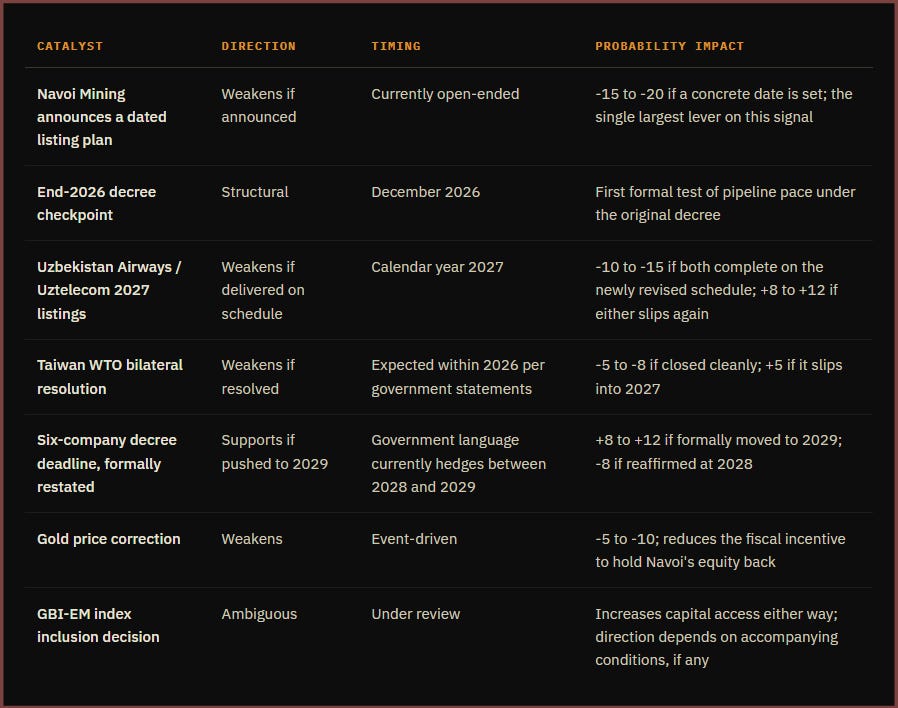
CATALYST MAP
Events that should trigger a probability update. Catalyst proximity for this signal: Near.
THE IMPOSSIBLE SCENARIO
“We tend to overestimate the effect of a technology in the short run and underestimate the effect in the long run.”
Roy Amara, futurist
Invert the question. What would have to be true for the privatisation programme to deliver fully on its original decreed schedule, with no further slippage?
The flagship trio, the airline, the telecom operator, and the gold miner, would all need to complete international listings on time: the first two in 2027, and the third on a schedule that does not currently exist. The government would need to prioritise equity dilution in the one company generating record profits, at precisely the moment two independent, conditionality-light financing channels are removing the fiscal pressure to do so. And it would need to do this while a decree deadline that was firm eighteen months ago is now being described in the government’s own words as “2028, or perhaps 2029.”
None of these conditions are impossible. Some are plausible individually. The question is whether all of them hold on the original timeline simultaneously, or whether the more likely path is the one already visible twice in the same month: real delivery, on a schedule that keeps sliding the moment it is checked.
Scenario A: Navoi stays dateless, others slip further — 38%. Navoi Mining reaches the end of the signal window with no announced listing date. The decree’s own six-company deadline is formally restated to 2029. The flagship pair’s 2027 listings themselves come under renewed pressure. The modal path, and the pattern already demonstrated twice this year.
Scenario B: The flagship pair delivers, Navoi remains unresolved — 30%. Uzbekistan Airways and Uztelecom both complete their 2027 listings broadly as now promised. Navoi still has no concrete date by the end of the window. The signal resolves correct on Navoi’s dateless status alone, even with real delivery elsewhere.
Scenario C: The full pipeline delivers roughly as promised — 20%. The flagship pair lists in 2027, Navoi announces a concrete date and follows through or is clearly on track, and the six-company decree target is substantially met. The signal resolves incorrect.
Scenario D: Structural resolution — 12%. A genuine shift, a gold price correction, renewed fiscal need, or a change in the government’s own calculus, accelerates Navoi specifically to a dated announcement well ahead of current expectations. The kill condition is satisfied. The signal resolves incorrect, and the record shows why.
Scenarios A and B resolve the signal correct: a combined 68%, matching the filed probability. Scenarios C and D resolve it incorrect: a combined 32%.
THE SIGNAL
Signal #UZB-001
We assess 68% probability that Uzbekistan’s flagship privatisation programme materially underdelivers against its officially decreed timeline, resolved by any of the following: Uzbekistan Airways or Uztelecom failing to complete listings within their current, already-once-revised 2027 schedules; Navoi Mining reaching the end of the signal window without a concrete, publicly announced listing date; the broader six-company decree commitment missing its deadline, however that deadline is finally stated; or a further formal postponement beyond what has already occurred.
Market-implied benchmark: approximately 20%, derived from UzNIF’s GDR trading at essentially par to its officially reported NAV, a signal of high market confidence in on-schedule delivery. Derivation shown above; this is an analogical estimate, not a direct formula-driven one.
The probability gap: 48 points.
When a post-devaluation manufacturing platform of this scale and structure has been established in comparable emerging market situations historically, the relevant equity and real asset instruments have repriced significantly within 18 to 36 months of the inflection point.
Market benchmarks at filing: UzNIF GDR (LSE: UZNF): $34.50 · UzNIF NAV per GDR: $33.60 (June 30, 2026) · RSE Tashkent index: all-time high, ~$35.5B market cap · CBU policy rate: 14% · CPI: 6.4% YoY (June 2026)
Catalyst proximity: Near. End-2026 decree checkpoint; 2027 listing windows for the flagship pair; the Taiwan WTO bilateral expected to resolve within the year; the six-company decree deadline, currently unsettled between 2028 and 2029.
Kill condition: Navoi Mining announces a concrete, dated international listing plan, and Uzbekistan Airways and Uztelecom both complete their 2027 listings on schedule, and the six-company decree commitment is met by whichever deadline the government ultimately confirms. Requiring a dated Navoi announcement, not merely eventual delivery, reflects that an open-ended suspension of the single most valuable asset in the programme is treated as evidence in itself, not a data gap
THE INSTRUMENT
The following instrument categories have structural exposure to Uzbekistan's timeline-realism thesis.
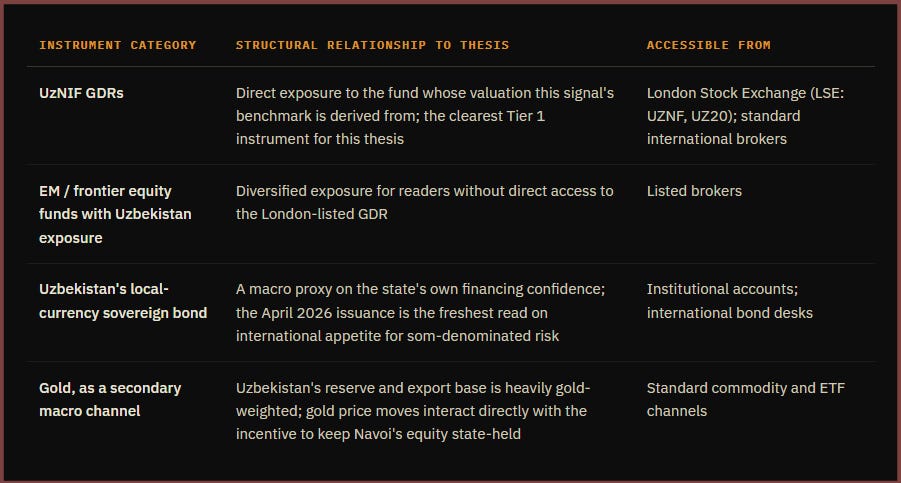
The information in this table is general in nature and has been prepared without taking into account your personal objectives, financial situation, or needs. Before acting on this information, you should consider its appropriateness having regard to your own circumstances and seek independent financial advice. Nothing in this table constitutes a recommendation to acquire or dispose of any financial product.
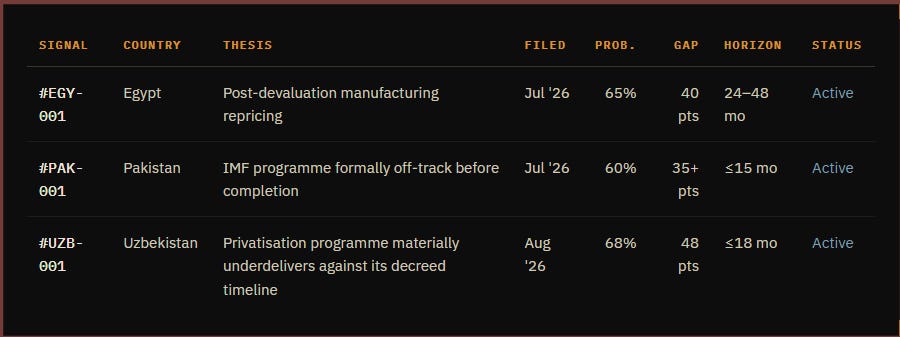
ACTIVE SIGNALS SCORECARD
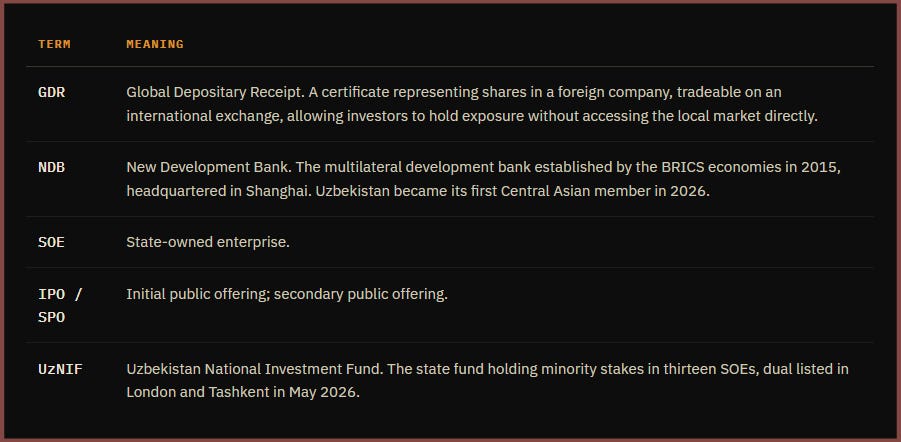
KEY TERMS
A NOTE ON SUBSCRIPTIONS
Impossible Signal launches as a free publication. Starter and Pro subscription tiers with market specifics will be made available in near future.
Thanks for reading Impossible Signal! Subscribe for free to receive new posts and support my work.
This analysis draws on more than 100 primary and secondary sources including the London Stock Exchange's own listing announcements, Cleary Gottlieb's deal documentation, UzNIF's official monthly NAV factsheets, Bloomberg reporting via Mining.com and Northern Miner, the Central Bank of Uzbekistan's monetary policy statements, the IMF's 2026 Article IV consultation, the World Bank's Financial Sector Assessment, bne IntelliNews, Gazeta.uz, UzDaily, and the Institute for Security and Development Policy.
Research for this publication is conducted using a human-directed, AI-assisted analysis framework. All signal assessments, probability estimates, and editorial judgments are made by a human analyst. AI tools are used to assist with data gathering, pattern recognition, and drafting; not to replace analyst judgment.
Impossible Signal publishes general financial information and macro analysis with the aim of increasing transparency and demystifying world economics. Nothing in this publication constitutes personal financial advice or a recommendation to buy or sell any financial instrument. Probability estimates are analytical assessments based on publicly available data. Past signal performance does not guarantee future results. You should seek independent financial advice before making investment decisions.