

Bolivia’s most famous landscape is a crust of salt a few meters thick, sitting on top a liquid brine reservoir most visitors never see. Its central bank’s reserves may be built the same way. Two credit rating upgrades and a freshly sold billion-dollar bond are being read as a proof the crisis is over. One technical finding on what is actually backing those reserves tell a different story.
WHAT CONSENSUS SAYS
Bolivia’s turnaround in 2026 has been unusually fast by sovereign standards. The country began the year with liquid reserves of just $73 million, the level when President Rodrigo Paz took office in November 2025, sovereign spreads above 2,000 basis points, and a currency peg held for fifteen years quietly becoming unsustainable. Within ten weeks, three separate credit rating agencies moved: Fitch from CCC- to CCC on January 16, Moody’s from Ca to Caa3 with a positive outlook on March 19, and S&P to CCC+ on March 23. The country met a $388 million bond payment on schedule and returned to international capital markets for the first time in years.
The clearest evidence of the turnaround is Bolivia’s bond market re-entry. On May 7, 2026, the government placed a new $1 billion Eurobond, a 9.45% coupon maturing 2031, priced at 98.835% with a yield of 9.75%. That sits alongside two already-outstanding issues, a 4.5% bond maturing 2028 and a 7.5% bond maturing 2030. Three live, actively traded dollar bonds, where a matter of months ago the country’s market access looked effectively closed.
The government paired this with a genuine and politically costly policy shift. In December 2025, under Decree 5503, Paz’s administration eliminated fuel subsidies that had cost the state roughly $2 billion annually for nearly two decades, an economic emergency measure that saved over $400 million in its first 45 days alone. On June 29, 2026, the government let the boliviano float for the first time in fifteen years, ending the peg at 6.96 to the dollar; the currency opened at 9.73 and has since stabilized in the 11 to 12 range. On July 29, 2026, the IMF and Bolivian authorities reached a staff-level agreement on a new Extended Fund Facility, in the range of $2.5 to $2.8 billion, aimed explicitly at rebuilding central bank reserves, a real, dated milestone, subject to Executive Board approval.
The consensus reading is straightforward: A new government inherited a genuine mess, took the difficult decisions quickly, and the market’s response, three upgrades, a successful bond sale, an IMF milestone, is the proof.
WHAT THE SIGNAL SHOWS
The reserves the recovery is built on may not be what they appear to be.
Three independent sources now describe the same mechanism. The Finance for Development Lab’s April 2026 analysis concludes Bolivia’s central bank is likely insolvent, citing extensive use of gold derivatives to inflate reported reserve figures. Bolivian law requires a minimum of 22 tonnes of gold to remain in reserves at all times; Harvard’s Growth Lab found that 6.6 of those tonnes had already been pre-sold under forward contracts, rendering a meaningful share of the legally mandated floor already spoken for. And the central bank itself confirmed the mechanism directly: on June 15, 2026, the BCB announced it had fulfilled payment on a gold forward-sale obligation originally struck on June 17, 2025. Reported liquid reserves rose from $73 million to a range of roughly $460 to $523 million through 2026, not through organic improvement, but through this pledging activity combined with frontloaded financing from the regional development bank CAF.
This matters because reserve credibility is the specific thing the recovery narrative rests on. Two of the three rating upgrades and the bond’s pricing are, in part, votes of confidence in the central bank’s balance sheet. If a meaningful share of the reported reserve position is a gold-derivative construction rather than a liquid, spendable asset, the upgrades and the bond pricing are resting on a number that may not mean what it says.
The market’s confidence outpaces the country’s own arithmetic.
Even during the celebrated recovery, Bolivia is running a net-negative financing flow: debt service of $1.28 billion against new loan disbursements of $1.21 billion in the same period. Total external public debt stood at $14.36 billion as of June 30, 2026, of which 70.4% is multilateral, the IDB alone holds 30.5% of it, CAF another 22.9%, the World Bank 12%, and just 15.9% is the celebrated bond market position. The IMF facility now under negotiation, $2.5 to $2.8 billion, would on its own be larger than the entire outstanding bond market stack. The story the market is pricing, “Bolivia is back,” is real but small relative to the multilateral relationships that actually determine the country’s room to manoeuvre. Debt service runs $1.6 billion through the remainder of 2026 and $12 billion through 2030, against total debt at roughly 95% of GDP.
The escape route that never opened.
Bolivia’s other card, alongside reserves, was always meant to be lithium. The country holds an estimated 23 million tonnes of lithium resource, roughly 20% of the global total, beneath the Salar de Uyuni. Since 2008, the state lithium company YLB has invested more than $800 million in evaporation-based extraction infrastructure. In 2025, that infrastructure produced 2,462 tonnes of lithium carbonate against a nameplate capacity of 15,000 tonnes, roughly one-sixth of design output. Harvard’s Growth Lab analysis describes YLB challenges as , what we would refer , technically bankrupt. Total lithium exports in 2024 amounted to approximately $100 million, a rounding error against the debt figures above. New joint ventures with Chinese partners CATL and CBC Investments, worth a combined $10 billion at full buildout on paper, still require direct lithium extraction technology to be proven at commercial scale before Bolivia’s resource estimates can be reclassified as economically recoverable reserves at all. The country that was meant to lithium its way out of a gas-revenue collapse has, after nearly two decades of state-led investment, not done so.
The political cost of a story that has to keep working.
None of this recovery has been free. Roughly fifty days of road blockades in May and June 2026, triggered in part by the fuel subsidy elimination, cost the economy an estimated $2.5 billion by the business chamber’s own accounting. That is a government that has already spent real political capital narrating this turnaround as fast and successful, three upgrades, a decree, a currency float, an IMF milestone, all within about eight months of taking office. The more that story gets told, the more it becomes something worth defending in its own right, independent of whether the underlying reserve mechanics are actually sound.
Where the risk sits.
The same structural asymmetry that shows up across every Impossible Signal issue shows up here. Bondholders in the new 2031 issue hold a liquid, exitable position; if the reserve-composition concern proves out, they can sell. The country cannot exit its own balance sheet. The market has priced three rating upgrades and a successful bond sale as confirmation that the underlying problem is solved. A specific, documented, and now triply-confirmed technical finding says the problem may simply be better hidden than before.
THE NOISE BLOCKING THE SIGNAL
Every Bolivia dimension plotted by market attention versus structural significance to the reserve-adequacy thesis. The signal lives top-left.
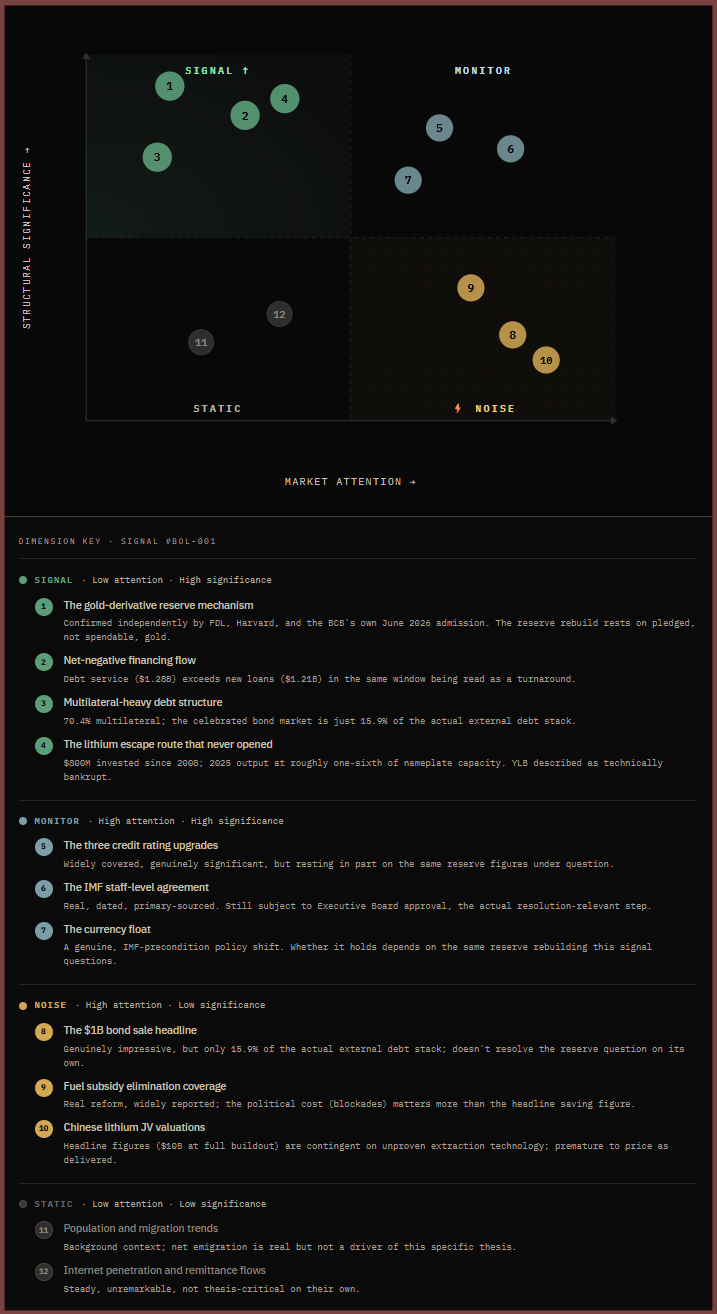
COUNTRY DIMENSION MAP
Impossible Signal scores every country across 12 structural dimensions before filing a signal.
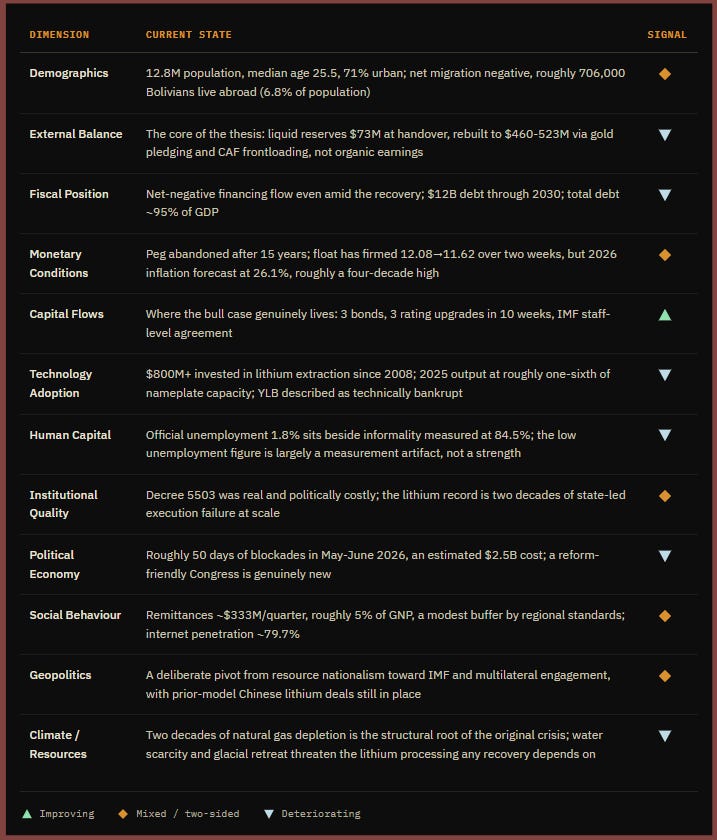
Primary dimensions driving the thesis: External Balance, Fiscal Position, Technology Adoption.
The dimension the market is most significantly underweighting: External Balance. Three rating agencies and a bond market have priced a reserve rebuild that three independent sources, including the central bank’s own admission, describe as substantially built on pledged rather than spendable gold.
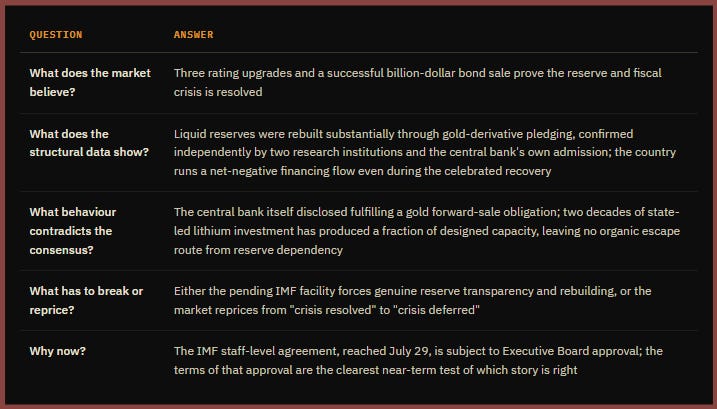
CORE CONTRADICTION
SIGNAL SCORING MODEL
Every probability estimate is derived from a transparent, weighted scoring model before analyst judgment is applied.
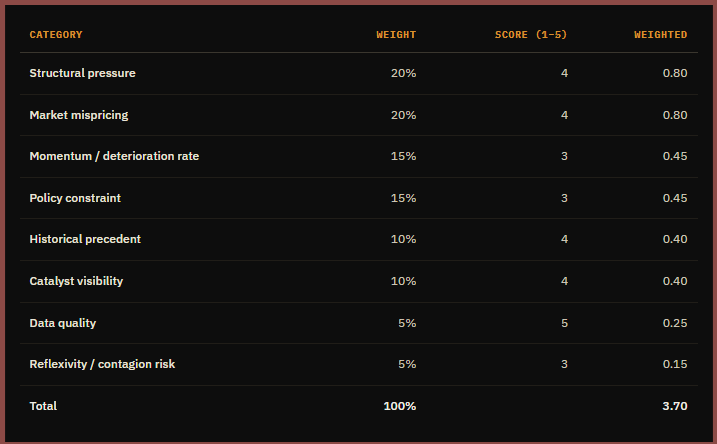
A weighted score of 3.70 maps to a model-implied probability band of 45 to 65%.
Final probability: 55%. The midpoint of the band, no override needed. Momentum and policy constraint both score lower here than in prior issues, deliberately: this is the first Impossible Signal thesis with genuine positive momentum running alongside the negative evidence, real upgrades, a real IMF milestone, a currency that has actually firmed in recent weeks. The score reflects that rather than forcing it to match the severity of prior signals.
Market-implied benchmark. No clean bond-spread or NAV-discount derivation was available here; the closest comparable, the 2031 bond’s secondary-market yield, sits behind a paywall this analysis could not clear, so it is excluded rather than estimated. The benchmark instead draws on ratings-cohort history: issuers initially rated CCC/C see the majority of defaults occur within fifteen months of that rating, almost exactly this signal’s window, and Bolivia remains in that tier, CCC (Fitch), CCC+ (S&P), Caa3 (Moody’s), despite the recent upgrades. That points toward a meaningfully elevated benchmark, tempered downward from a raw historical average because three real upgrades in ten weeks and a real IMF milestone represent priced-in positive momentum a stale base rate would not capture. Approximately 30%.
Probability gap: approximately 25 percentage points. The smallest gap Impossible Signal has filed to date, and appropriately so: this is the first thesis where the market has already begun pricing some of the underlying risk, rather than dismissing it outright.
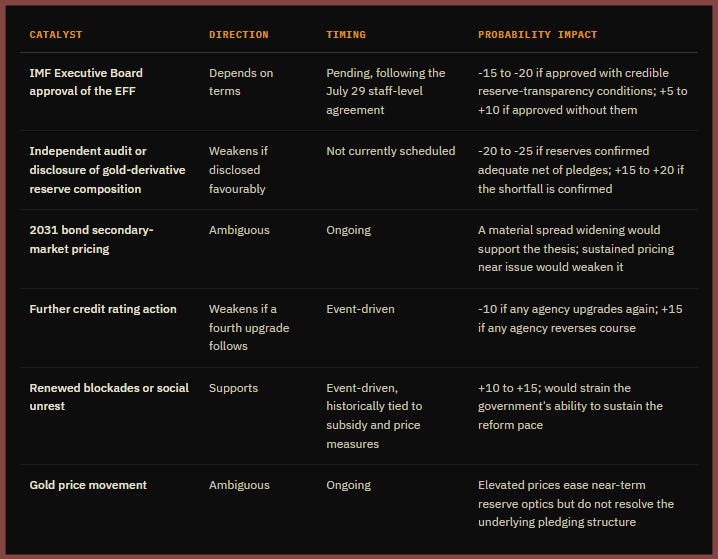
CATALYST MAP
Events that should trigger a probability update. Catalyst proximity for this signal: Near.
THE IMPOSSIBLE SCENARIO
“Even though this progression has happened many times in history, most policy makers and investors think their current circumstances and monetary system won’t change.”
Ray Dalio
Invert the question. What would have to be true for the recovery narrative to be fully correct, with no reserve-composition problem underneath it?
The central bank’s reported reserves would need to be substantially what they claim to be, with the gold-derivative positions representing a legitimate, liquid, spendable asset rather than an accounting construction confirmed by the bank’s own disclosures. The net-negative financing flow would need to be a temporary, one-off feature of the transition rather than an ongoing structural pattern. Lithium, the one plausible organic escape route from reserve dependency, would need to begin delivering after two decades of not doing so. And the pending IMF facility would need to close on favorable terms without requiring the kind of independent reserve verification that would be unnecessary if the position were already sound.
None of these conditions are impossible. Some are plausible individually. The question is whether all of them hold simultaneously, or whether the more likely path is the one the historical pattern Dalio describes would predict: a debt crisis that gets managed and narrated rather than genuinely resolved, until the narration itself runs out of road.
Scenario A: Reserve inadequacy confirmed or forced into the open — 30%. An audit, an IMF condition, or further disclosure confirms that reserves net of gold-derivative obligations fall meaningfully short of what has been reported. The modal path given the evidence already in hand.
Scenario B: The IMF facility closes without real transparency conditions — 25%. The Executive Board approves the facility, headline financing improves, but the reserve-composition question is never genuinely tested or resolved. The signal resolves correct on the underlying adequacy problem persisting, even without a clean disclosure event.
Scenario C: Genuine reserve rebuilding is achieved — 28%. IMF conditions are met in substance, not just on paper, and reserves net of pledged gold become demonstrably adequate against stated obligations. The signal resolves incorrect.
Scenario D: Reputation-preservation drives a genuinely favorable outcome — 17%. Having already spent enormous political capital narrating this as a fast, successful turnaround, the government pushes hard enough, accepting real economic cost if necessary, to make the recovery genuinely durable rather than merely narrated. The kill scenario. The signal resolves incorrect, and the record shows why.
Scenarios A and B resolve the signal correct: a combined 55%, matching the filed probability. Scenarios C and D resolve it incorrect: a combined 45%.
THE SIGNAL
Signal #BOL-001
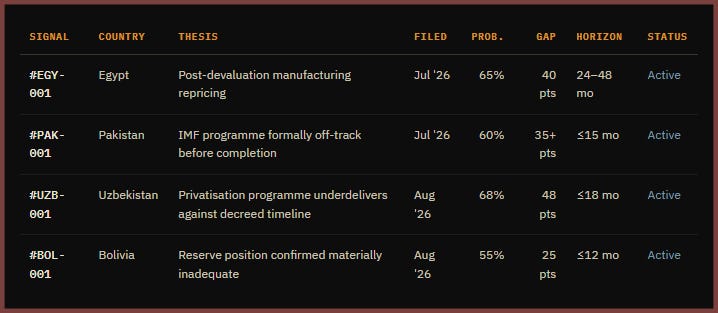
We assess 55% probability that Bolivia’s central bank reserve position is confirmed to be materially inadequate relative to what is currently reported, whether through an independent audit, IMF-mandated disclosure, or a subsequent reserve shortfall that becomes evident despite the current recovery narrative.
Probability gap: approximately 25 percentage points. Issuers initially rated CCC/C see the majority of defaults occur within fifteen months of that rating, almost exactly this signal’s window, and Bolivia remains in that tier across all three agencies despite the recent upgrades, pointing toward a meaningfully elevated benchmark. That figure is tempered down to approximately 30% market-implied, from a raw historical average, because three real upgrades in ten weeks and a real IMF milestone represent priced-in positive momentum a stale base rate would not capture. The smallest gap filed to date, appropriately: this is the first thesis where the market has already begun pricing some of the underlying risk.
Market benchmarks at filing: Fitch CCC · S&P CCC+ · Moody’s Caa3 (positive) · BCB official rate 11.62 BOB/USD (August 14, 2026) · 2031 bond (USP37878AF56) issued at 9.75% yield · Liquid reserves ~$460-523M (2026, reported)
Resolution trigger: Reserve inadequacy confirmed through an independent audit, IMF-mandated disclosure, or a subsequent shortfall event, after the filing date; or the IMF facility closing on terms that produce demonstrable, verified reserve adequacy, which resolves the signal incorrect.
Kill condition: The IMF Executive Board approves the Extended Fund Facility, and subsequent central bank reporting or an independent audit confirms reserves net of gold-derivative and forward-sale obligations meet a reasonable coverage threshold against near-term external obligations. Requiring verification net of the pledging mechanism, not just a headline reserve figure, reflects that the mechanism itself, not the number, is what this signal questions.
Catalyst proximity: Near. IMF Executive Board decision pending following the July 29 staff-level agreement; ongoing debt service through the remainder of 2026; any further rating action from an agency already primed to move quickly, three times in ten weeks.
THE INSTRUMENT
The following instrument categories have structural exposure to Bolivia’s reserve-adequacy thesis.
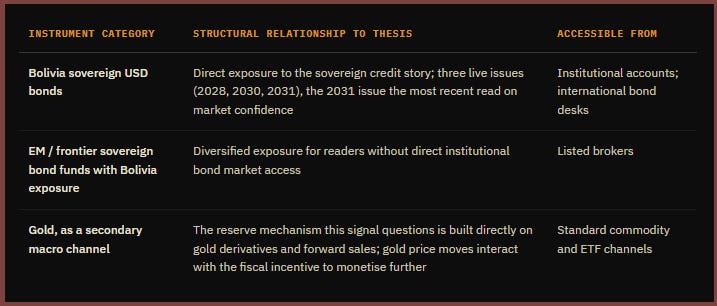
The information in this table is general in nature and has been prepared without taking into account your personal objectives, financial situation, or needs. Before acting on this information, you should consider its appropriateness having regard to your own circumstances and seek independent financial advice.
ACTIVE SIGNALS SCORECARD
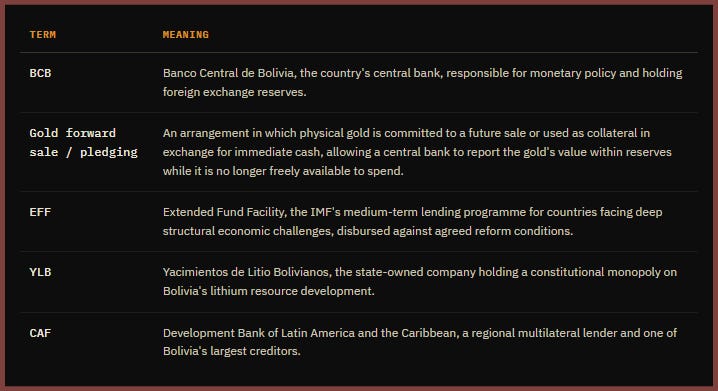
KEY TERMS
Institutions and mechanisms referenced in this issue, for quick reference.
NEXT ISSUE
Guyana, the fastest-growing economy in the world, sitting on an oil boom that transformed one of South America's poorest countries within a few years. Two-thirds of its territory sits under an active claim from a neighbor whose government was removed earlier in the year, by a US military operation, but still won’t relinquish the claim. Publishing in two weeks
A NOTE ON SUBSCRIPTIONS
Impossible Signal launches as a free publication. Starter and Pro subscription tiers with market specifics will be made available in near future.
Thanks for reading Impossible Signal! Subscribe for free to receive new posts and support my work.
This analysis draws on more than 100 primary and secondary sources reviewed across the research cycle, including the Finance for Development Lab's April 2026 policy note, the Harvard Growth Lab's April and May 2026 working papers on Bolivia's macroeconomic pivot, the Central Bank of Bolivia's own public disclosures and exchange rate reporting, the IMF's July 29, 2026 press release, Fitch Ratings, S&P Global Ratings, Moody's Investors Service, Cbonds, and bne IntelliNews.
Research for this publication is conducted using a human-directed, AI-assisted analysis framework. All signal assessments, probability estimates, and editorial judgments are made by a human analyst. AI tools are used to assist with data gathering, pattern recognition, and drafting; not to replace analyst judgment.
Impossible Signal publishes general financial information and macro analysis with the aim of increasing transparency and demystifying world economics. Nothing in this publication constitutes personal financial advice or a recommendation to buy or sell any financial instrument. Probability estimates are analytical assessments based on publicly available data. Past signal performance does not guarantee future results. You should seek independent financial advice before making investment decisions.