

Guyana is the fastest-growing economy in the world, transformed by a single offshore oil discovery into one of the wealthiest nations per capita in the hemisphere. A big oil player responsible for that transformation is also racing back into the one neighboring country that claims two-thirds of Guyana’s own territory. The market is pricing one of these facts. Not both.
A note before the signal
Like Uzbekistan, this is a timing and concentration signal, not a crisis signal. Guyana is not going through severe fiscal distress; it is one of the least indebted , fastest growing economies anywhere. The question this signal asks is whether a state of under a million people, and a single foreign operator with newly divided regional loyalties, can absorb what’s coming at the speed the market is pricing.
WHAT CONSENSUS SAYS
Guyana’s transformation is real and extraordinary. Real GDP grew over 19% in 2025, following average growth near 40% annually across 2023-24, the highest in the world. Oil production surpassed 900,000 barrels per day by the end of 2025. GDP per capita has reached roughly $29,883. The IMF’s own July 2026 Article IV mission praised the government’s “very good economic management,” crediting a well-governed Natural Resource Fund: mandatory parliamentary approval for every withdrawal, criminal liability for the Finance Minister over non-transparent reporting, an independent oversight committee, and EITI membership since 2017.
The offshore Stabroek Block, the source of it all, is owned by ExxonMobil (45%, operator), Chevron (30%), and China’s CNOOC (25%). Chevron’s stake arrived via its roughly $53 billion acquisition of Hess Corporation, completed in July 2025 after a public arbitration battle against ExxonMobil and CNOOC over pre-emptive rights; analysts had estimated Hess’s Guyana stake at approximately 70% of the company’s total value before the deal closed. Guyana’s own strategic posture is a calculated multi-alignment: a Western security anchor (US Southern Command underwrites its defense; ExxonMobil operates its central economic asset) alongside tactical Eastern engagement (CNOOC’s stake, Belt and Road-financed infrastructure, functional ties with India), without ever formally seeking BRICS membership.
WHAT THE SIGNAL SHOWS
The company betting on both sides of the fault line.
Chevron is the one name connecting two of the biggest energy stories in the hemisphere simultaneously. It holds 30% of Stabroek. And since a US military operation captured Venezuela’s president in January 2026, Chevron has been the most active Western major expanding back into the neighboring country that claims two-thirds of Guyana’s landmass. On the same day in late January that the US Treasury issued its first major sanctions relief license, Venezuela’s National Assembly passed a genuine legislative reform of its Hydrocarbons Law, reducing taxes and granting foreign firms more operational independence. By June 2026, Chevron, Shell, BP, Eni, Repsol, and France’s Maurel & Prom were all cleared and active in Venezuela; Chevron specifically confirmed as expanding a joint venture there.
This is not simply “Venezuela reopening drains capital from Guyana.” The relief comes with a structural condition worth noting precisely: firms owned or controlled by Russia, China, or Iran are explicitly barred from the new Venezuela arrangements. CNOOC, Guyana’s other Stabroek partner, is locked out by design. The sharper version of this thesis isn’t Guyana against Venezuela. It’s whether Chevron’s own capital allocation, between the two biggest growth bets on its own balance sheet, begins to tilt now that both are open to it simultaneously. ExxonMobil and ConocoPhillips, by contrast, remain confirmed as cautious, both still pursuing billions in unresolved claims from Venezuela’s 2007 nationalizations (ConocoPhillips approximately $12 billion, ExxonMobil approximately $2 billion) and uncommitted to fresh investment there.
“Ten Years from now, twenty years from now, you will see oil will bring us ruin, Oil is the devil’s excrement.”
Juan Pablo Perez Alfonso, Venezuela’s oil minister and a co-founder of OPEC, 1975
Alfonzo made that warning about his own country's oil decades before Venezuela's collapse provided him right. The country now reopening to Chevron’s capital is the same one his own words describe.
The claim that survived a regime change.
Guyana’s ICJ case against Venezuela over the Essequibo region closed its merits hearings in May 2026. Venezuela’s agent formally rejected the Court’s jurisdiction on Mid-May , calling the claim “Irrenunciable”; Venezuela’s Acting President stated directly in her own closing arguments that the government “would be unable to comply” with any ruling favoring Guyana, whatever it says. A ruling is informally expected from August 2026 onward, timing genuinely uncertain. What makes this durable rather than a Maduro-era artifact: Venezuela’s government changed entirely in the interim, a US military operation captured Maduro on January 3, 2026, and his own vice president was sworn in as acting president days later. Four months after that transition, under a government now actively cooperating with Washington on oil and security matters, Venezuela’s position on Essequibo had not moved. The claim is described by regional analysts as a rare point of consensus across Venezuela’s factional divide, one of the few positions that appears to have survived the collapse of the government that held it.
A neighbor whose own risk now includes you.
The relationship cuts both directions in a way worth stating plainly. Congress’s own research service, in an assessment updated this month, names tensions with Guyana specifically, alongside Colombia, as a factor that could destabilize the Rodríguez government itself. This is not abstract: in June 2026, Venezuelan security forces conducted operations against illicit mining networks in the Orinoco Mining Arc, directly on the border area with Guyana, while separately supporting a US strike that killed a major criminal organization's leader. The transition itself remains genuinely contested eight months in: pro-government paramilitary groups rallied against Maduro’s capture within a day of it happening; the internationally recognized winners of Venezuela’s 2024 election remain sidelined from the US-backed dialogue process; a sanctioned figure with a $25 million US bounty remains in the cabinet; and independent inflation estimates run as high as 600% annually against the central bank’s own reported 71.8% for a single quarter. A neighbor this unsettled, with a stated interest in your territory, is not a background risk. It is a live one.
The people the boom needs and doesn’t have.
Guyana’s Natural Resource Fund is, on paper, well designed. The 2026 budget draws roughly $2.37 billion from it, funding nearly a third of the entire national budget. The constraint isn’t the rules. It’s roughly ten independent sources, the CIA World Factbook, a 2024 US State Department report, and a 2026 UNDP Democracy and Development Report among them, converging on the same figure: more than 80%, by some recent counts approaching 90%, of Guyanese with a tertiary education have emigrated. This is not new to the oil era. Under the Burnham government in the 1960s, roughly 70% of the country’s university-trained professionals left within a six-year span. The scale is now precisely measurable: approximately 1.5 million Guyanese live abroad against 816,000 at home, more citizens outside the country than in it.
The government’s own strategy to reverse this is itself showing the pattern it is trying to fix. On May 26, 2026, at the country’s 60th independence celebration, the president announced a diaspora bond would launch within one week, intended to convert emigrant capital into infrastructure funding. Six weeks later, at a town hall in Saint Lucia held specifically to court the same diaspora, the bond’s size, rate of return, eligibility, and use of proceeds all remained undisclosed. Officials point to India and Israel as precedents; both published terms when they made the same ask. The state now managing a multi-decade, multi-billion-dollar transformation is doing so with a demonstrated, multi-generational pattern of losing exactly the people, and struggling to mobilise the capital, such a transformation requires.
The debt that’s climbing anyway, and the picture is genuinely two-sided.
Despite the boom, Guyana’s debt-to-GDP ratio rose from 24.3% in 2024 to 28.6% in 2025, with total public debt projected to reach $10.3 billion by the end of 2026, more than sixfold in 6 years. But the debt service as a share of government revenue has actually fallen, from roughly 7% in the years before oil to about 5% since , because revenue is currently growing even faster than debt. the Inter-American development Bank’s own August 2026 assessment calls Guyana's position "highly sustainable," citing the Natural Resource Fund's withdrawal rules and the concessional terms of most of the debt. That is a fair, credible read, and it holds precisely as long as revenue growth keeps outrunning debt growth, a relationship that reverses quickly if oil prices or production disappoint. Worth stating directly: the same IDB report explicitly cites "persistent geopolitical tensions" as a risk to Guyana's outlook, connecting this fiscal picture to the Essequibo dispute rather than treating them as separate stories.
Where the risk sits.
The familiar asymmetry, sharper here than anywhere else this project has found it. A reader can hold Chevron, one of the most liquid stocks in the world, and exit in a single session. Guyana cannot exit its on geography, it’s own labor market, or it’s own neighbor. The market is pricing the fastest-growing economy story. It has not yet had to price what happens if the company carrying that story starts weighing it against a second, newly-reopened one next door.
THE NOISE BLOCKING THE SIGNAL
Guyana’s strategic dimensions plotted by market attention versus structural significance to the default thesis. The signal lives top-left.
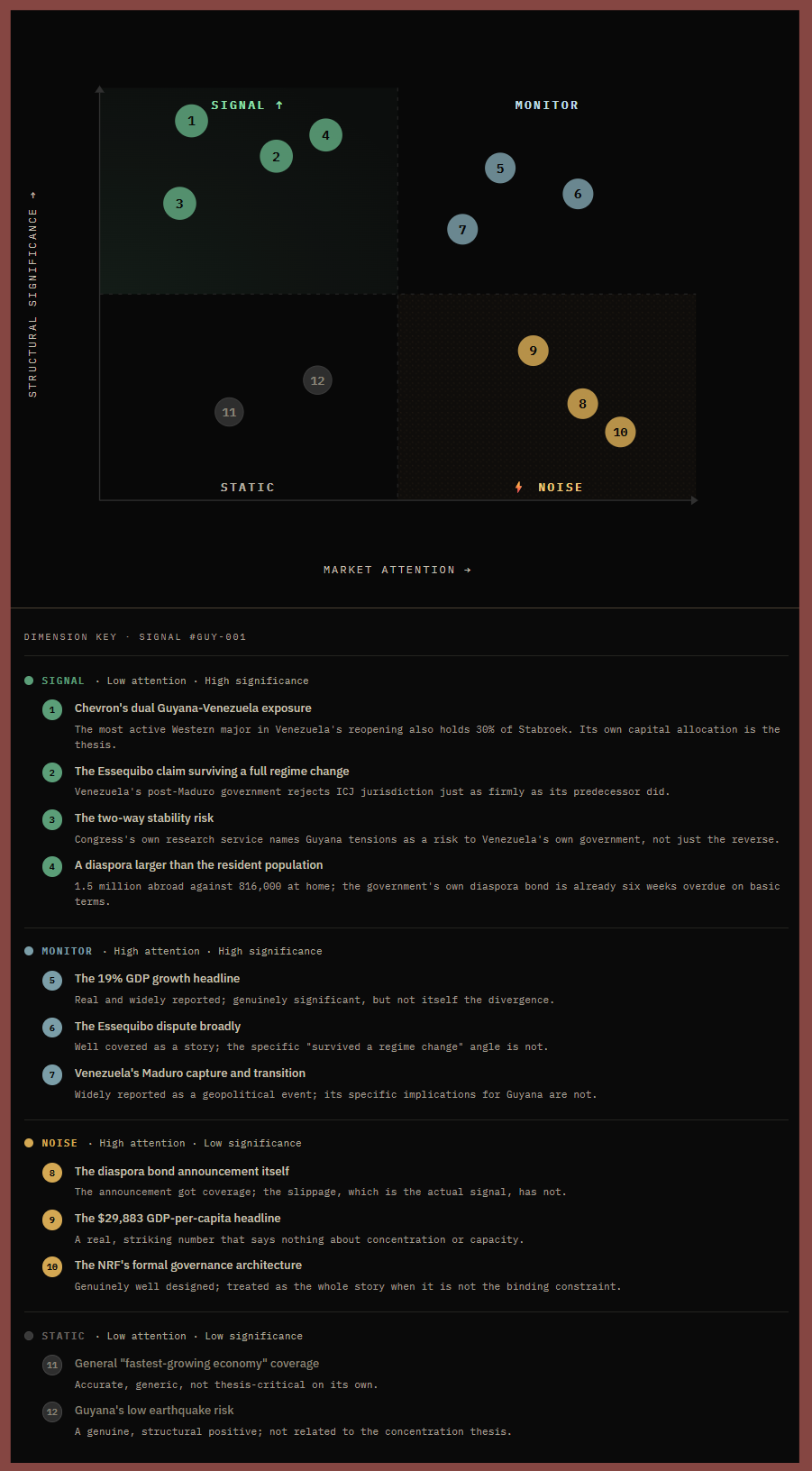
COUNTRY DIMENSION MAP
Impossible Signal scores every country across 12 structural dimensions before filing a signal.
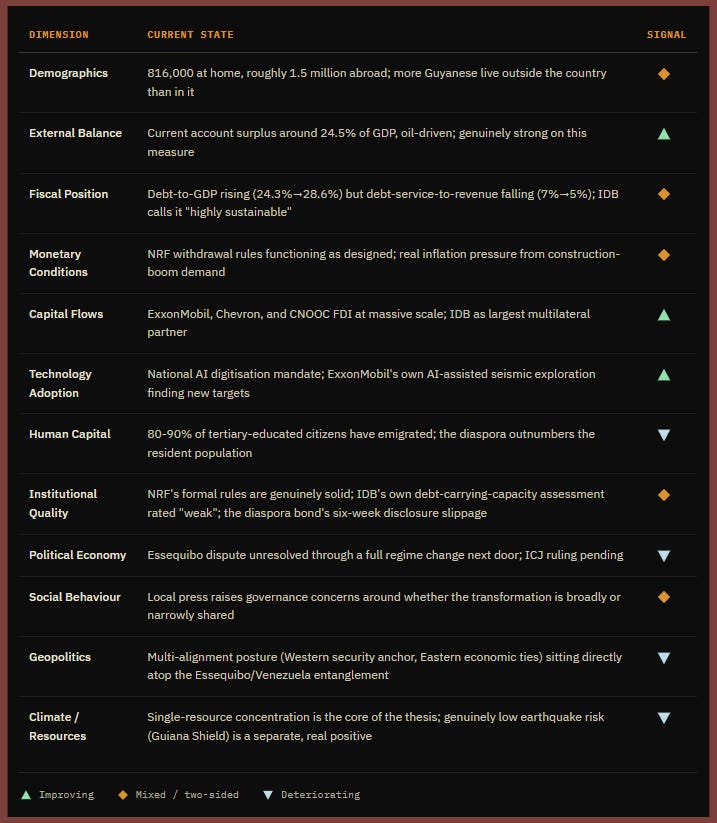
Primary dimensions driving the thesis: External Balance, Fiscal Position, technology Adoption.
The dimension the market is most significantly underweighting: External Balance. Three rating agencies and a bond market have priced a reserve rebuild that three independent sources, including the central bank’s own admission, describe as substantially built on pledged rather than spendable gold.
CORE CONTRADICTION
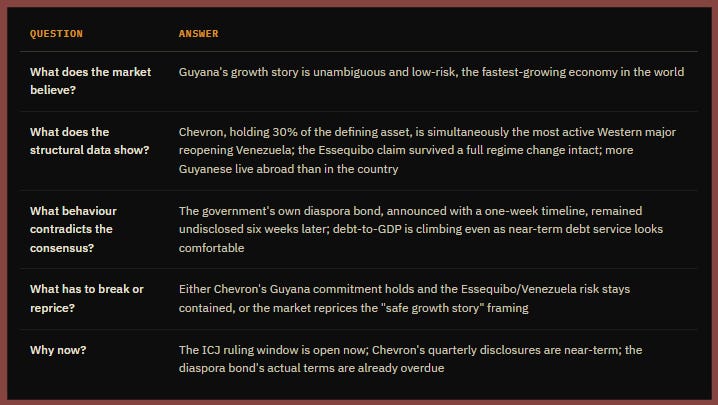
SIGNAL SCORING MODEL
Every probability estimate is derived from a transparent, weighted scoring model before analyst judgement is applied.
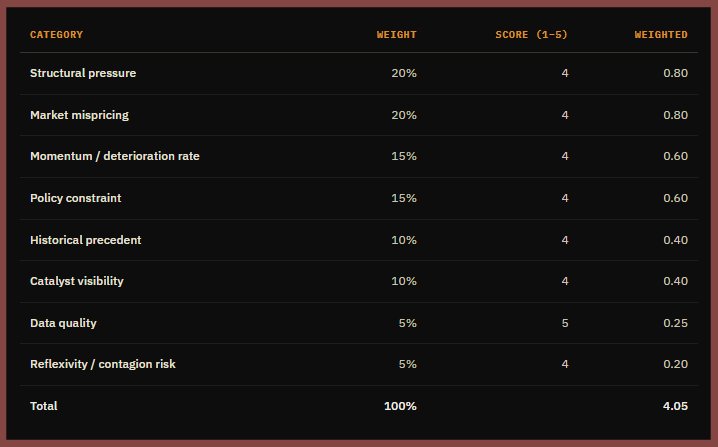
A weighted score of 4.05 maps to a model-implied probability band of 65 to 80%. Filed probability, market-implied benchmark, and the resulting gap are stated in full in The Signal, below.
CATALYST MAP
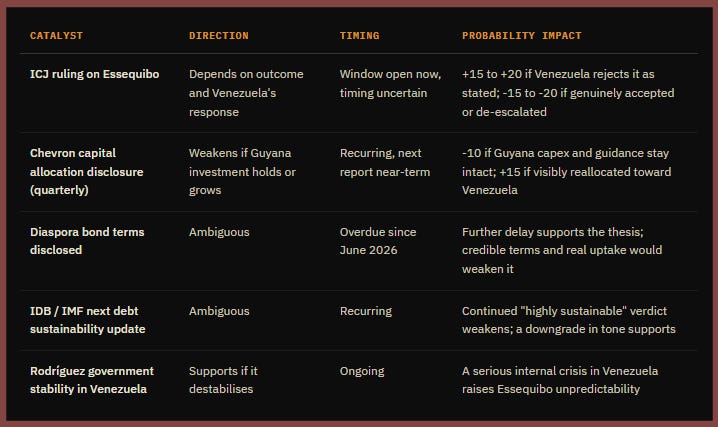
Events that should trigger a probability update. Catalyst proximity for this signal: Near.
THE IMPOSSIBLE SCENARIO
“The existence of a valuable natural resource represents a permissive condition... But unless the nation shows a capacity for modifying its social institutions in time to take advantage of the opportunity, it will have only a transient effect.”
Simon Kuznets, Nobel laureate in Economic Sciences, “Economic Growth of Small Nations,” 1960
Invert the question. What would have to be true for Guyana’s growth story to be fully correct, with no concentration or capacity risk underneath it?
Chevron’s capital allocation would need to stay committed to Guyana at its current pace even as Venezuela offers a second, newly-reopened growth path on the same balance sheet. The Essequibo dispute would need to resolve, or simply stop mattering, despite surviving a complete regime change intact. The state would need the people to execute a multi-decade transformation despite a demonstrated, multi-generational pattern of losing exactly those people, one already repeating in real time in the diaspora bond’s own six-week slippage. And the comfortable debt-service ratio would need revenue growth to keep outrunning debt growth indefinitely, a relationship that has never held indefinitely anywhere.
None of these conditions are impossible. Some are plausible individually. Kuznets wrote his warning about small nations and natural resources decades before Guyana’s oil was discovered, without needing to know the specific country to describe the specific risk. The question is whether Guyana becomes the exception, or the illustration.
Scenario A: Essequibo escalates following a rejected ICJ ruling — 28%. The Court rules, Venezuela rejects it as its own leadership has already stated it would, and the dispute moves from legal to genuinely destabilizing. The modal path given the evidence already on record.
Scenario B: Chevron’s capital allocation visibly tilts toward Venezuela — 22%. Guyana’s growth story continues, but Chevron’s own disclosed guidance or capex begins favoring its Venezuela position at Guyana’s relative expense.
Scenario C: Debt or capacity strain produces a visible setback — 20%. The revenue-outrunning-debt relationship reverses, or an execution failure tied to the brain-drain constraint becomes publicly visible.
Scenario D: All threads hold, the boom continues without incident — 20%. Chevron stays committed to both, Essequibo stays contained, and the debt ratio keeps improving. The signal resolves incorrect.
Scenario E: Reputation-preservation holds the risk in check — 10%. Rodríguez’s own political survival, per filing discipline rule 6, depends in part on visible restraint toward Guyana, and that pressure is enough to prevent escalation even without genuine resolution. The signal resolves incorrect.
Scenarios A, B, and C resolve the signal correct: a combined 70%, matching the filed probability. Scenarios D and E resolve it incorrect: a combined 30%.
THE SIGNAL
Signal #GUY-001
We assess 70% probability that within the signal window, at least one of the following occurs: Chevron’s own capital allocation demonstrably shifts towards Venezuela at Guyana’s expense; the Essequibo dispute escalate materially following an ICJ ruling Venezuela rejects; or Guyana’s debt trajectory or execution capacity produces a visible fiscal or infrastructure setback.
The probability gap: 45 % points.
No clean, publishable estimate of Guyana’s specific share of Chevron’s post-merger valuation exists, unlike the roughly 70% figure analysts assigned to Hess per-merger, since Chevron is now diversified across the Permian, Kazakhstan, the Gulf of Mexico, and Iraq. Sell-Side coverage ties part of Chevron’s current discount to it’s own price target and calculated intrinsic value to “Its Guyana Story”, while separately showing real caution, net debt has risen sharply since the Hess acquisition and free cash flow turned negative in early 2026. Resolving to an internal estimate that reflects this caution rather than pure complacency: Approximately 25% market-implied.
Market benchmarks at filing: Chevron (NYSE: CVX) trading with an approximate 24% discount to average analyst price target · Stabroek production past 900,000 bpd · Guyana debt-to-GDP 28.6% (2025) · IDB debt-service-to-revenue ratio ~5% · ICJ ruling pending since May 2026 hearings
Resolution trigger: Any qualifying event above, after the filing date; or the full period elapsing with Chevron's Guyana commitment intact, Essequibo contained, and no visible debt or capacity setback, which resolves the signal incorrect.
Kill condition: Chevron's Guyana capital allocation and production guidance remain intact through the signal window with no visible reallocation toward Venezuela; the ICJ issues a ruling that Venezuela accepts or that resolves without material escalation; and Guyana's debt-service-to-revenue ratio continues improving or holding steady, with no visible infrastructure or execution setback tied to capacity constraints.
Catalyst proximity: Near. The ICJ ruling window is already open; Chevron's quarterly disclosures are regular and near-term; IDB and IMF debt reporting is current and recurring.
THE INSTRUMENT
The following instrument categories have structural exposure to Guyana's concentration-and-capacity thesis.
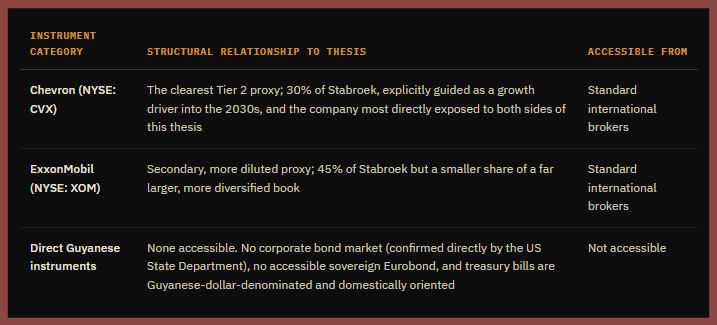
The information in this table is general in nature and has been prepared without taking into account your personal objectives, financial situation, or needs. Before acting on this information, you should consider its appropriateness having regard to your own circumstances and seek independent financial advice. Nothing in this table constitutes a recommendation to acquire or dispose of any financial product.
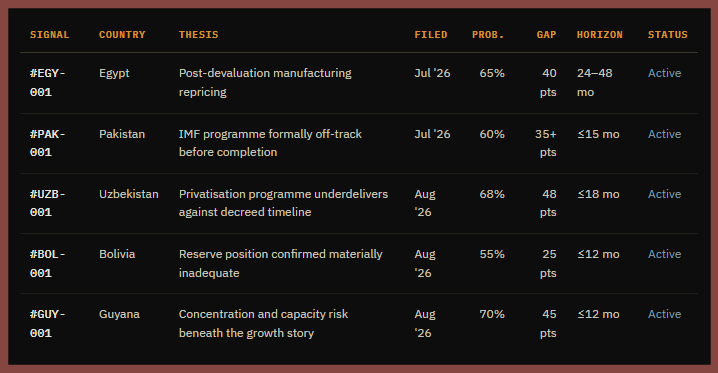
ACTIVE SIGNALS SCORECARD
KEY TERMS
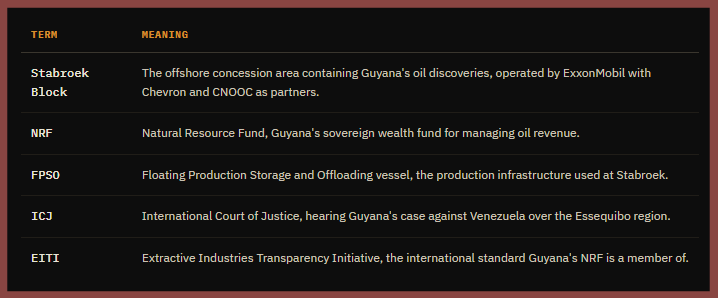
Institutions and mechanisms referenced in this issue, for quick reference.
NEXT ISSUE
Armenia, where a fresh peace agreement and collapsing Russian trade are being read as a clean pivot to the West. What that pivot actually costs is still being worked out. Publishing in two weeks.
A NOTE ON SUBSCRIPTIONS
Impossible Signal launches as a free publication. Starter and Pro subscription tiers with market specifics will be made available in near future.
Thanks for reading Impossible Signal! Subscribe for free to receive new posts and support my work.
This analysis draws on more than 100 primary and secondary sources reviewed across the research cycle, including the IMF's 2025 and 2026 Article IV consultations, the Inter-American Development Bank's Caribbean Economics Quarterly, the US Department of State's Investment Climate Statement, the US Congressional Research Service, ACLED, Crisis Group, the Global Centre for the Responsibility to Protect, the Guyana Business Journal, and multiple regional outlets including RioTimes, Kaieteur News, and Demerara Waves.
Research for this publication is conducted using a human-directed, AI-assisted analysis framework. All signal assessments, probability estimates, and editorial judgments are made by a human analyst. AI tools are used to assist with data gathering, pattern recognition, and drafting; not to replace analyst judgment.
Impossible Signal publishes general financial information and macro analysis with the aim of increasing transparency and demystifying world economics. Nothing in this publication constitutes personal financial advice or a recommendation to buy or sell any financial instrument. Probability estimates are analytical assessments based on publicly available data. Past signal performance does not guarantee future results. You should seek independent financial advice before making investment decisions.