

Armenia says it’s turning West. It’s also the route Russian Gold takes out to the world, and sanctioned western goods takes in to Russia. The market is pricing the first claim, not the second.
A note before the signal
This is not a story about whether Armenia's Western pivot is real. The election was real, decisive, and won against active foreign interference. It's a story about what a meaningful share of the growth cited as proof of that pivot actually was, and about a second, ongoing channel running in the opposite direction the pivot narrative doesn't account for.
WHAT CONSENSUS SAYS
Armenia’s recent economic and political trajectory reads as a genuine reorientation story. On June 7, 2026, Nikol Pashinyan’s Civil Contract party won parliamentary elections decisively, 49.8% of the vote, 64 seats, in a contest widely described as a direct referendum on his peace-with-Azerbaijan, pivot-from-Russia platform. S&P and Moody’s have both revised Armenia’s outlook to positive, at BB- and Ba3 respectively, citing structural growth and controlled fiscal deficits. Armenia’s own Finance Minister has noted the country’s Eurobond spreads run tighter than regional peers including Georgia, Turkey, Romania, and Uzbekistan. GDP grew 7.2% in 2025. A peace agreement with Azerbaijan, mediated by Washington, was initialed at the White House in August 2025, formalising an end to decades of conflict.
The institutional read has been consistently positive. The IMF has not flagged Armenia’s growth figures as a concern. Multilateral development banks cite the country’s tech sector and structural reforms. The consensus, implicit in credit ratings, bond pricing, and multilateral commentary alike, is that Armenia is doing something difficult and doing it well: reorienting a small, historically Russia-dependent economy toward the West, under real pressure, and succeeding.
WHAT THE SIGNAL SHOWS
The boom that already ended.
Armenia’s official exports rose from $3.0 billion in 2021 to $13.1 billion in 2024, a 4.4x increase in three years, a figure cited widely as evidence of genuine economic transformation. A detailed statistical analysis of Armenia’s own customs data, cross-verified against UN Comtrade, attributes almost all of that growth to a single mechanism: Russian gold, embargoed from Western markets since June 2022, imported into Armenia, relabelled, refined, and resold to buyers in the UAE and Hong Kong at market rates. Armenia charges no export duty on the trade, and structuring it through private individuals rather than corporations obscured the gold’s origin. At the peak, in early 2024, Armenia was importing over $1.3 billion and exporting $1.5 billion in precious metals every single month. Only 10 to 15% of that value stayed in Armenia as intermediary fees.
In April 2024, Russia changed its own domestic rules governing the trade. The corridor closed. Armenia’s exports fell to $8.4 billion in 2025. The growth still cited today as evidence of Armenia’s economic reorientation was, to a substantial degree, a temporary arbitrage window that had already ended before most of the coverage citing it was written.
The channel that didn’t close.
A second, separate mechanism runs the opposite direction and appears to still be active: European, American, and other Western-origin goods, cars, mobile phones, household appliances, electronics, moving into Russia through Armenia, exploiting Armenia’s EAEU membership to bypass Russia’s own external tariff and the sanctions regime directly. Armenia does not manufacture these goods. Reporting since 2022 has named specific companies and banks involved in both directions of this trade, Araratbank and Converse Bank among the financial institutions that handled Russian gold flows before growing more cautious by 2024; a factory linked to the Sukiasyan and Avagyan families was found relabelling Russian-origin jewellery as Armenian-made, sourcing from roughly thirty Russian companies. Germany’s Deutsche Welle separately documented a parallel scheme in diamonds, run through the state-linked company Hay-Almast before EU sanctions closed that specific channel in 2024.
A pivot that just won a real election, and a Russia that didn’t accept that quietly.
None of this means Armenia’s Western pivot is theatre. Pashinyan’s election win was real and came against active opposition: Reuters, citing Western intelligence officials, reported covert Russian efforts, including disinformation, to undermine his campaign and support pro-Russian candidates. A pro-Russian opposition figure made the empirical challenge explicit on the campaign trail: “He talked so much about peace that he started an economic war with Russia... We exported one truckload of goods to Europe, while a thousand are sent to Russia every day.” That’s a real, unresolved dispute inside Armenian politics, not something constructed from outside, and it points at exactly the gap this signal is about: the scale of genuine Western trade diversification, against the scale of trade that continues moving through Armenia toward Russia in one form or another.
The peace deal itself remains unsigned.
The August 2025 agreement was initialed, not signed as a binding treaty. Azerbaijan has stated repeatedly, including President Aliyev directly as recently as August 26, 2026, that it will not sign until Armenia completes a constitutional referendum removing territorial-claim language, a referendum tied to 2027. The corridor connecting Azerbaijan to its Nakhchivan exclave through southern Armenia, called Zangezur regionally and TRIPP in Washington’s own branding, remains unresolved alongside it.
Where the risk sits.
A reader can hold Armenia’s sovereign bonds and exit whenever the market allows it, and right now the market is charging almost nothing for the risk described above. Armenia cannot exit its own geography, its EAEU membership, or the economic relationships built during the arbitrage window now closed. The market is pricing a clean reorientation story. It has not yet had to price the two years of documented, named, specific reporting on the mechanism sitting underneath that story, reporting that has moved neither Armenia’s growth narrative nor its cost of capital.
THE NOISE BLOCKING THE SIGNAL
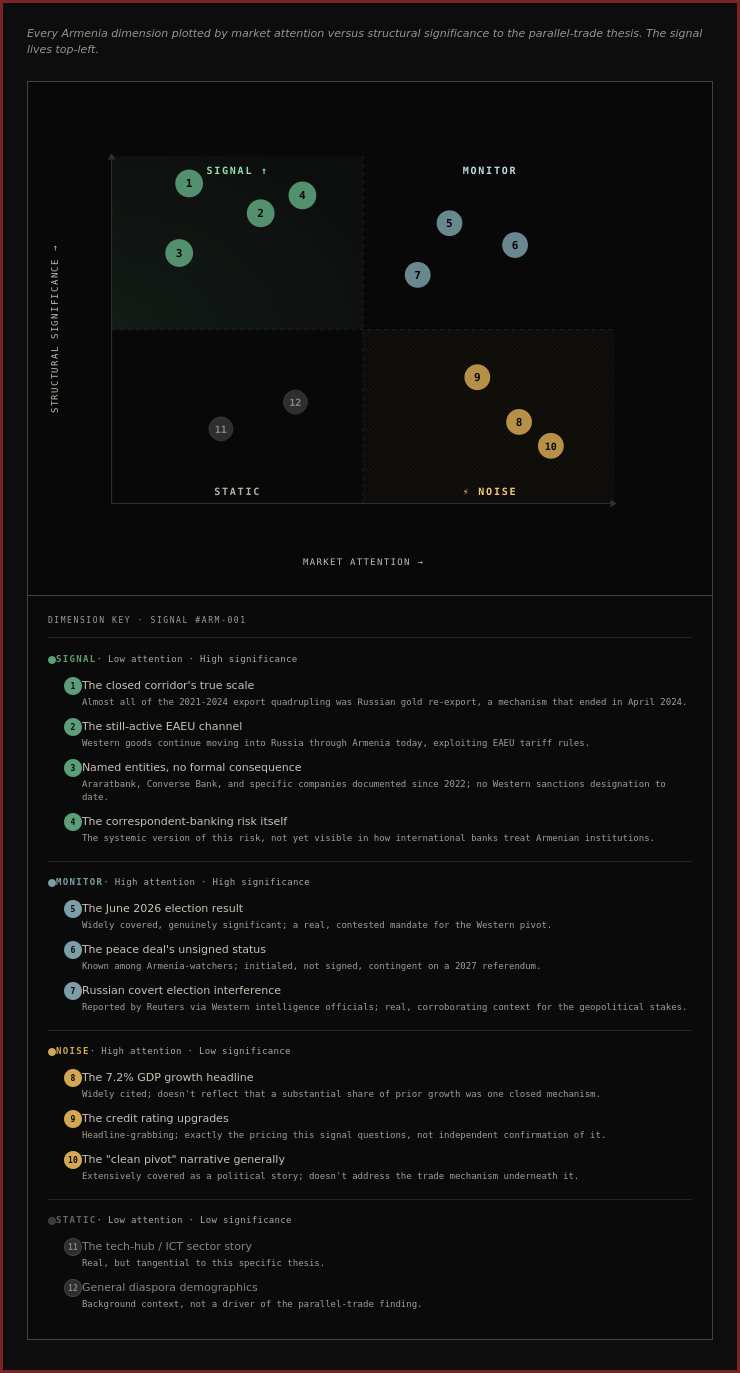
COUNTRY DIMENSION MAP
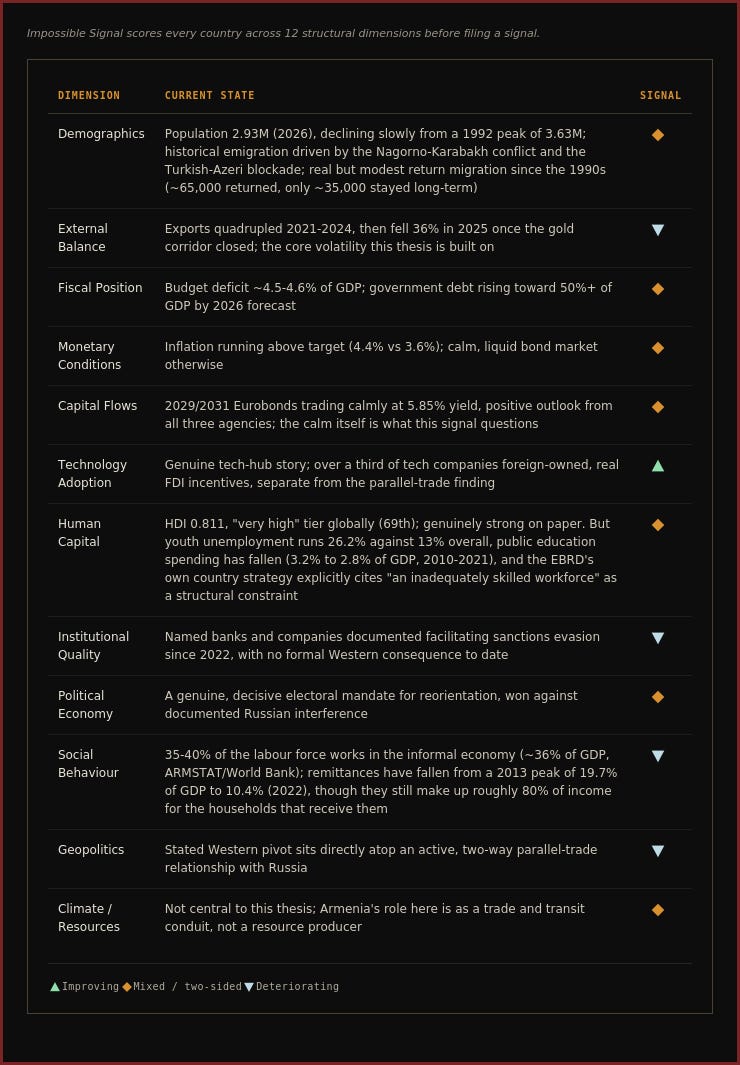
Primary dimensions driving the thesis: External Balance, Institutional Quality, Geopolitics.
The dimension the market is most significantly underweighting: Institutional Quality. Two years of named, specific reporting on sanctions-evasion facilitation has moved neither Armenia’s growth narrative nor its cost of capital.
CORE CONTRADICTION
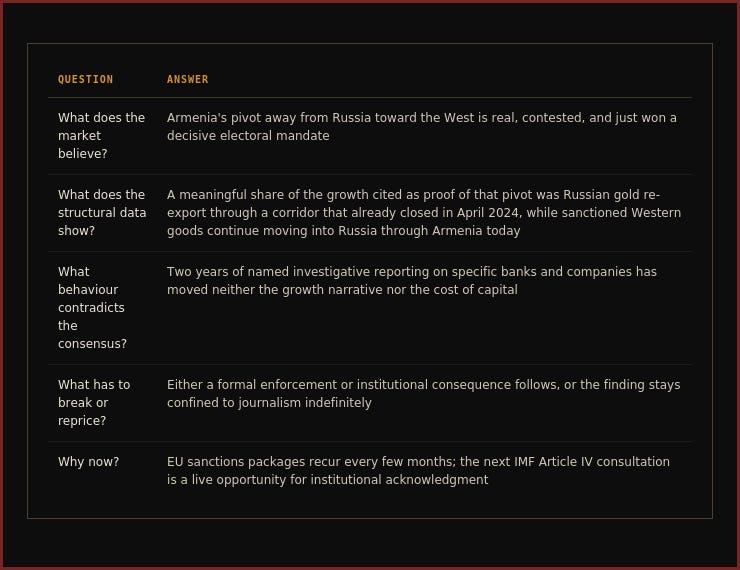
SIGNAL SCORING MODEL
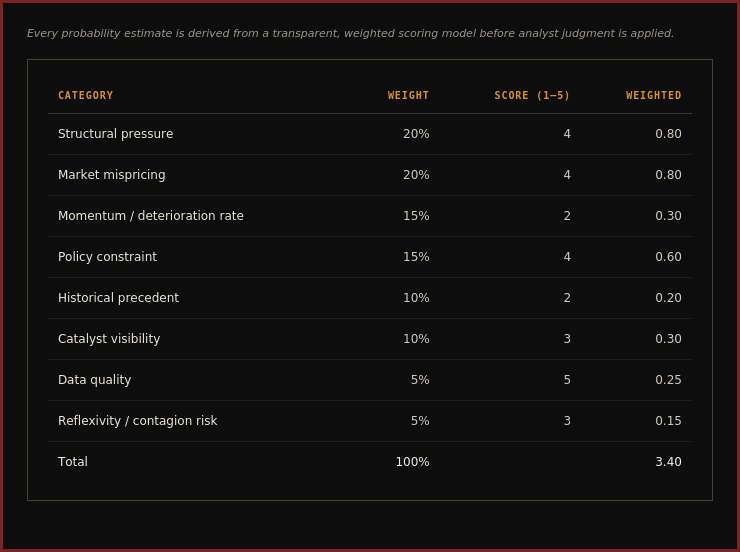
A weighted score of 3.40 maps to a model-implied probability band of 45 to 65%. Filed probability, market-implied benchmark, and the resulting gap are stated in full in The Signal, below.
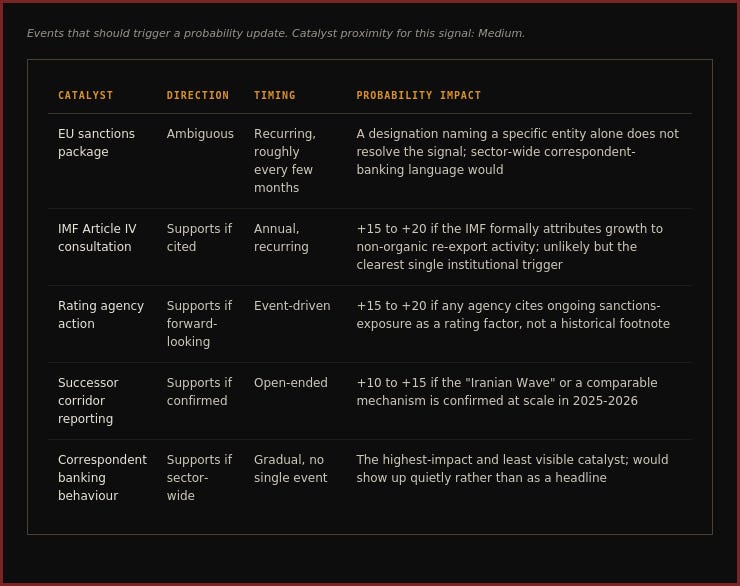
CATALYST MAP
THE IMPOSSIBLE SCENARIO
“The prevailing wisdom is that markets are always right, I take the opposite position. I assume that markets are always wrong”
George Soros, Soros on Soros: Staying Ahead of the Curve
Invert the question. What would have to be true for the market’s current pricing to be correct, for Armenia’s growth and reorientation story to be exactly what it appears?
The 2022-2024 export boom would need to represent genuine, durable economic diversification rather than a specific, now-closed arbitrage window. Two years of named investigative reporting on specific banks and companies would need to have found nothing that Western regulators consider actionable. And whatever comes next, the “Iranian Wave” our own sourcing flagged but did not independently verify, or something else entirely, would need to not resemble the pattern that just closed.
None of these conditions are impossible. The market’s current pricing assumes all of them.
Scenario A: A single entity is sanctioned or penalised, isolated, not systemic — not scored as resolving. The likely near-term outcome given the pattern already established, but per this signal’s own resolution trigger, an isolated designation alone does not confirm or deny the thesis.
Scenario B: Correspondent banking relationships with Armenian banks are visibly restricted sector-wide — 18%. International banks begin treating Armenian banking as a systemic compliance risk rather than an isolated one.
Scenario C: A major rating agency cites ongoing sanctions-exposure as a forward-looking rating factor — 15%. Not a historical footnote on 2022-2024, but a live factor in Armenia’s current and future rating trajectory.
Scenario D: Credible reporting establishes sector-wide, not isolated, banking involvement — 12%. A finding that a meaningful share of the banking system itself was structurally involved, not just a handful of named companies.
Scenario E: None of the above; the finding stays confined to journalism — 55%. The market’s current position, in effect. The signal resolves incorrect.
Scenarios B, C, and D resolve the signal correct: a combined 45%, matching the filed probability. Scenario E resolves it incorrect at 55%.
THE SIGNAL
We assess 45% probability that Armenia’s role as a parallel-trade conduit produces a systemic, capital-relevant consequence within the signal window: Western financial institutions visibly restricting correspondent banking relationships with Armenian banks as a sector, a major rating agency explicitly citing ongoing sanctions-exposure as a forward-looking factor in Armenia’s sovereign rating, or credible reporting establishing sector-wide rather than isolated banking involvement.
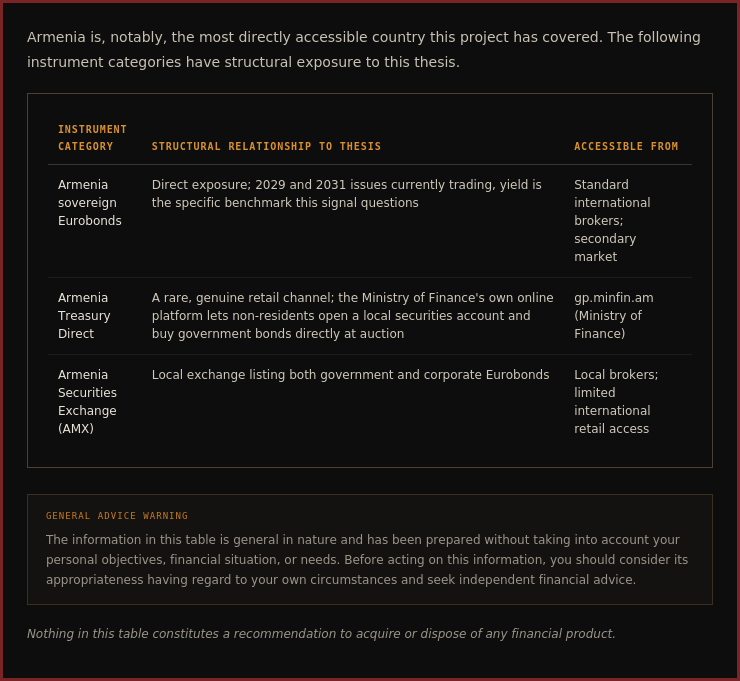
Probability gap: approximately 33 percentage points. Armenia’s Eurobonds trade at a calm 5.85% yield with a positive rating trajectory across all three major agencies, pricing consistent with the market not weighing this risk at all, even at the easier, single-entity threshold, let alone the systemic one. That gap is itself the finding: two years of named, specific investigative reporting (Hetq, The Insider, bne IntelliNews, Deutsche Welle) on banks including Araratbank and Converse Bank has moved neither the growth narrative nor the cost of capital. Resolving to a market-implied estimate of roughly 12%, reflecting how rare a fully sector-wide consequence is historically, not just how thin the coverage has been.
Market benchmarks at filing: Armenia 2031 Eurobond yield 5.85% · S&P BB- (positive) · Moody’s Ba3 (positive) · Official exports: $13.1B (2024) → $8.4B (2025) · Gold/diamond corridor closed April 2024 per Russia’s own rule change
Resolution trigger: Western financial institutions visibly restrict correspondent banking relationships with Armenian banks as a sector, not a named entity; or a major rating agency explicitly cites ongoing sanctions-exposure risk as a forward-looking factor in Armenia’s sovereign rating; or credible reporting establishes systemic, sector-wide banking involvement rather than isolated companies.
Kill condition: None of the above occurs within the window. A single bank or company may still be individually sanctioned or penalised, that outcome alone does not satisfy resolution, leaving the finding confined to isolated enforcement and investigative journalism without a systemic, capital-relevant consequence.
Catalyst proximity: Medium. No single scheduled event. Recurring opportunities instead: EU sanctions packages roughly every few months, Armenia’s annual IMF Article IV consultation, and open-ended reporting on correspondent-banking behaviour toward Armenia specifically.
THE INSTRUMENT
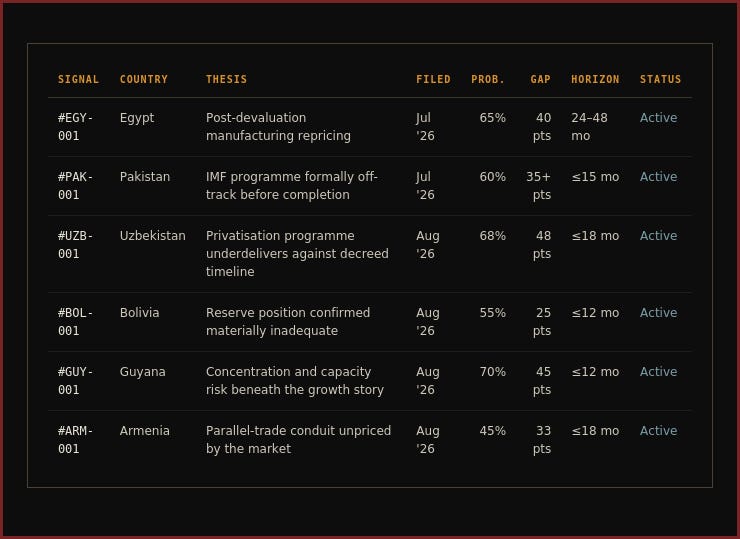
ACTIVE SIGNALS SCORECARD
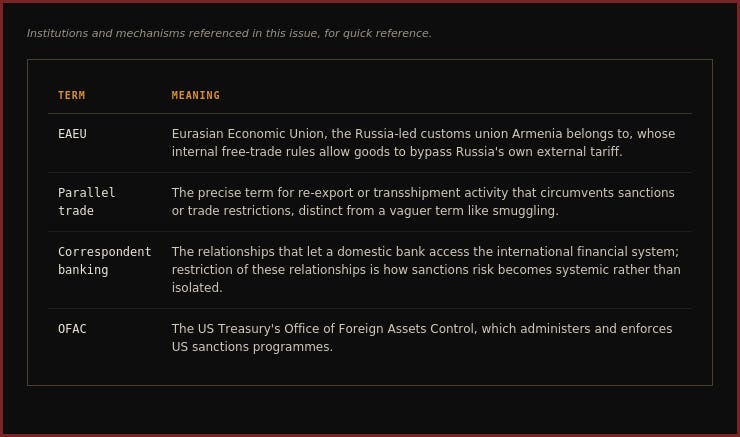
KEY TERMS
NEXT ISSUE
The search widens to Africa, where a sharp unresolved thread on our active investigative pipeline is awaiting economic and financial verification. Publishing in two weeks.
A NOTE ON SUBSCRIPTIONS
Impossible Signal launches as a free publication. Starter and Pro subscription tiers with market specifics will be made available in near future.
Thanks for reading Impossible Signal! Subscribe for free to receive new posts and support my work.
This analysis draws on more than 100 primary and secondary sources reviewed across the research cycle, including Hetq, The Insider, bne IntelliNews, Deutsche Welle, Caucasus Watch, a detailed statistical analysis cross-verified against Armstat and UN Comtrade data, Reuters reporting on election interference, IMF’s Guidance, S&P Global Ratings, Moody's Investors Service, and the Armenian Ministry of Finance.
Research for this publication is conducted using a human-directed, AI-assisted analysis framework. All signal assessments, probability estimates, and editorial judgments are made by a human analyst. AI tools are used to assist with data gathering, pattern recognition, and drafting; not to replace analyst judgment.
Impossible Signal publishes general financial information and macro analysis with the aim of increasing transparency and demystifying world economics. Nothing in this publication constitutes personal financial advice or a recommendation to buy or sell any financial instrument. Probability estimates are analytical assessments based on publicly available data. Past signal performance does not guarantee future results. You should seek independent financial advice before making investment decisions.