

Zambia’s Eurobonds now trade like any other sub-Saharan success story. The IMF’s own debt sustainability analysis, published the same month, still calls the underlying debt high risk. The market picked a side. The Fund didn’t.
A note before the signal
This is not a story about whether Zambia's post-default recovery is real. It is real: six completed IMF reviews, a G20 Common Framework restructuring that mostly closed, a copper investment cycle with actual capital behind it. It's a story about the gap between "mostly closed" and "closed," and about who is left holding that gap once the market stops pricing it.
WHAT CONSENSUS SAYS
Zambia is the G20 Common Framework’s proof-of-concept success story. It defaulted on its Eurobonds in November 2020, the first African country to do so during the pandemic, and became the first case referred to the Common Framework, the mechanism the G20 built specifically because prior sovereign-debt architecture had no clean process for coordinating China alongside Paris Club creditors and private bondholders. It took nearly four years of contentious negotiation, but by 2024 Zambia had restructured Eurobonds, reached terms with official bilateral creditors, and in August 2022 secured a 38-month, $1.7 billion IMF Extended Credit Facility. That programme completed its sixth and final review on January 27, 2026, disbursing the last tranche in full.
The market has re-rated accordingly. Zambian Eurobond spreads are, in the IMF’s own words from that same Sixth Review report, “now on par with other SSA issuers.” S&P Global and Fitch have both upgraded Zambia’s rating, citing improved investor confidence. Gross international reserves rose $1.0 billion in the second half of 2025 to $5.3 billion, covering 4.2 months of imports. GDP grew 5.2% in 2025. Zambia’s 10-year local-currency bond now yields 15.79%, down from an all-time high of 38% in December 2020 and its lowest level since December 2012. Copper, the country’s core export, is drawing real capital: over $2.2 billion in named investment commitments since December 2024, including KoBold Metals’ $2.3 billion Mingomba project and a $553 million US DFC-backed stake in the Lobito Atlantic Railway, aimed at tripling national copper output to 3 million tonnes a year by 2031. In August 2026, President Hakainde Hichilema, the man who negotiated the restructuring, won re-election by a landslide, 2,965,326 votes to 1,856,217. Continuity read as a feature, not a risk.
What the same report actually says about the debt.
The IMF’s Sixth Review Staff Country Report, the same document containing the “on par with SSA issuers” language the market is pricing, also states plainly that Zambia’s public debt is “assessed as sustainable but remains at high risk of overall and external debt distress.” Reclassification to “moderate risk” is explicitly conditional, not scheduled: it depends on Zambia sustaining fiscal consolidation over the medium term. That is a different claim than “the crisis is over.” It is closer to “the crisis is on probation.”
A quarter of the restructuring itself is also still open. Of roughly $13.4 billion in total debt subject to restructuring, agreements cover $10.1 billion, 75%, split between $6.3 billion in official bilateral terms and $3.8 billion in restructured Eurobonds. The remaining $3.3 billion, about 25% of Zambia’s commercial-creditor exposure, was still unresolved as of early 2026. Separately, roughly 94% of Zambia’s narrower pool of formally eligible external debt has been restructured, a figure often cited interchangeably with the 75% number even though the two describe different denominators. Zambia has held a B+ “highly speculative” rating since 2011 and has never once exceeded that tier, including through this entire re-rating.
No programme behind the consolidation it now has to sustain.
Zambia’s ECF concluded on schedule with its sixth and final review in January 2026. No successor IMF arrangement has been announced. The fiscal consolidation the debt reclassification depends on now rests on domestic political commitment alone, unbacked by programme conditionality or the disbursement leverage that came with it, at precisely the moment that commitment is being tested by a newly re-elected government facing pressure, per its own post-election commentary, to expand economic benefits beyond mining and address living costs.
A landslide, contested in its conduct.
Hichilema’s margin was not close. But the process around it was not clean. The opposition alliance raised concerns about vote-tabulation conduct and what it called an uneven political environment restricting opposition activity. Zambia’s Electoral Commission briefly suspended result announcements over security concerns, including attacks on election officials and theft of marked ballot papers. The EU Election Observation Mission separately noted campaign-related violence and political intimidation, even while confirming that opposition candidates were able to hold rallies. None of this changes the numerical outcome. It does mean the government now carrying sole responsibility for the IMF’s fiscal-consolidation condition took office through a process international observers flagged, not one that closes debate about its durability.
Where the risk sits.
A reader can exit a Zambian Eurobond position whenever secondary-market liquidity allows it. Zambia cannot exit a debt-sustainability classification the IMF itself still calls high-risk, a quarter of its commercial restructuring still unresolved, or a fiscal-consolidation obligation it must now meet without a programme enforcing it. The market has priced the restructuring as the story’s ending. The IMF’s own document treats it as an unfinished condition.
THE NOISE BLOCKING THE SIGNAL
Zambia’s strategic dimensions plotted by market attention versus structural significance to the default thesis. The signal lives top-left.
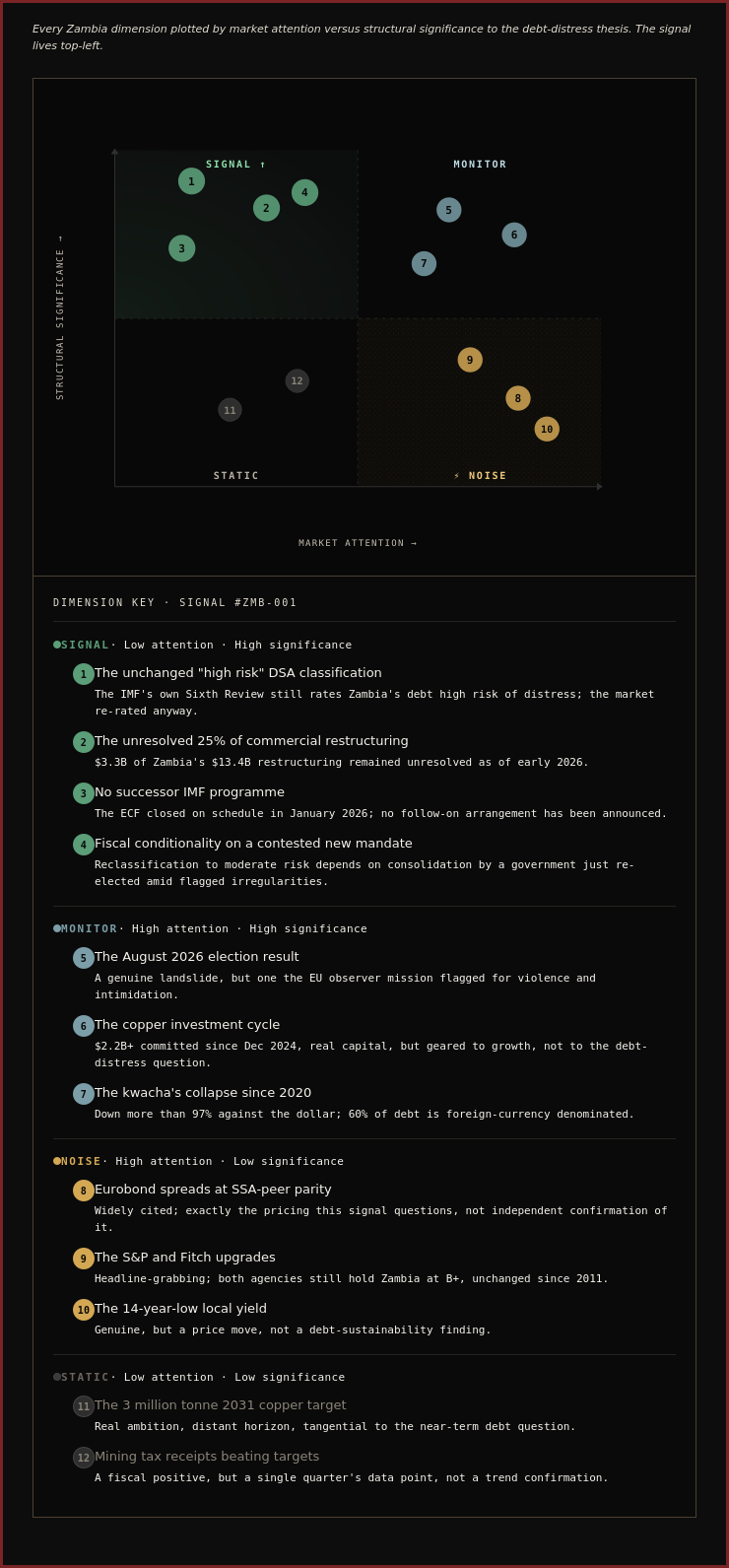
COUNTRY DIMENSION MAP
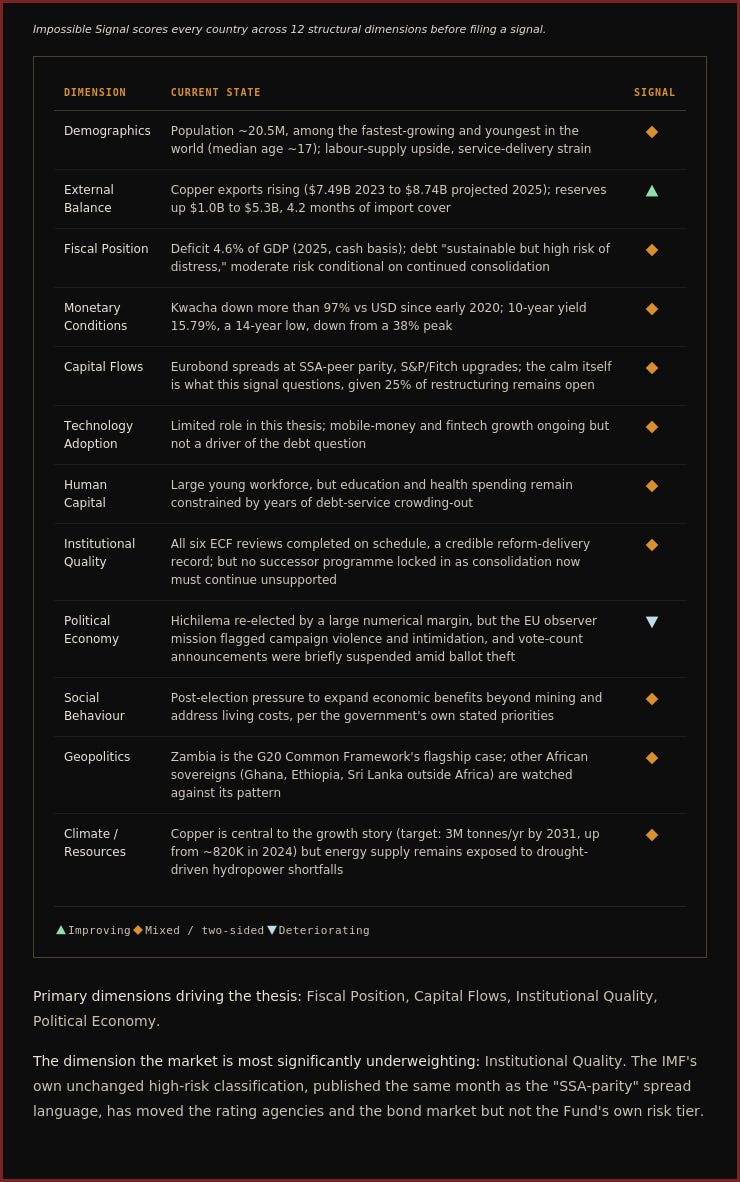
CORE CONTRADICTION
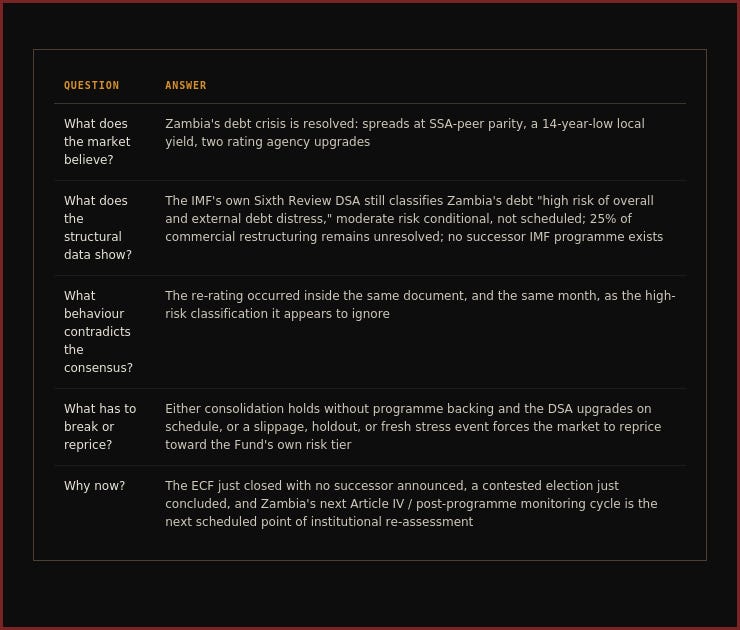
SIGNAL SCORING MODEL
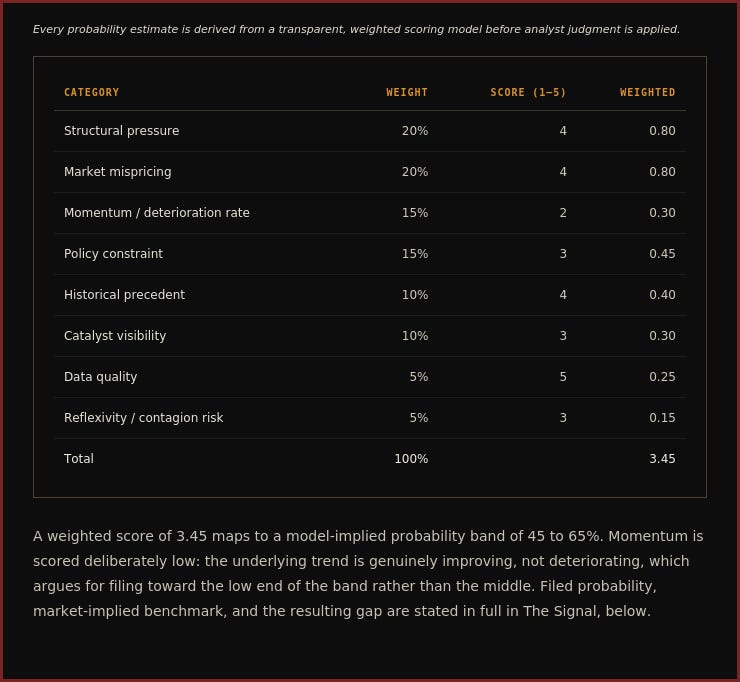
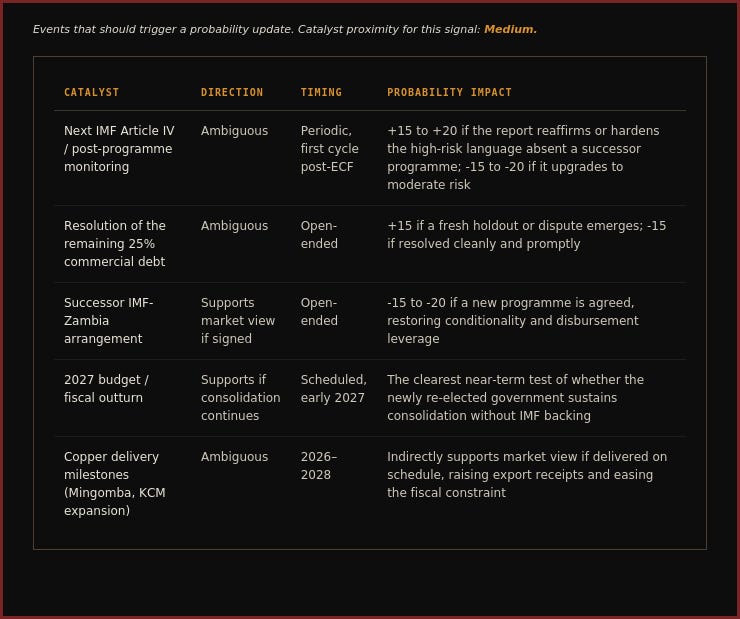
CATALYST MAP
THE IMPOSSIBLE SCENARIO
“The essential fixation on the part of policymakers, government officials, and even academic economists that financial crises are things that happen to other people in other countries.”
Carmen Reinhart and Kenneth Rogoff, This Time Is Different: Eight Centuries of Financial Folly
Invert the question. What would have to be true for the market’s current pricing to be correct, for Zambia’s restructuring to be exactly the closed, resolved case the spread compression implies?
Fiscal consolidation would need to hold through at least one more electoral cycle, without IMF programme conditionality behind it, under a government now facing domestic pressure to spend more, not less. The remaining 25% of commercial-creditor restructuring would need to resolve without a fresh holdout. And the IMF’s own Debt Sustainability Analysis would need to move from “high risk” to “moderate” on schedule, not because the market willed it there first.
None of these conditions are impossible. The market’s current pricing assumes all of them, ahead of the Fund’s own analysis confirming any of them.
Scenario A: Consolidation holds, the remaining 25% resolves cleanly, DSA upgrades to moderate on schedule — 38%. The market’s current position validated in full. The signal resolves incorrect.
Scenario B: Mild fiscal slippage emerges post-election but stays below any formal distress threshold within the window — not scored as resolving. The likely muddle-through outcome; per this signal’s own resolution trigger, ambiguous slippage alone does not confirm or deny the thesis.
Scenario C: The IMF reaffirms or hardens the high-risk classification at the next review without a successor programme in place — 22%. The Fund’s own analysis explicitly declines to follow the market’s re-rating.
Scenario D: A fresh holdout or dispute reopens on the unresolved 25% of commercial debt — 15%. The restructuring proves less closed than the spread compression implies.
Scenario E: A new fiscal or external-balance stress event forces renewed external financing need — 11%. A copper-price shock, an energy crisis, or election-related spending overshoot reopens the financing gap the restructuring was meant to close.
Scenarios C, D, and E resolve the signal correct: a combined 48%, matching the filed probability. Scenarios A and B resolve it incorrect at a combined 52%.
THE SIGNAL
We assess 48% probability that Zambia’s post-restructuring credit story fails to fully validate current market pricing within the signal window: either the IMF’s own Debt Sustainability Analysis reaffirms or hardens its “high risk of debt distress” classification at the next Article IV / post-programme review without a successor financing arrangement in place, the remaining 25% of unresolved commercial-creditor restructuring produces a fresh holdout or dispute, or a new fiscal or external-balance stress event forces Zambia back toward renewed external financing need.
Probability gap: approximately 33 percentage points. Zambian Eurobond spreads trade at SSA-peer parity, the 10-year local yield sits at a 14-year low, and both S&P and Fitch have upgraded the rating, pricing consistent with the market treating the restructuring as a closed, resolved case. That gap is itself the finding: the IMF’s own Sixth Review, published the same month, still classifies the debt high risk, not moderate, conditional on consolidation the country now must sustain without programme backing. Resolving to a market-implied estimate of roughly 15%, a ratings-cohort-style estimate given no clean sovereign CDS quote was available, reflecting how a B+ “highly speculative” issuer with an unresolved restructuring tail is typically priced once spreads compress this far.
Market benchmarks at filing: Zambia 10Y local yield 15.79% (24 Sep 2026, lowest since Dec 2012) · Eurobond spreads at SSA-peer parity per IMF · S&P and Fitch upgraded, rating unchanged at B+ “highly speculative” since 2011 · Reserves $5.3B, 4.2 months import cover · Fiscal deficit 4.6% of GDP (2025)
Resolution trigger: The IMF reaffirms or hardens its high-risk debt-distress classification at the next Article IV or post-programme review without a successor arrangement signed; or a fresh holdout or dispute reopens on the unresolved 25% of commercial-creditor restructuring; or a new fiscal or external-balance stress event forces Zambia toward renewed external financing need.
Kill condition: None of the above occurs within the window; fiscal consolidation holds, the remaining restructuring resolves without incident, and the IMF’s DSA is upgraded to moderate risk on schedule.
Catalyst proximity: Medium. No single scheduled event resolves this alone. Recurring and near-term markers instead: Zambia’s first post-ECF Article IV cycle, ongoing negotiation on the unresolved 25% of restructuring, and the 2027 budget cycle as the first real fiscal test facing the newly re-elected government.
THE INSTRUMENT
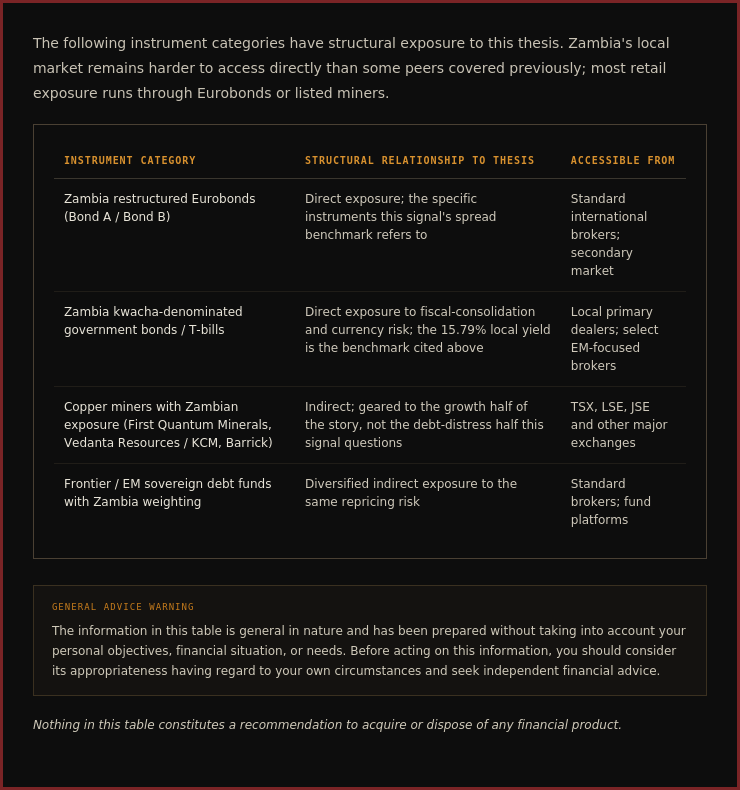
The following instrument categories have structural exposure to this thesis. Zambia's local market remains harder to access directly than some peers covered previously; most retail exposure runs through Eurobonds or listed miners.
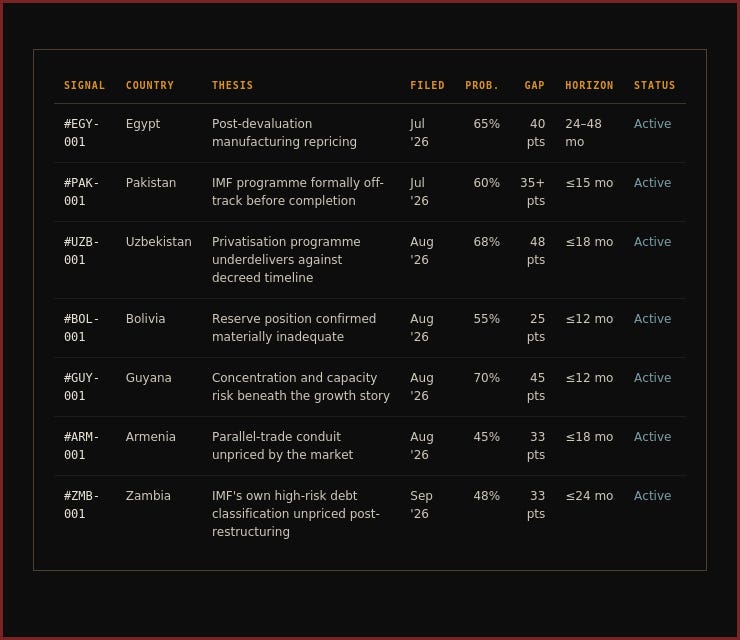
ACTIVE SIGNALS SCORECARD
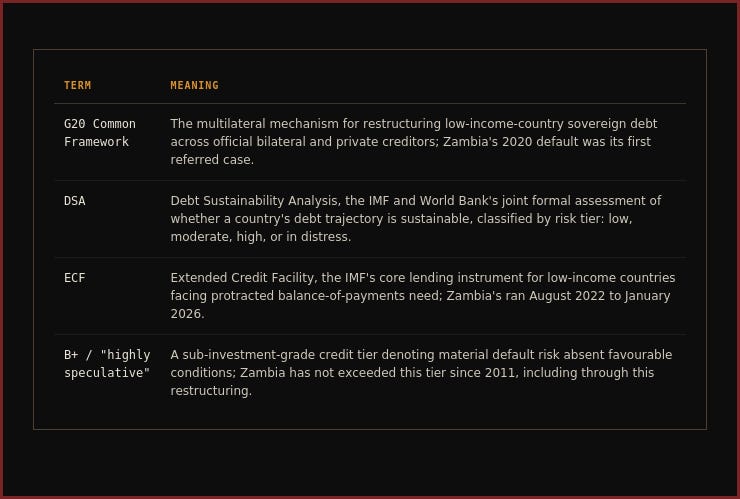
KEY TERMS
Institutions and mechanisms referenced in this issue, for quick reference.
NEXT ISSUE
Peru. Nine presidential transitions in a decade, and the market has just re-priced political risk as solved: Moody's reaffirmed Peru at Baa1, stable outlook, within weeks of a new president taking office, explicitly citing reduced odds of further authority changes. What that rating didn't name is a channel the IMF's own numbers put at several points of GDP: illegal mining now entangled enough with Congress that a majority of Peruvians believe their legislature is captured by it, sitting directly beneath a $12 billion formal mining pipeline the "stability" story depends on. Publishing in two weeks.
A NOTE ON SUBSCRIPTIONS
Impossible Signal launches as a free publication. Starter and Pro subscription tiers with market specifics will be made available in near future.
Thanks for reading Impossible Signal! Subscribe for free to receive new posts and support my work.
This analysis draws on more than 100 primary and secondary sources reviewed across the research cycle, including the IMF's Sixth and Final ECF Review Staff Country Report for Zambia (January 2026), IMF Press Release 26/024, S&P Global Ratings, Fitch Ratings, tradingeconomics.com bond-yield data, and reporting on Zambia's August 2026 general election including Al Jazeera and the EU Election Observation Mission's public statements. One claim regarding a Bond B coupon-step-up mechanism, sourced to a single non-primary outlet, could not be independently corroborated and is explicitly flagged rather than filed as fact.
Research for this publication is conducted using a human-directed, AI-assisted analysis framework. All signal assessments, probability estimates, and editorial judgments are made by a human analyst. AI tools are used to assist with data gathering, pattern recognition, and drafting; not to replace analyst judgment.
Impossible Signal publishes general financial information and macro analysis with the aim of increasing transparency and demystifying world economics. Nothing in this publication constitutes personal financial advice or a recommendation to buy or sell any financial instrument. Probability estimates are analytical assessments based on publicly available data. Past signal performance does not guarantee future results. You should seek independent financial advice before making investment decisions.