

Peru's sovereign spread prices a country that has solved its politics. Its illegal gold economy, nearly half of national gold exports and entangled with a Congress most Peruvians believe it controls, prices one that has not. We assess a 40% probability that at least one of the three major rating agencies cuts Peru's rating or outlook within two years.
WHAT CONSENSUS SAYS
Peru has had nine presidents in ten years and the economy has barely noticed. The central bank is independent and credible, public debt sits near 30% of GDP, reserves are among the largest in the region relative to output, and copper and gold carry the external accounts. A regular election in June 2026 ended a run of congressional removals and caretaker governments.
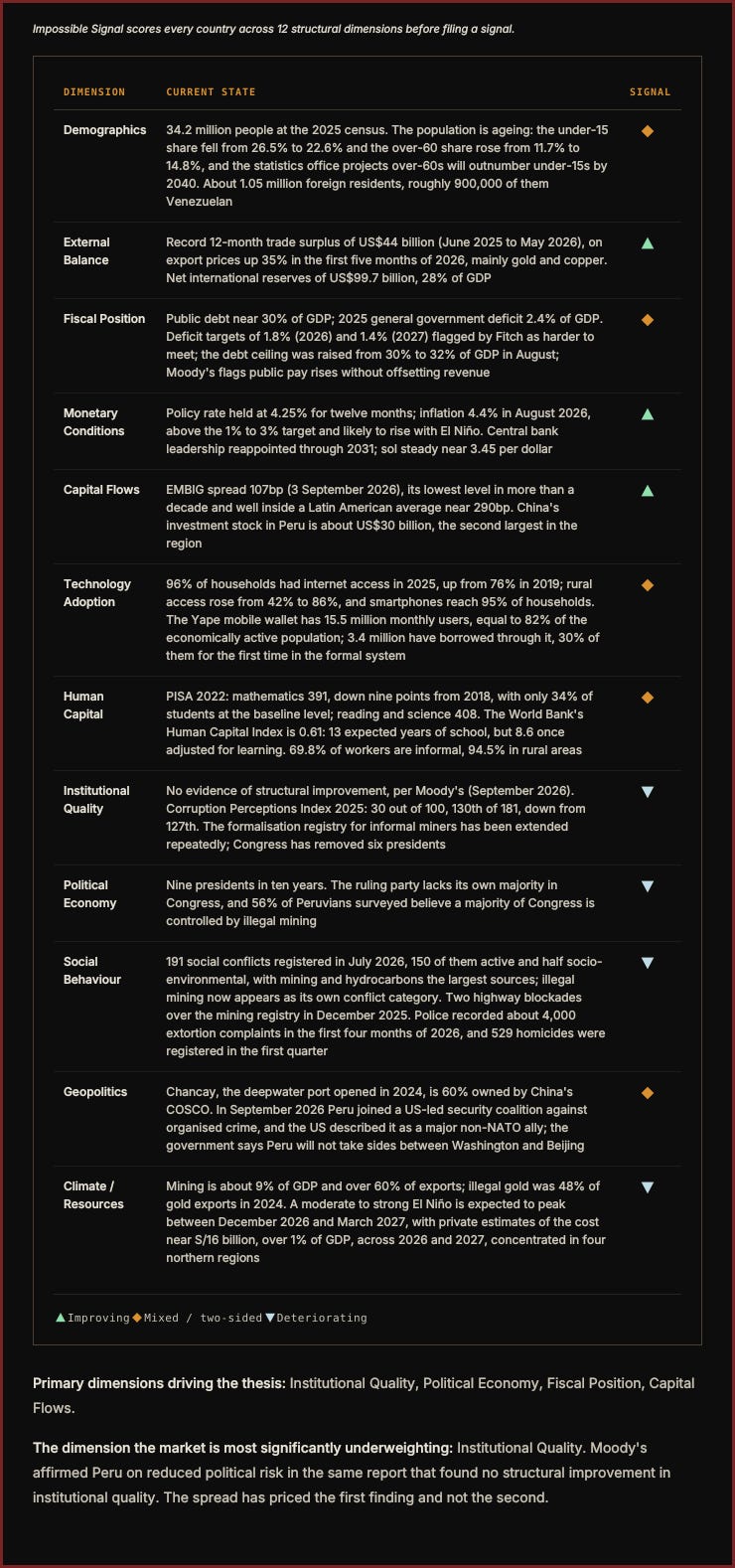
The market has drawn the obvious conclusion. Peru’s EMBIG spread fell to 108 basis points in June and 107 in early September, its lowest level in more than a decade and the second lowest in Latin America after Chile, against a regional average near 290 [Sources: BCRP; El Peruano, June 2026; Ministry of Economy and Finance via Andina, July 2026]. In September, Moody’s reaffirmed Peru at Baa1 with a stable outlook, citing the election as reducing the risk that frequent changes of authorities disrupt economic activity or fiscal decisions [Source: Moody’s, committee 17 September 2026].
The consensus is that Peru’s politics and Peru’s economy have decoupled. The question is what is holding them apart.
WHAT THE SIGNAL SHOWS
The market is pricing Peru above its own ratings.
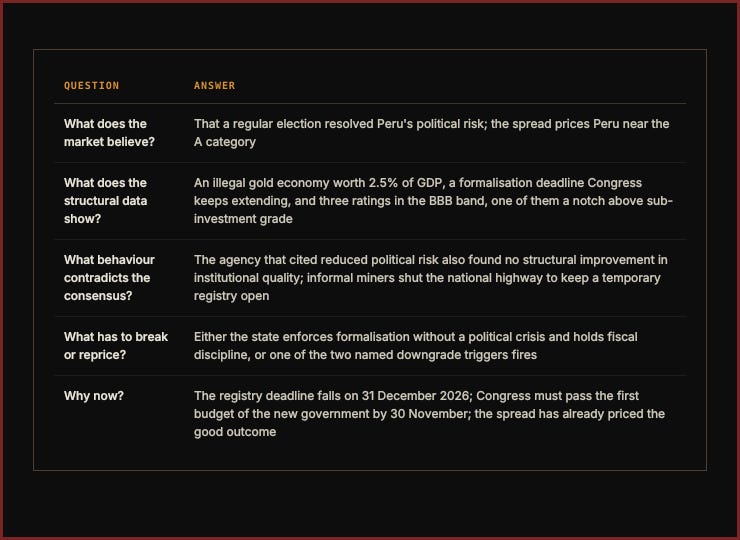
S&P rates Peru BBB-, one notch above sub-investment grade. Fitch rates it BBB. Moody’s rates it Baa1 [Sources: S&P, December 2025; Fitch, July 2026; Moody’s, September 2026]. A 108 basis point spread sits close to Chile, which is rated in the A category. The market is not pricing the ratings Peru holds. It is pricing the ratings it expects Peru to earn.
The illegal economy is not small.
The IMF’s June 2026 Selected Issues report estimates that illegal gold was 48% of Peru’s total gold exports in 2024, equivalent to 2.5% of GDP, and that illegal copper accounted for up to 5% of copper exports [Source: IMF Country Report No. 26/130]. A Datum survey cited by the IMF found that 56% of Peruvians believe a majority of Congress is controlled by illegal mining.
The formalisation deadline keeps moving.
Reinfo, the registry that lets informal miners operate while they formalise, was designed as temporary. Congress extended it again in December 2025, to 31 December 2026 or until a new small-scale mining law takes effect, in a session that lasted under thirty minutes [Source: Energiminas, 17 December 2025]. The extension arrived alongside two blockades of the Pan-American Highway in Arequipa in the same month.
In early December 2025 informal miners cut the highway at Atico and Chala for four days, stranding hundreds of vehicles and holding up ambulances, until police cleared it [Source: El Búho, 5 December 2025]. On 17 December they blocked it again at kilometre 618 in Chala while the extension went to its second vote, and lifted the blockade only once it passed [Sources: RPP and Panamericana TV, 17 December 2025].
The agencies see the problem and file it under growth.
Moody’s lists illegal mining among the obstacles to growth. Its stated downgrade triggers are “a new political crisis or a sustained deterioration of public accounts.” The same report states there is no evidence of a structural improvement in institutional quality, and warns that public sector pay rises without offsetting revenue reduce room for investment.
Fitch has warned that measures passed by the outgoing Congress could make the 2026 and 2027 deficit targets, 1.8% and 1.4% of GDP, harder to meet [Source: Fitch via El Peruano, July 2026]. In August the new fiscal consolidation path raised the ceiling on non-financial public debt from 30% to 32% of GDP, a wider deficit path built into the rules themselves [Sources: Infobae and Perú Retail, 13 August 2026].
The growth damage is modest. The institutional exposure is not.
The IMF’s central estimate of illegal mining’s direct drag on growth is small, 0.03 to 0.05 percentage points a year by 2030, rising to 0.25 points only if the entire formal mining pipeline stalled, which the IMF itself treats as unlikely [Source: IMF CR 26/130]. This is the point. If illegal mining reaches Peru’s rating, it will not be through the growth channel the agencies already monitor. It will be through the two triggers they have named: a political crisis over formalisation, or fiscal concessions a fragmented Congress cannot refuse.
Peru has done this before.
In the last period of political churn, Peru drew ten negative rating actions in four years: outlook cuts from Fitch (December 2020, October 2022), Moody’s (May 2021, January 2023) and S&P (October 2021, December 2022), and downgrades from Moody’s (September 2021, to Baa1), Fitch (October 2021, to BBB) and S&P (March 2022 to BBB, April 2024 to BBB-) [Source: Ministry of Economy and Finance, rating history, September 2024]. The spread today prices none of that history.
THE NOISE BLOCKING THE SIGNAL
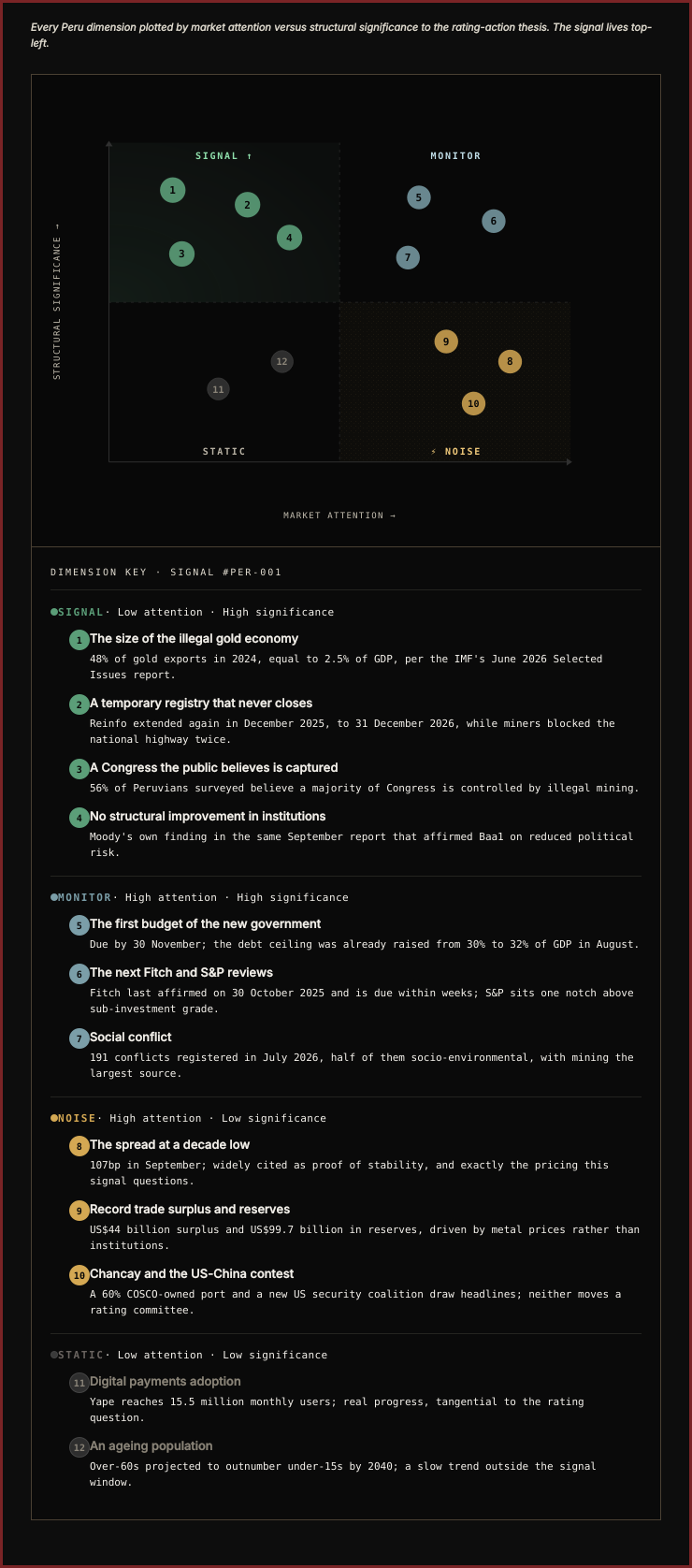
COUNTRY DIMENSION MAP
CORE CONTRADICTION
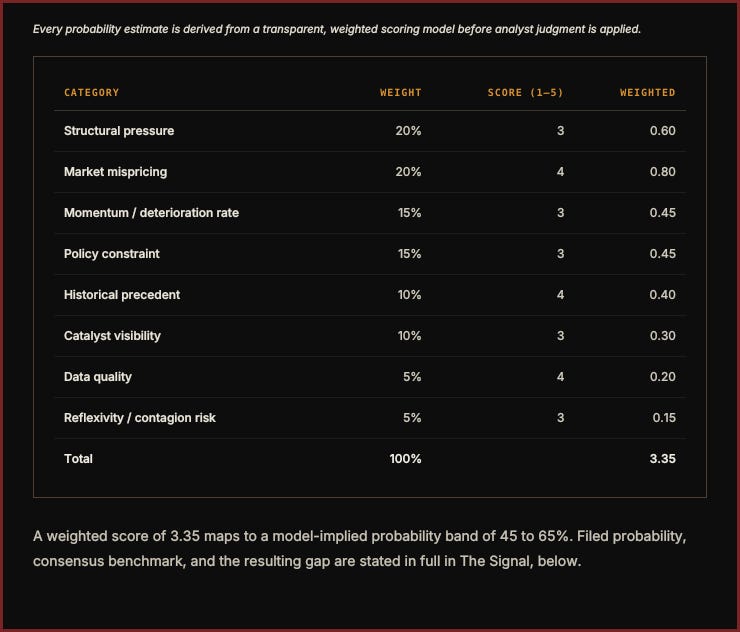
SIGNAL SCORING MODEL
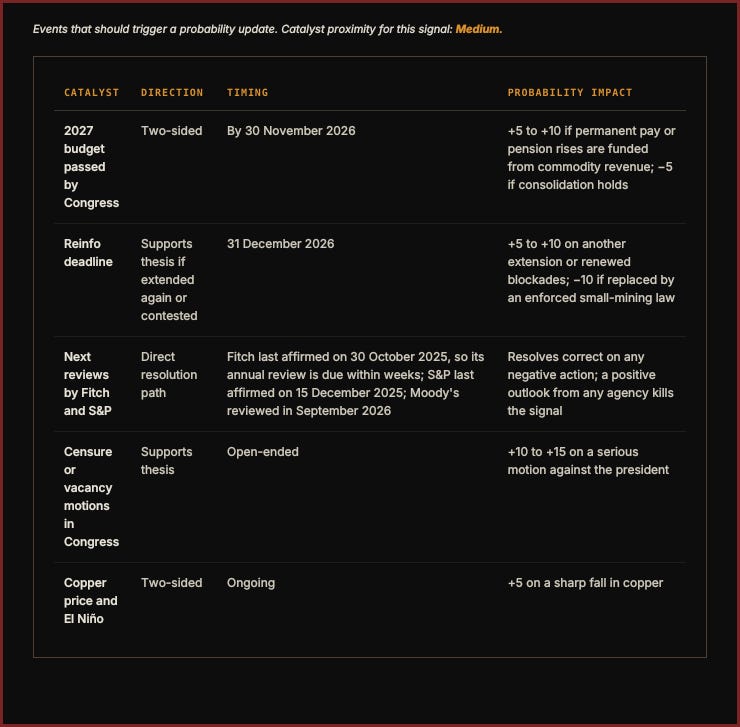
CATALYST MAP
THE IMPOSSIBLE SCENARIO
“Over periods of prolonged prosperity, the economy transits from financial relations that make for a stable system to financial relations that make for an unstable system.”
Hyman P. Minsky, The Financial Instability Hypothesis, Levy Economics Institute Working Paper No. 74, May 1992
Invert the question. What would have to be true for none of the three agencies to move against Peru for two years?
Congress would have to let the registry close, or replace it with a law the state can enforce, without the confrontation that has met every previous deadline. The new government would have to pass its first budget without funding permanent pay and pension increases from temporary metal revenue, which two agencies have already warned about. A legislature that has removed six presidents would have to stop using removal as a tool. And all of this would have to hold while the market is paying Peru as though it already has.
Each condition is possible. The thesis is that holding all of them at once, for two years, under a government without its own majority, is less likely than the spread implies. In 1532 the Inca emperor filled a room with gold to buy his freedom, and the payment did not buy what was promised. Peru’s illegal gold is paying for something too. The market assumes it is not paying for the institutions.
Scenario A: Fiscal slippage — 16%. Permanent pay or pension rises are funded from temporary commodity revenue, and an agency moves its outlook to negative.
Scenario B: The formalisation fight becomes a political crisis — 14%. Renewed blockades, a clash between the executive and Congress, or a vacancy attempt.
Scenario C: External or climate shock — 10%. A copper fall or El Niño pushes the deficit off its path, and a negative action follows.
Scenario D: The security agenda works — 20%. Formalisation is enforced through a new law without a crisis, and the agencies hold or improve.
Scenario E: Muddle-through — 40%. The registry is extended again, the noise continues, and no agency acts.
Scenarios A, B and C resolve the signal correct: a combined 40%, matching the filed probability. Scenarios D and E resolve it incorrect: a combined 60%.
THE SIGNAL
Signal #PER-001
We assess 40% probability that, within 24 months of filing, at least one of S&P, Moody’s, or Fitch downgrades Peru’s long-term foreign-currency rating or revises its outlook to negative.
Probability gap: 25 percentage points. The scoring model places this signal in the 45% to 65% band; we file five points below its floor. All three agencies affirmed stable within the last twelve months, Moody’s only in September, and agencies rarely reverse within months absent a shock, which suppresses the first year of the window. The IMF’s central estimate of the direct growth drag is also small, so the path to a downgrade runs through policy choices, not mechanics. No traded instrument prices a rating action, so the benchmark is an I.S. consensus. The market prices Peru close to the A category. On S&P’s own sovereign data for 1975 to 2020, A-rated sovereigns were downgraded a full category 5.3% of the time within one year and 15.5% within three years [Source: S&P Global Ratings, 2020 Annual Sovereign Default and Rating Transition Study]. Allowing for single-notch moves and outlook revisions across three agencies, which category data does not capture, we assess the consensus at about 15%. As a floor from the bond market itself, a 108 basis point spread at a 40% recovery assumption implies a default intensity of about 1.8% a year, or roughly 3.6% over two years.
Market benchmarks at filing: Moody’s Baa1 stable (September 2026) · S&P BBB- stable (December 2025) · Fitch BBB stable (October 2025) · EMBIG Peru spread 107bp (3 September 2026, latest BCRP print) · USD/PEN 3.453 (7 October 2026, SBS) · iShares MSCI Peru ETF (EPU) US$90.68 (9 October 2026 close)
Resolution trigger: Any downgrade of Peru’s long-term foreign-currency sovereign rating, or any revision of its outlook to negative, by S&P, Moody’s, or Fitch within 24 months of filing. The stated reason does not need to name illegal mining. Actions on Peruvian banks, companies, or regions do not count; a credit watch that resolves without an outlook change or downgrade does not count.
Kill condition: Any of the three agencies upgrades Peru or revises its outlook to positive within the window.
Catalyst proximity: Medium. The budget deadline (30 November) and the registry deadline (31 December) fall inside 90 days; the rating response, if it comes, is more likely in 2027.
THE INSTRUMENT
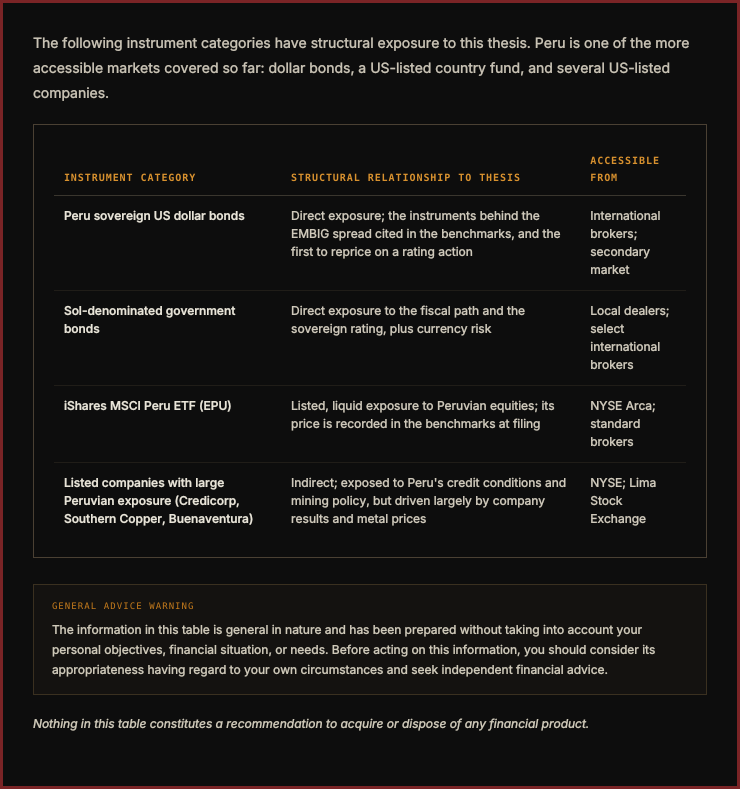
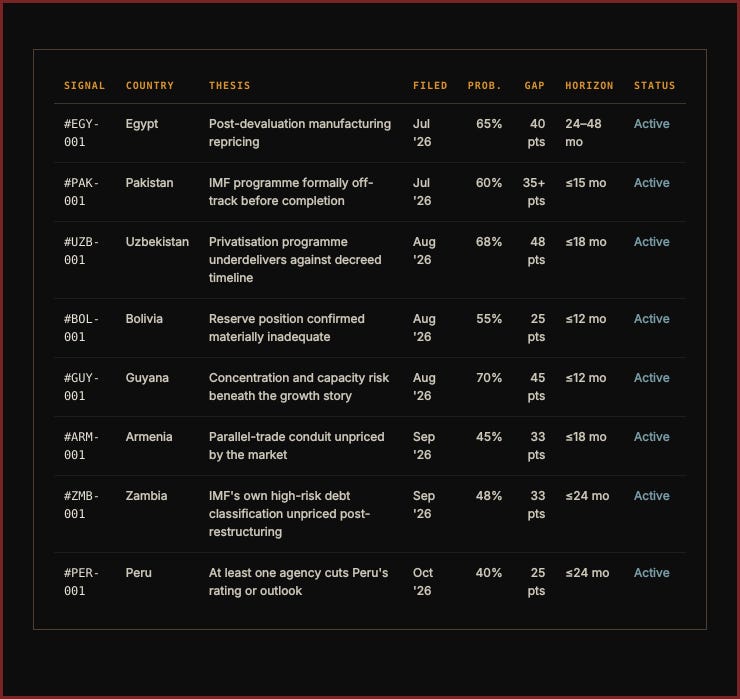
ACTIVE SIGNALS SCORECARD
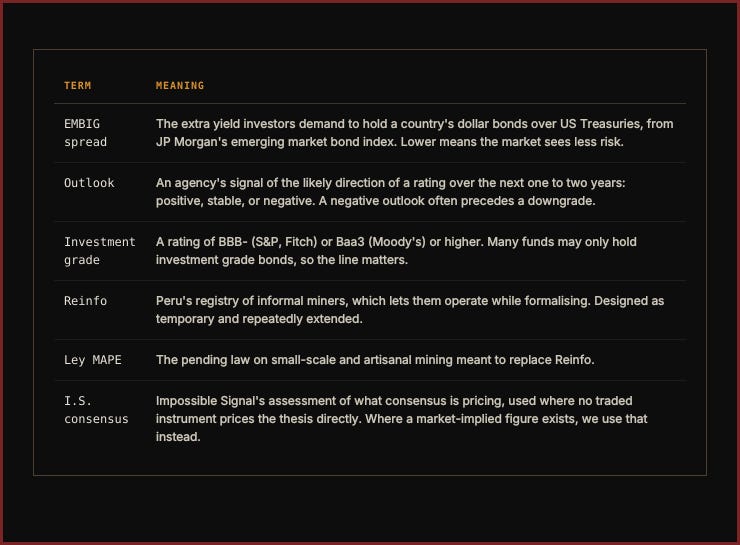
KEY TERMS
Institutions and mechanisms referenced in this issue, for quick reference.
NEXT ISSUE
Mongolia. On 8 October a rating agency affirmed the country on an expectation of budget surpluses in 2026 and 2027. The same day, the IMF said the same budgets propose a large fiscal expansion funded by one-off mining revenue. The bond market has sided with the agency: Mongolia's dollar bonds now trade at a narrower spread over Treasuries than any it has ever issued at. Mongolia has run this cycle once before. Publishing in two weeks.
A NOTE ON SUBSCRIPTIONS
Impossible Signal launches as a free publication. Starter and Pro subscription tiers with market specifics will be made available in near future.
Thanks for reading Impossible Signal! Subscribe for free to receive new posts and support my work.
This analysis draws on more than 100 primary and secondary sources reviewed across the research cycle, including the IMF’s June 2026 Selected Issues report for Peru (Country Report No. 26/130), Moody’s, S&P Global Ratings and Fitch Ratings, S&P’s 2020 Annual Sovereign Default and Rating Transition Study, the Central Reserve Bank of Peru (BCRP), Peru’s Ministry of Economy and Finance, INEI, Osiptel, the World Bank Human Capital Index, Transparency International, the Ombudsman’s social conflict reports, and Peruvian reporting including El Peruano, Andina, RPP, El Búho, Energiminas, Gestión, Infobae and Perú Retail.
Research for this publication is conducted using a human-directed, AI-assisted analysis framework. All signal assessments, probability estimates, and editorial judgments are made by a human analyst. AI tools are used to assist with data gathering, pattern recognition, and drafting; not to replace analyst judgment.
Impossible Signal publishes general financial information and macro analysis with the aim of increasing transparency and demystifying world economics. Nothing in this publication constitutes personal financial advice or a recommendation to buy or sell any financial instrument. Probability estimates are analytical assessments based on publicly available data. Past signal performance does not guarantee future results. You should seek independent financial advice before making investment decisions.