

Mongolia's exports are up by half and its economy is growing at nearly 8%. The rating agencies have rewarded it with the best ratings in more than a decade. The IMF says the same boom is being spent on permanent wages, pensions and tax cuts, and that the rules meant to stop that are being rewritten. A dzud is a winter disaster that is set in the summer. We assess a 45% probability that at least one agency cuts Mongolia's rating or outlook, or that Mongolia asks the IMF for money, within two years.
WHAT CONSENSUS SAYS
Mongolia is having its best year in a decade. Exports reached US$16.2 billion in the first nine months of 2026, up 51% on a year earlier, on record coal volumes and a 79% jump in copper concentrate as the Oyu Tolgoi underground mine ramps up [Sources: National Statistics Office via Trading Economics and Central Asia Wire, October 2026]. Growth was 7.7% in the first half [Source: IMF PR 26/329, 8 October 2026]. Gross reserves reached US$8.9 billion at end-September.
The rating agencies have followed. S&P upgraded Mongolia to BB- in October 2025, its highest rating in 13 years, and affirmed it with a stable outlook on 8 October 2026, saying it expects Mongolia “to maintain fiscal surpluses in 2026 and 2027” and that the fiscal stability framework should keep government debt near 25% of GDP. It sees room for an upgrade within twelve months [Source: S&P via Investing.com and Montsame, 8 October 2026]. Moody’s rates Mongolia B1 stable, unchanged since its upgrade in October 2025, and Fitch B+ stable, affirmed in August [Source: Fitch via Investing.com, 19 August 2026].
The bond market agrees. In March Mongolia sold US$500 million of 2032 bonds at 5.95% and used the proceeds to retire older, more expensive debt. In June the state development bank sold US$500 million at four and a half times cover [Sources: Cleary Gottlieb, March and July 2026; Mirae Asset, June 2026]. The consensus is that Mongolia has broken its boom and bust cycle.
WHAT THE SIGNAL SHOWS
Same Budget: a surplus, a small deficit and a large deficit.
For 2026, S&P expects a surplus. Fitch expects a deficit of 2.2% of GDP, widening to 3.3% in 2027 on pre-election spending and pension reform [Source: Fitch, 19 August 2026]. The IMF, on its own definition, projects a deficit of 6.6% of GDP in 2026, after 5.2% in 2025 [Source: IMF PR 26/274, 6 August 2026]. The figures use different definitions, and none is wrong on its own terms. The gap between them is the point.
The national measure counts transfers into the stability funds and leaves some state projects outside the rules. The IMF measure counts what the whole public sector spends. The ratings rest on the first. The debt will follow the second.
The IMF says the boom is being spent.
On 8 October the IMF said the 2026 supplementary and 2027 draft budgets “propose a large fiscal expansion”: tax cuts, higher social spending and higher public wages and pensions, funded largely by one-off dividends from state companies and Oyu Tolgoi. It warned that the expansion “is likely to lift the deficit and debt paths,” that draft legislation accompanying the budget “would further undermine the effectiveness of fiscal rules,” and that a revenue shortfall would require “sharp fiscal adjustment” [Source: IMF PR 26/329].
In August it projected revenue falling from 36.3% of GDP in 2025 to 28.8% in 2027, and government debt rising from 45.1% of GDP to 55.9% by 2028 and 63.7% by 2031 [Source: IMF PR 26/274].
Parliament is moving in the same direction.
The 2026 supplementary budget, passed on 16 October, adds MNT 971.5 billion of spending, most of it for public sector pay and agricultural and energy subsidies, and leaves a deficit of MNT 2 trillion [Source: ikon.mn, 16 October 2026]. The draft 2027 budget raises spending by 32% to MNT 43.6 trillion [Source: Capital Markets Mongolia, September 2026], which is 19.4% above the spending ceiling Parliament itself set in May [Source: Mongolia Weekly, 7 October 2026]. A basic pension starts on 1 November, lifting the average pension by about a quarter at a cost of MNT 1.2 trillion a year [Source: Asia News Network, October 2026].
Two amendments to the Fiscal Stability Law were before Parliament as of 23 October. The first, considered by committee on 6 October, concerns the deficit limit. The second would let dividend revenue raise the spending ceiling without being bound by the law’s fiscal rules [Sources: MNB, 6 October 2026; gogo.mn, 1 September 2026].
Inflation is already answering.
Consumer prices rose 12.9% in the year to September, against a target of 6%, with food up 20.8% [Sources: IMF PR 26/329; ikon.mn, 13 October 2026]. The central bank raised its policy rate to 12.5% at an extraordinary meeting in August and named government spending and wages as a risk. The IMF has asked for further tightening.
The bond market has started to notice, a little.
The 5.95% 2032 bond closed at 95.74 on 23 October, a yield of 6.92% [Source: finanzen.net, Stuttgart]. Against a five-year US Treasury yield of 4.95% [Source: US Treasury via Alpha Vantage, 21 October 2026], that is a spread of about 197 basis points, wider than the roughly 180 of early October but still inside the 222 basis points at which Mongolia priced what was then its tightest bond, in February 2025 [Source: IFRE].
One sign points the other way.
On 23 October the government withdrew its plan to spend an expected MNT 3 trillion Oyu Tolgoi dividend on power and heating projects, after a public poll in which most respondents chose to save it, and said the money would go to the Savings Fund instead [Source: ikon.mn, 23 October 2026]. A government that has just won its best ratings in 13 years has a reason to protect them. A presidential election in June 2027 gives it a reason not to.
Mongolia has run this cycle before.
After the commodity boom of 2011 and 2012, expansionary policy cushioned the downturn and then broke. Moody’s cut Mongolia to B3 and placed it on review for further downgrade in August 2016 [Source: bne IntelliNews]. Government debt reached nearly 90% of GDP by end-2016, and a US$5.5 billion IMF-led package followed in May 2017 [Source: IMF PR 17/193]. The IMF’s own account is that looser policy supported growth for a time, then raised debt and weakened the external position.
THE NOISE BLOCKING THE SIGNAL
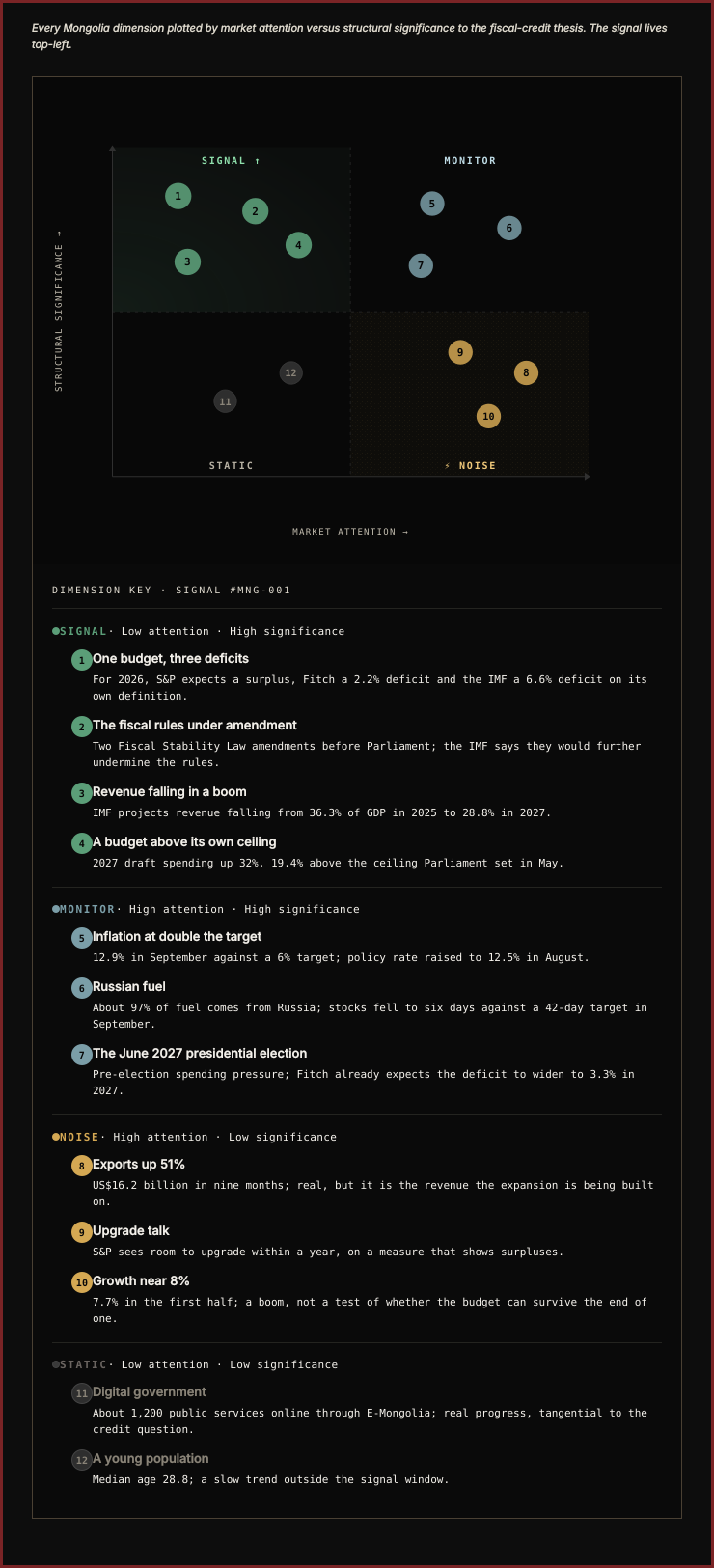
COUNTRY DIMENSION MAP
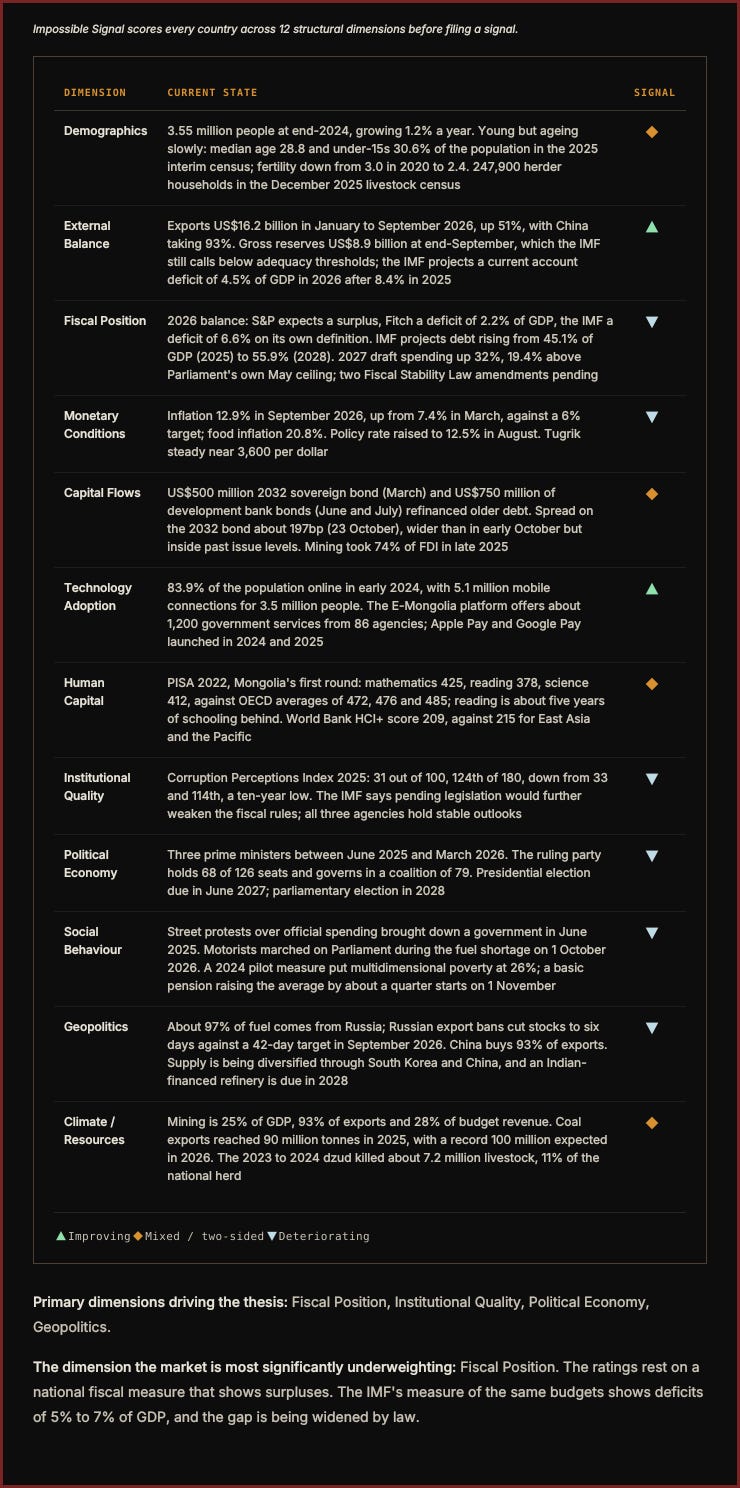
CORE CONTRADICTION
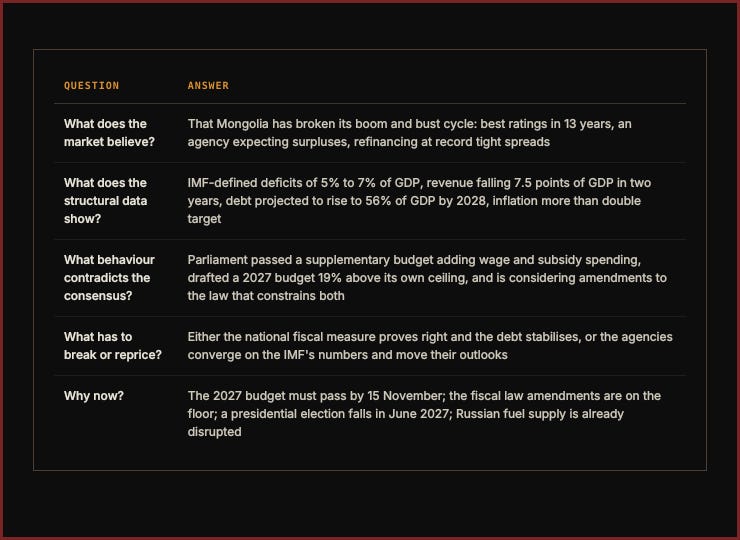
SIGNAL SCORING MODEL
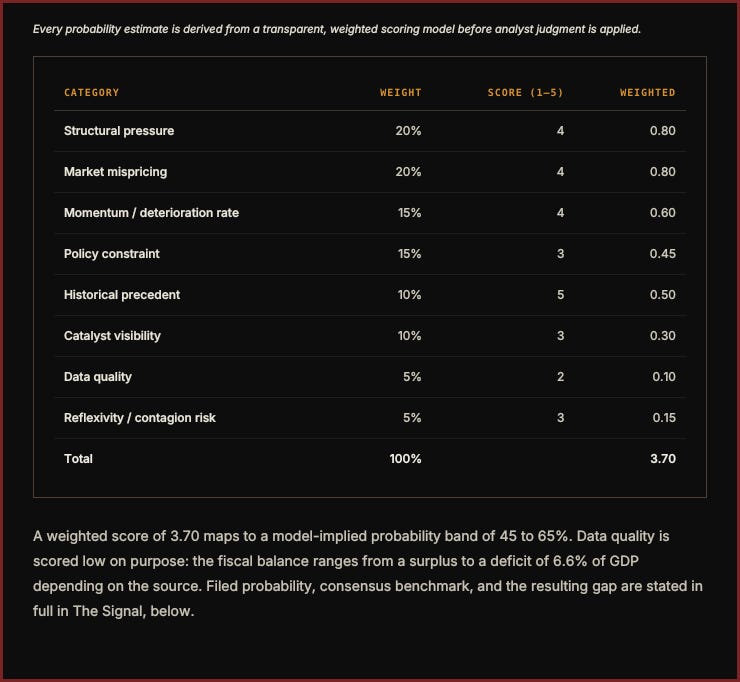
CATALYST MAP
THE IMPOSSIBLE SCENARIO
“The boom, not the slump, is the right time for austerity at the Treasury.”
John Maynard Keynes, How to Avoid a Slump, The Times, January 1937
Invert the question. What would have to be true for none of the three agencies to move against Mongolia for two years, and for Mongolia never to need the IMF?
The national fiscal measure would have to be the right one, so that the surpluses S&P expects arrive while the IMF’s deficits do not. Revenue would have to hold up as coal and copper prices move, after tax cuts the IMF says will hurt non-mining revenue. Parliament would have to pass a 2027 budget close to its own ceiling, leave the fiscal rules intact, and resist adding to wages and pensions ahead of a presidential election. And Russia would have to keep supplying almost all of Mongolia’s fuel.
Each condition is possible, and the 23 October decision to save the Oyu Tolgoi dividend shows the government can choose restraint. The thesis is that all of them holding at once, for two years, in the year before a presidential election, is less likely than three stable outlooks imply. A dzud is decided in the summer, when the grass fails and nobody is cold yet. Mongolia’s fiscal summer is now.
Scenario A: Election-year slippage — 20%. The 2027 budget and pre-election spending push the deficit well past the national target, and an agency moves its outlook to negative.
Scenario B: External shock — 12%. A fall in coal prices or Chinese demand, or a renewed fuel disruption, opens a revenue gap, and a negative action follows.
Scenario C: The rules give way — 8%. Parliament loosens the Fiscal Stability Law and an agency responds with a negative outlook.
Scenario D: Financing stress — 5%. Reserves fall with the current account and Mongolia requests IMF financing.
Scenario E: Muddle-through — 35%. Deficits run wider than the national measure shows, but strong mining revenue keeps the agencies stable.
Scenario F: Restraint holds — 20%. The dividend is saved, the rules stay intact, and S&P upgrades.
Scenarios A, B, C and D resolve the signal correct: a combined 45%, matching the filed probability. Scenarios E and F resolve it incorrect: a combined 55%.
THE SIGNAL
Signal #MNG-001
We assess 45% probability that, within 24 months of filing, at least one of S&P, Moody’s, or Fitch downgrades Mongolia’s long-term foreign-currency rating or revises its outlook to negative, or Mongolia requests financing from the IMF.
Probability gap: 25 percentage points. The scoring model places this signal in the 45% to 65% band; we file at its floor. All three agencies hold stable outlooks, S&P affirmed in October and has flagged a possible upgrade, which suppresses the first year of the window. The 23 October decision to save the Oyu Tolgoi dividend is a real counterweight. No traded instrument prices a rating action, so the benchmark is an I.S. consensus. On S&P’s sovereign data for 1975 to 2020, BB-rated sovereigns were downgraded a full category 6.5% of the time within one year and 14.4% within three [Source: S&P Global Ratings, 2020 Annual Sovereign Default and Rating Transition Study]. Allowing for single-notch moves and outlook revisions across three agencies, and for the IMF financing leg, which category data does not capture, we assess the consensus at about 20%. As a floor from the bond market itself, a spread of about 197 basis points at a 40% recovery assumption implies a default intensity of about 3.3% a year, or roughly 6.4% over two years.
Market benchmarks at filing: S&P BB- stable (8 October 2026) · Moody’s B1 stable (October 2025) · Fitch B+ stable (19 August 2026) · Mongolia 5.95% 2032: 95.74, yield 6.92% (23 October 2026, Stuttgart) · US 5-year Treasury 4.95% (21 October 2026) · Spread about 197bp · Policy rate 12.5% · CPI 12.9% (September 2026) · Gross reserves US$8.9 billion (end-September 2026)
Resolution trigger: Any downgrade of Mongolia’s long-term foreign-currency sovereign rating, or any revision of its outlook to negative, by S&P, Moody’s, or Fitch within 24 months of filing; or a formal request by Mongolia for an IMF financing arrangement within the same window. Actions on Mongolian banks, companies or the development bank do not count; IMF technical assistance or a non-financing programme does not count.
Kill condition: Any of the three agencies upgrades Mongolia or revises its outlook to positive within the window.
Catalyst proximity: Medium. The 2027 budget vote (by 15 November) and the Fiscal Stability Law amendments fall within weeks; the presidential election falls in June 2027; the rating response, if it comes, is more likely in 2027.
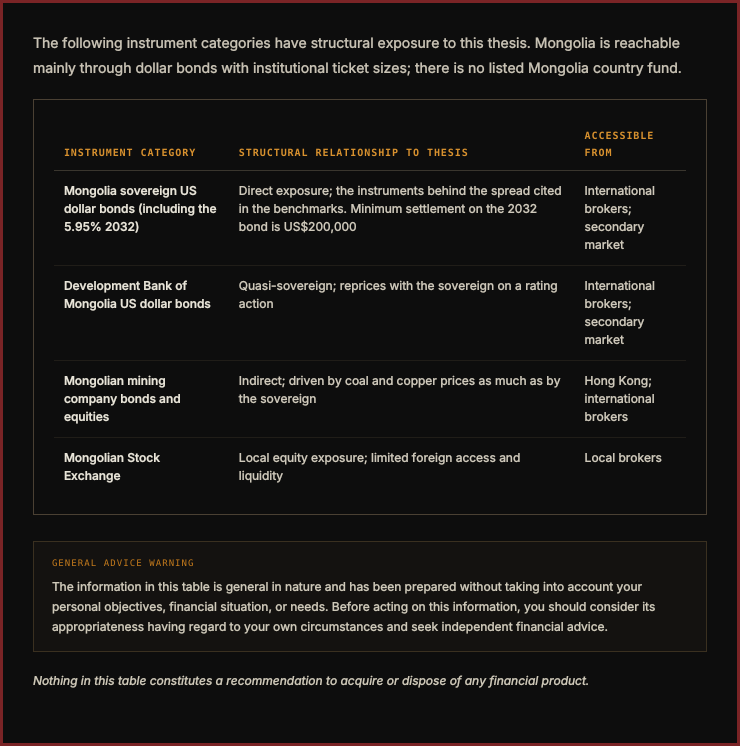
THE INSTRUMENT
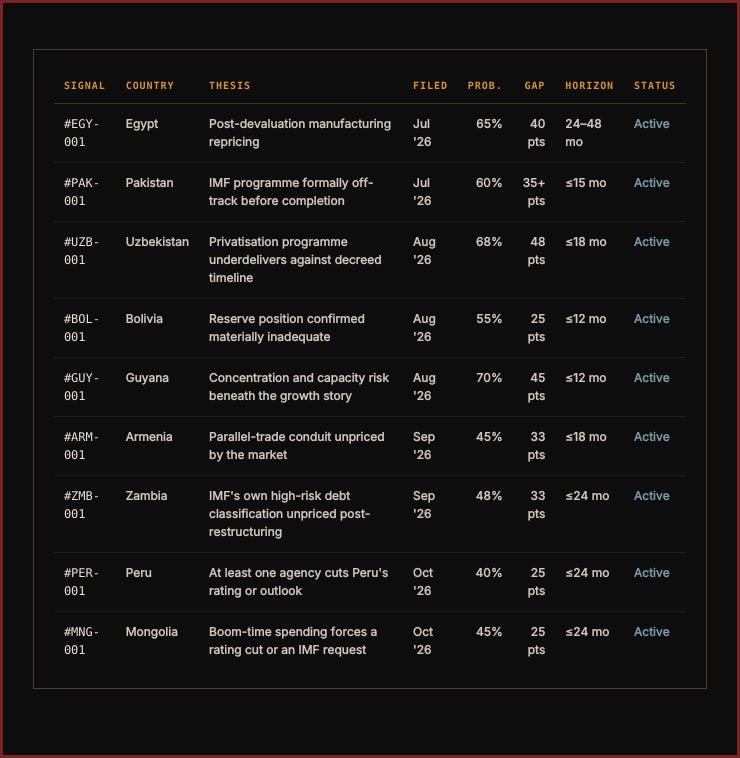
ACTIVE SIGNALS SCORECARD
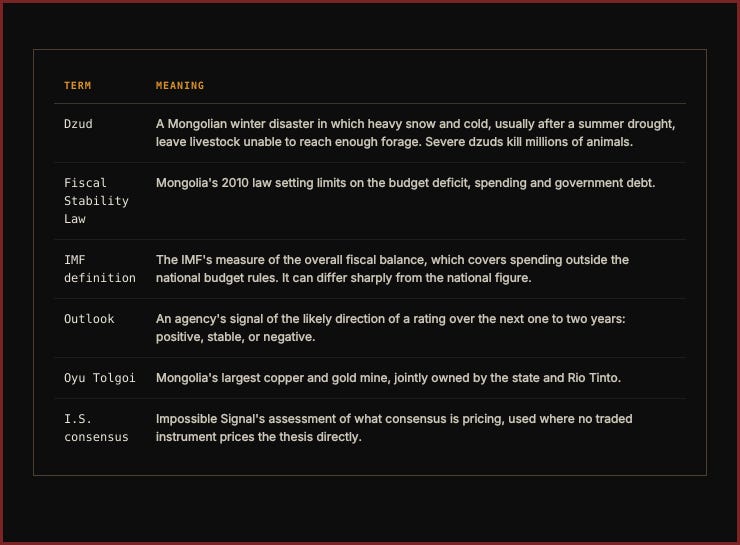
KEY TERMS
NEXT ISSUE
Romania. Its budget deficit was the largest in the European Union in 2025, at 7.9% of GDP. It is shrinking toward a 6% target this year, and Fitch has kept it one notch above junk on a negative outlook. Part of what is paying for the improvement is European Union recovery money, and that runs out this year. Publishing in two weeks.
A NOTE ON SUBSCRIPTIONS
Impossible Signal launches as a free publication. Starter and Pro subscription tiers with market specifics will be made available in near future.
Thanks for reading Impossible Signal! Subscribe for free to receive new posts and support my work.
This analysis draws on more than 100 primary and secondary sources reviewed across the research cycle, including the IMF's 2026 Article IV press release for Mongolia (PR 26/274) and its October 2026 staff visit statement (PR 26/329), S&P Global Ratings, Moody's and Fitch Ratings, S&P's 2020 Annual Sovereign Default and Rating Transition Study, Mongolia's Ministry of Finance, National Statistics Office and Bank of Mongolia, the State Great Khural's published proceedings, the UN Office for Disaster Risk Reduction, and reporting including Montsame, ikon.mn, MNB, Mongolia Weekly, Capital Markets Mongolia and Mirae Asset.
Research for this publication is conducted using a human-directed, AI-assisted analysis framework. All signal assessments, probability estimates, and editorial judgments are made by a human analyst. AI tools are used to assist with data gathering, pattern recognition, and drafting; not to replace analyst judgment.
Impossible Signal publishes general financial information and macro analysis with the aim of increasing transparency and demystifying world economics. Nothing in this publication constitutes personal financial advice or a recommendation to buy or sell any financial instrument. Probability estimates are analytical assessments based on publicly available data. Past signal performance does not guarantee future results. You should seek independent financial advice before making investment decisions.